

NASA and DARPA’s Nuclear Propulsion Collaboration
NASA and the Defense Advanced Research Projects Agency (DARPA) recently announced a collaboration to demonstrate a nuclear thermal rocket engine in space, an enabling capability for NASA crewed missions to Mars.
NASA and DARPA will partner on the Demonstration Rocket for Agile Cislunar Operations, or DRACO, program. The non-reimbursable agreement designed to benefit both agencies, outlines roles, responsibilities, and processes aimed at speeding up development efforts.
“NASA will work with our long-term partner, DARPA, to develop and demonstrate advanced nuclear thermal propulsion technology as soon as 2027. With the help of this new technology, astronauts could journey to and from deep space faster than ever – a major capability to prepare for crewed missions to Mars,” said NASA Administrator Bill Nelson. “Congratulations to both NASA and DARPA on this exciting investment, as we ignite the future, together.”
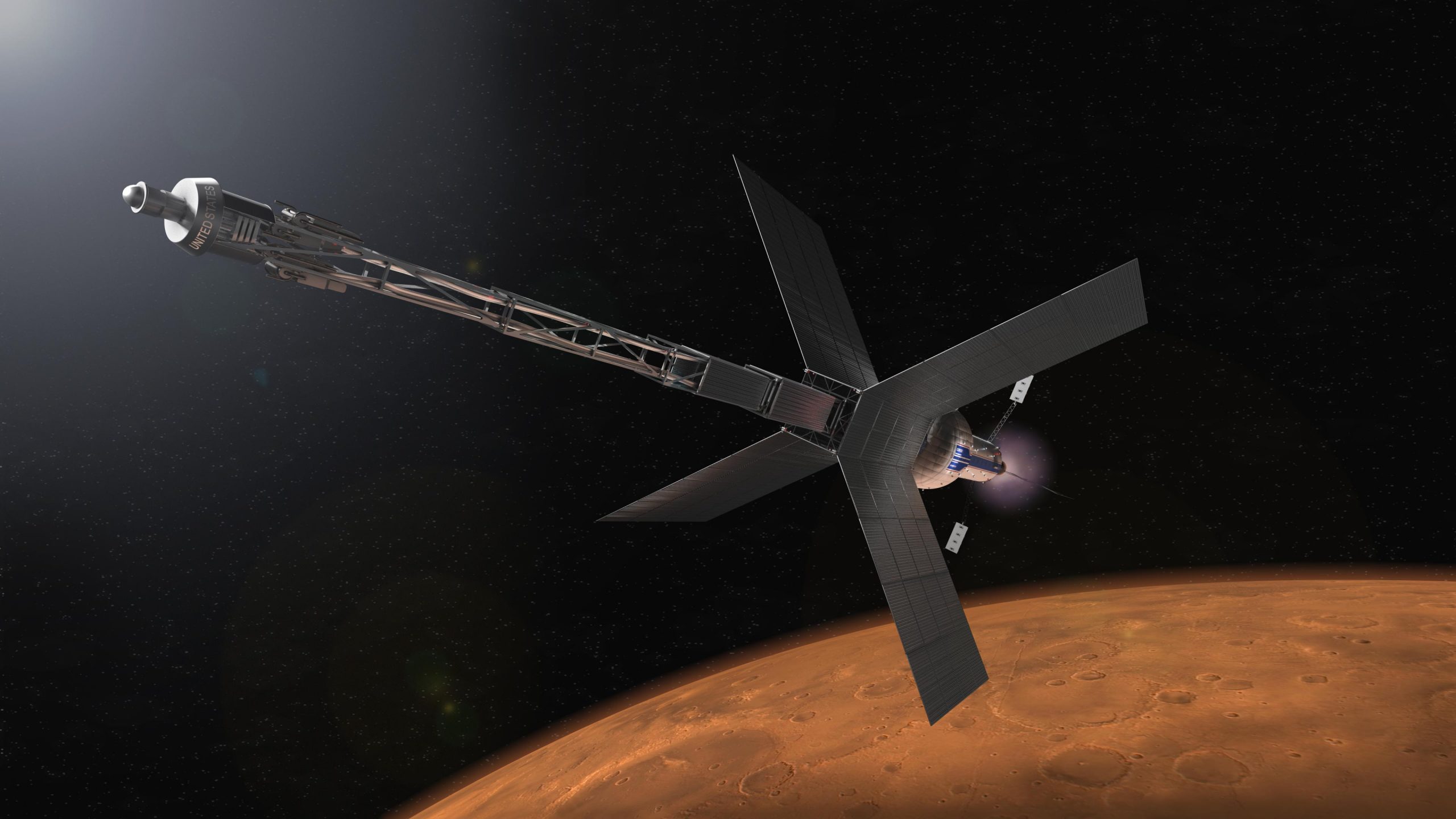
Benefits of Nuclear Thermal Propulsion
Using a nuclear thermal rocket allows for faster transit time, reducing risk for astronauts. Reducing transit time is a key component for human missions to Mars, as longer trips require more supplies and more robust systems. Maturing faster, more efficient transportation technology will help NASA meet its Moon to Mars Objectives.
Other benefits to space travel include increased science payload capacity and higher power for instrumentation and communication. In a nuclear thermal rocket engine, a fission reactor is used to generate extremely high temperatures. The engine transfers the heat produced by the reactor to a liquid propellant, which is expanded and exhausted through a nozzle to propel the spacecraft. Nuclear thermal rockets can be three or more times more efficient than conventional chemical propulsion.
“NASA has a long history of collaborating with DARPA on projects that enable our respective missions, such as in-space servicing,” said NASA Deputy Administrator Pam Melroy. “Expanding our partnership to nuclear propulsion will help drive forward NASA’s goal to send humans to Mars.”
Under the agreement, NASA’s Space Technology Mission Directorate (STMD) will lead technical development of the nuclear thermal engine to be integrated with DARPA’s experimental spacecraft. DARPA is acting as the contracting authority for the development of the entire stage and the engine, which includes the reactor. DARPA will lead the overall program including rocket systems integration and procurement, approvals, scheduling, and security, cover safety and liability, and ensure overall assembly and integration of the engine with the spacecraft. Over the course of the development, NASA and DARPA will collaborate on assembly of the engine before the in-space demonstration as early as 2027.
“DARPA and NASA have a long history of fruitful collaboration in advancing technologies for our respective goals, from the Saturn V rocket that took humans to the Moon for the first time to robotic servicing and refueling of satellites,” said Dr. Stefanie Tompkins, director, DARPA. “The space domain is critical to modern commerce, scientific discovery, and national security. The ability to accomplish leap-ahead advances in space technology through the DRACO nuclear thermal rocket program will be essential for more efficiently and quickly transporting material to the Moon and eventually, people to Mars.”
Leveraging Past Experience for Space Nuclear Power
The last nuclear thermal rocket engine tests conducted by the United States occurred more than 50 years ago under NASA’s Nuclear Engine for Rocket Vehicle Application and Rover projects.
“With this collaboration, we will leverage our expertise gained from many previous space nuclear power and propulsion projects,” said Jim Reuter, associate administrator for STMD. “Recent aerospace materials and engineering advancements are enabling a new era for space nuclear technology, and this flight demonstration will be a major achievement toward establishing a space transportation capability for an Earth-Moon economy.”
NASA, the Department of Energy (DOE), and industry are also developing advanced space nuclear technologies for multiple initiatives to harness power for space exploration. Through NASA’s Fission Surface Power project, DOE awarded three commercial design efforts to develop nuclear power plant concepts that could be used on the surface of the Moon and, later, Mars.
NASA and DOE are working another commercial design effort to advance higher temperature fission fuels and reactor designs as part of a nuclear thermal propulsion engine. These design efforts are still under development to support a longer-range goal for increased engine performance and will not be used for the DRACO engine.
Never miss a breakthrough: Join the SciTechDaily newsletter.
Follow us on Google and Google News.
1 Comment
Hello, it was a very good and informative article, but I wish you could explain both the structure of this engine and the necessary characteristics for choosing the propellant fluid. I am a chemistry teacher from Iran who is interested in space and astronomy. Thanks