
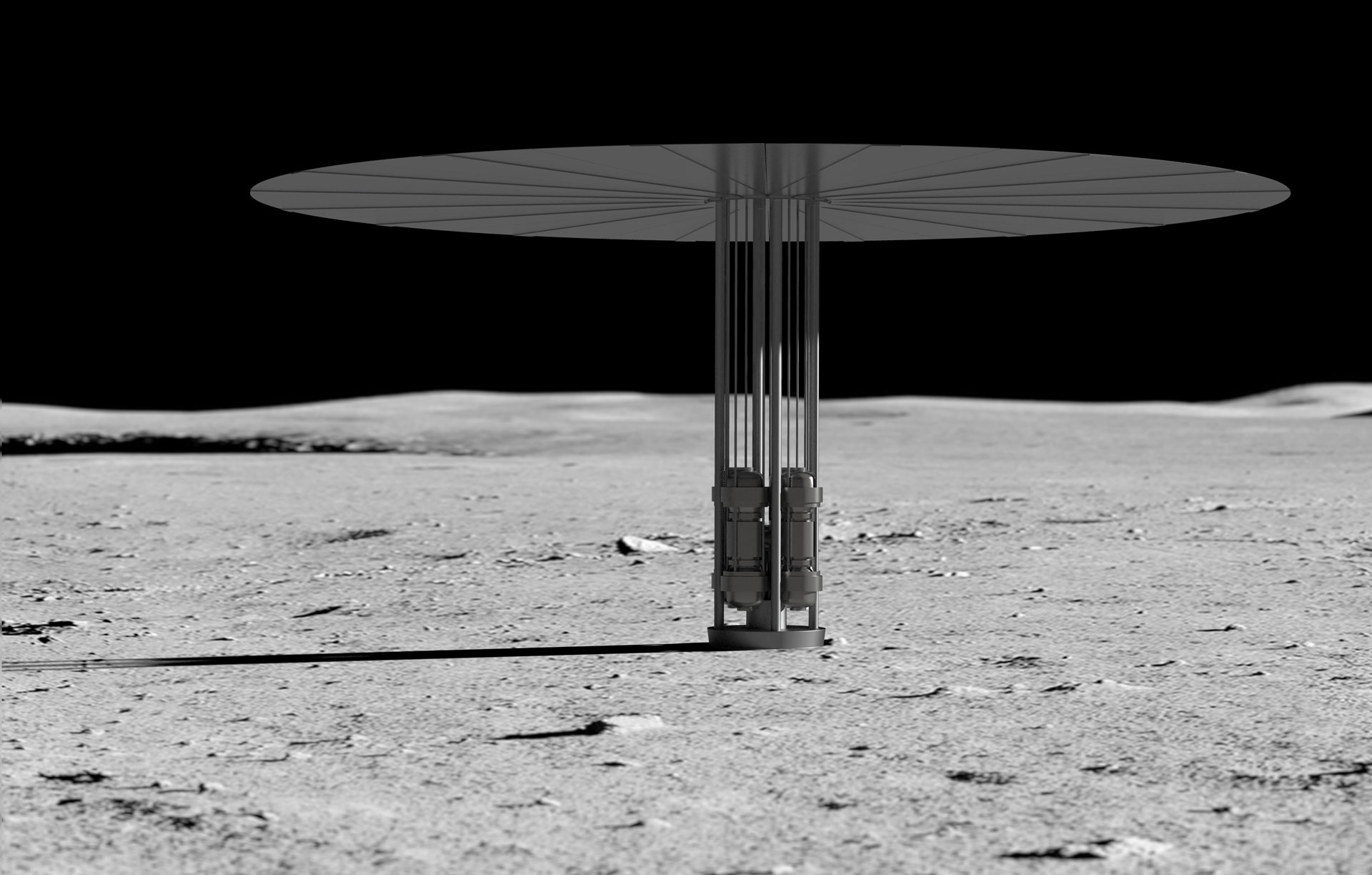
NASA’s fission power project aims to develop compact nuclear systems to support lunar missions, enhancing space exploration.
NASA and the U.S. Department of Energy (DOE) are working together to advance space nuclear technologies. The agencies have selected three design concept proposals for a fission surface power system design that could be ready to launch by the end of the decade for a demonstration on the Moon. This technology would benefit future exploration under the Artemis umbrella.
The contracts, to be awarded through the DOE’s Idaho National Laboratory, are each valued at approximately $5 million. The contracts fund the development of initial design concepts for a 40-kilowatt class fission power system planned to last at least 10 years in the lunar environment.
Relatively small and lightweight compared to other power systems, fission systems are reliable and could enable continuous power regardless of location, available sunlight, and other natural environmental conditions. A demonstration of such systems on the Moon would pave the way for long-duration missions on the Moon and Mars.
“New technology drives our exploration of the Moon, Mars, and beyond,” said Jim Reuter, associate administrator for NASA’s Space Technology Mission Directorate. “Developing these early designs will help us lay the groundwork for powering our long-term human presence on other worlds.”
Battelle Energy Alliance, the managing and operating contractor for Idaho National Laboratory, led the Request for Proposal development, evaluation, and procurement sponsored by NASA. Idaho National Laboratory will award 12-month contracts to the following companies to each develop preliminary designs:
- Lockheed Martin of Bethesda, Maryland – The company will partner with BWXT and Creare.
- Westinghouse of Cranberry Township, Pennsylvania – The company will partner with Aerojet Rocketdyne.
- IX of Houston, Texas, a joint venture of Intuitive Machines and X-Energy – The company will partner with Maxar and Boeing.
Achieving Nuclear Power on the Moon
“The Fission Surface Power project is a very achievable first step toward the United States establishing nuclear power on the Moon,” said Idaho National Laboratory Director John Wagner. “I look forward to seeing what each of these teams will accomplish.”
The Phase 1 awards will provide NASA critical information from industry that can lead to a joint development of a full flight-certified fission power system. Fission surface power technologies also will help NASA mature nuclear propulsion systems that rely on reactors to generate power. These systems could be used for deep space exploration missions.
NASA’s fission surface power project is managed by the agency’s Glenn Research Center in Cleveland. The power system development is funded by the Space Technology Mission Directorate’s Technology Demonstration Missions program, which is located at Marshall Space Flight Center in Huntsville, Alabama.
Never miss a breakthrough: Join the SciTechDaily newsletter.
Follow us on Google and Google News.
2 Comments
Fission based Radioactive Thermoelectric Generators (RTG) have been on the moon since Apollo 11, GE’s SNAP27. As for the use of RTG’s in deep space probes I believe we have two probes outside the orbit of Pluto that are running on RTG power. These projects are not “first steps” but rather a logical extension of our existing technology.
RTGs are not fission based, they are decay based. This is a project to build a fission-based reactor on the moon in the 40 kw class. In contrast the Voyager RTGs produced about 130 w each.