
Researchers discovered that sleeping too little or too much is linked to accelerated aging in organs throughout the body. The study also connected abnormal sleep patterns to mental health, cardiovascular, respiratory, and metabolic disorders.
An analysis of biological aging clocks across the body suggests that both too little sleep and too much sleep may accelerate aging in organs, including the brain, heart, lungs, and immune system. The findings also link unhealthy sleep patterns to a broad range of diseases.
“Previous studies have found that sleep is largely linked to aging and the pathological burden of the brain. Our study goes further and shows that too little and too much sleep are associated with faster aging in nearly every organ, supporting the idea that sleep is important in maintaining organ health within a coordinated brain-body network, including metabolic balance and a healthy immune system,” says study leader Junhao Wen, assistant professor of radiology at Columbia University Vagelos College of Physicians and Surgeons.
The research was published in Nature.
Scientists increasingly use biological aging clocks to estimate whether a person is aging faster or slower than expected for their age. These tools rely on machine learning and biological measurements such as proteins detected in blood samples.
Organ-Specific Aging and Personalized Health Insights
Although many aging clocks evaluate the body as a whole, different organs can age at different speeds. One familiar example is the faster aging of ovaries tied to female fertility.
Wen’s team has focused on creating organ-specific aging clocks that may offer more personalized health insights.
“Everyone is excited by these aging clocks and their ability to predict disease and mortality risk,” Wen says. “But to me, the more exciting question is, can we link aging clocks to a lifestyle factor that can be modified in time to slow aging?”
Sleep became an ideal area to study because researchers increasingly recognize its importance for overall health. “I’m also a light sleeper and was getting worried about the effects on myself,” says Wen.
Machine Learning Reveals Sleep’s Impact on Organ Aging
To develop the aging clocks, the researchers analyzed data from about 500,000 participants in the UK Biobank. They used machine learning to identify biological signatures linked to aging in specific organs. The models incorporated medical imaging data, organ-specific proteins, and molecules found in blood.
“In the liver, for example, we have an aging clock built with protein data, an aging clock of metabolic data, and an aging clock of imaging data,” Wen says. “This allows us to see whether sleep is distinctively associated with aging clocks derived from multiple omics and molecular layers.”
The team then compared participants’ reported sleep duration with biological age measurements from 23 aging clocks covering 17 organ systems.
Sleep Duration Linked to Mental and Physical Disease Risks
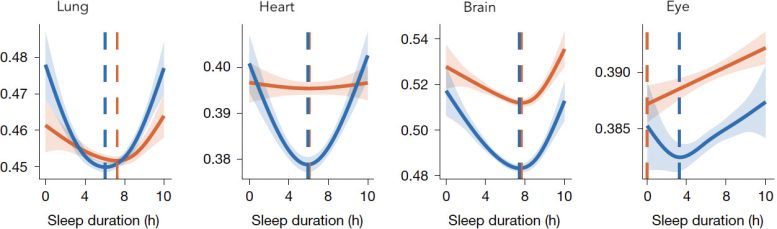
Across the body, researchers observed a U-shaped pattern. People who slept fewer than 6 hours or more than 8 hours showed signs of faster aging, while the healthiest aging patterns appeared in people who slept between 6.4 and 7.8 hours per night. The results do not prove that sleep duration directly causes organs to age faster or slower, but they suggest that both insufficient and excessive sleep may reflect poorer overall health.
The findings also support the idea that sleep affects the entire brain-body system, not just the brain alone.
Short sleep was strongly associated with depression and anxiety disorders, consistent with earlier sleep and mental health research. Sleeping too little was also linked to obesity, type 2 diabetes, high blood pressure, ischemic heart disease, and heart rhythm disorders. Both short and long sleep were associated with chronic obstructive pulmonary disease, asthma, and digestive conditions, including gastritis and gastroesophageal reflux disease.
“The broad brain-body pattern is important because it tells us that sleep duration is a deeply embedded part of our entire physiology, with far-reaching implications across the body,” Wen said.
Different Sleep Patterns May Influence Depression Through Separate Brain Pathways
The organ-specific aging clocks may also help researchers better understand how sleep relates to certain diseases, including late-life depression.
Although the study could not determine whether sleep problems cause late-life depression or whether depression affects sleep, the researchers used a “mediation analysis” to explore whether aging clocks help explain the connection between sleep duration and depression. The results suggest that short sleep may directly influence late-life depression, while long sleep may affect depression through biological pathways linked to brain and adipose tissue aging.
“This has a strong implication for future sleep management and future therapeutics,” Wen says. “Our study suggests there may be different biological pathways between long and short sleepers that lead to the same outcome, late-life depression, and we shouldn’t treat them the same way.”
Reference: “Sleep chart of biological ageing clocks in middle and late life” by The MULTI Consortium, Cliodhna Kate O’Toole, Zhiyuan Song, Filippos Anagnostakis, Zhijian Yang, Ye Ella Tian, Michael R. Duggan, Chunrui Zou, Yue Leng, Yi Cai, Wenjia Bai, Cynthia H. Y. Fu, Michael S. Rafii, Paul Aisen, Gao Wang, Philip L. De Jager, Jian Zeng, Hamilton Se-Hwee Oh, Xia Zhou, Keenan A. Walker, Daniel W. Belsky, Andrew Zalesky, Eleanor M. Simonsick, Susan M. Resnick, Luigi Ferrucci, Christos Davatzikos and Junhao Wen, 13 May 2026, Nature.
DOI: 10.1038/s41586-026-10524-5
This study was funded by the NIH/National Institutes of Health.
Never miss a breakthrough: Join the SciTechDaily newsletter.
Follow us on Google and Google News.
3 Comments
How do I fix it – i usually sleep for about 5.5 or less hrs. I’m 77.
1.Lock in a strict wake-up time:Every single day。Pick a realistic wake-up time (e.g., 6:30 AM) and stick to it strictly, even on weekends. This anchors your internal biological clock.2.Keep a 1-week sleep diary:Track the reality。Track when you actually turn the lights off, roughly how long you sleep, and when you wake up. This tells you your true average sleep capacity.3.Align your time in bed:Consolidate the sleep window。If you only sleep 5.5 hours, don’t lie in bed for 8 hours tossing and turning. That teaches your brain that the bed is a place to be awake. Instead, limit your total time in bed to around 6 hours initially (e.g., 11:30 PM to 5:30 AM) to compress your sleep and make it deeper.4.Gradually expand the window:15-minute increments。Once you are sleeping soundly through that condensed window without waking up frequently, move your bedtime 15 minutes earlier. Hold that for a week, then repeat until you reach 7 hours.3. Optimize Your Environment and HabitsSimple environmental triggers make a massive difference in how deeply you sleep: Sunlight Exposure: Spend at least 15–30 minutes in natural sunlight every morning. This stops the production of melatonin (the sleep hormone) during the day so it can build up powerfully for the night.The 20-Minute Rule: If you wake up in the middle of the night and can’t get back to sleep within 20 minutes, get out of bed. Go to a dimly lit room and read a book or do a quiet activity until you feel sleepy again. Never lie there staring at the clock. Watch the Caffeine and Alcohol: Cut off caffeine by noon. While alcohol might make you feel drowsy initially, it completely fragments the second half of your night, guaranteed to wake you up early.
In Chinese medicine they say the organ most weakest between 70 to 80 yrs old is the spleen. Digestion becomes slower and the muscles become weaker. The worst things to be done at this age is to sit longer time or eating too late. Especially women then have a harder time relaxing and at this age is more pronounced. This is where exercise becomes the best remedy, walking the best medicine. Cannot sleep take a walk then try again.