
A rare particle decay measured at the LHC may be showing one of the strongest recent hints of physics beyond the Standard Model.
A highly unusual pattern detected in rare B meson decays is giving researchers fresh reason to suspect new physics may be hiding beyond the Standard Model.
New findings from research we are conducting at the Large Hadron Collider (LHC) at CERN in Geneva suggest that scientists may be getting closer to evidence of physics beyond what is currently known.
If verified, these signs could challenge the Standard Model, the theory that has guided particle physics for the past 50 years. The results indicate that certain subatomic particles produced in the LHC may behave in ways that do not match the model’s predictions.
Fundamental particles are the most basic known units of matter. They cannot be broken down into smaller parts. Their interactions are governed by four fundamental forces: gravity, electromagnetism, the weak force, and the strong force.
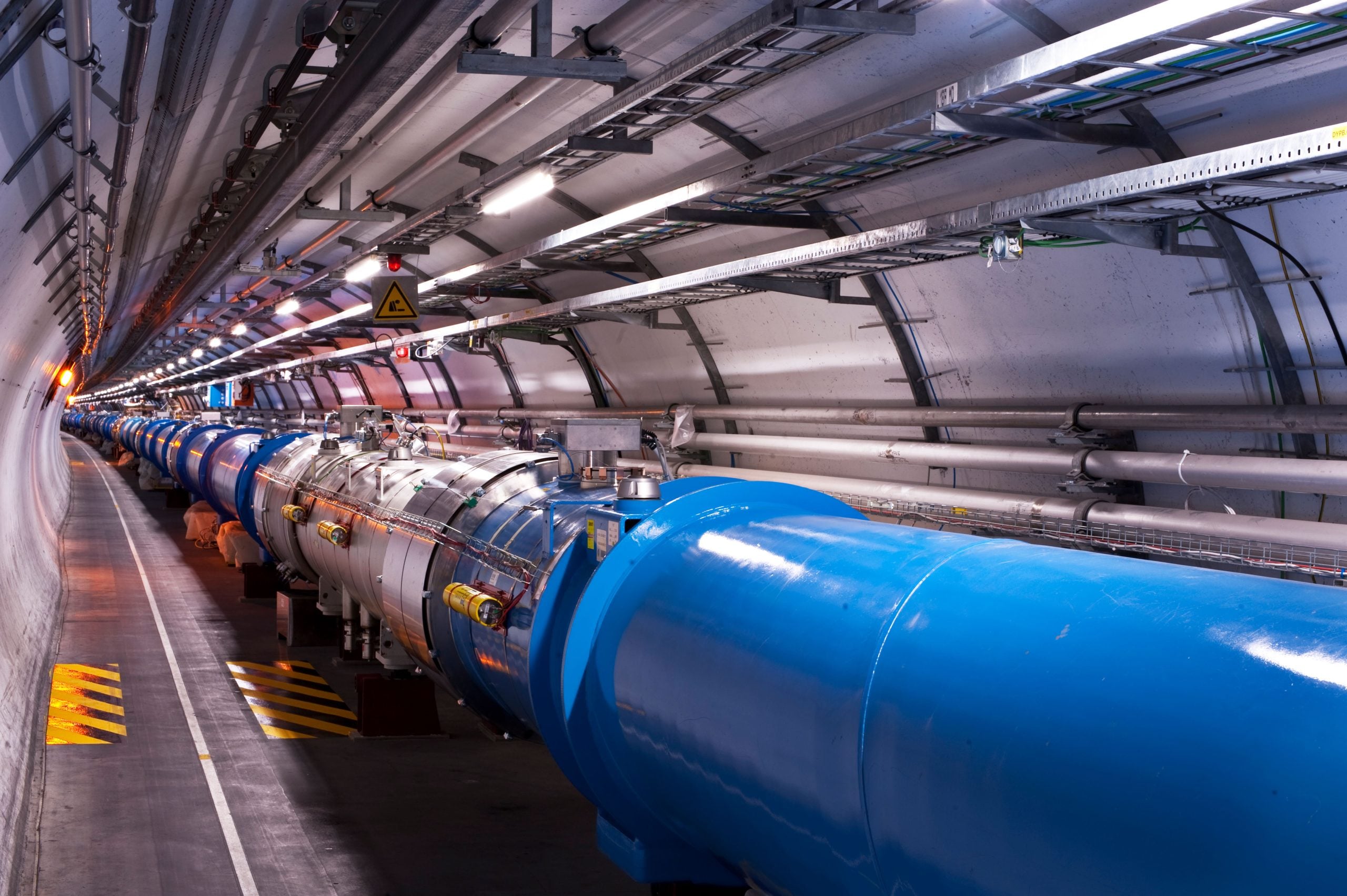
The LHC is a massive particle accelerator housed in a circular tunnel 27 kilometers long beneath the border between France and Switzerland. Its central purpose is to test the Standard Model and look for places where the theory may fail.
The Standard Model remains the best explanation scientists have for fundamental particles and forces, but it is known to be incomplete. It does not include gravity, and it cannot explain dark matter, the invisible and still undetected form of matter thought to make up about 25% of the universe.
In the LHC, beams of proton particles traveling in opposite directions are made to collide, in a bid to uncover hints of undiscovered physics. The new results come from LHCb, an experiment at the Large Hadron Collider where these collisions are analyzed.
The result comes from studying the decay – a kind of transformation – of sub-atomic particles called B mesons. We investigated how these B mesons decay into other particles, finding that the particular way in which this happens disagrees with the predictions of the Standard Model.
A theory under strain
The Standard Model is built on two of the 20th century’s most transformative advances in physics: quantum mechanics and Einstein’s special relativity.
Physicists can compare measurements made at facilities such as the LHC with predictions based on the Standard Model to rigorously test the theory.
Despite the fact that we know the Standard Model is incomplete, in over 50 years of increasingly rigorous testing, particle physicists are yet to find a crack in the theory. That is, potentially, until now.
Our measurement, published in Physical Review Letters, shows a tension of four standard deviations from the expectations of the Standard Model.
In real-world terms, this means that, after considering the uncertainties from the experimental results and from the theory predictions, there is only a one in 16,000 chance that a random fluctuation in the data this extreme would occur if the Standard Model is correct.
Although this falls short of science’s gold standard – what’s known as five sigma, or five standard deviations (about a one in 1.7 million chance) – the evidence is starting to mount. Adding to this compelling narrative are results from an independent LHC experiment, CMS, that were published earlier in 2025.
Although the CMS results are not as precise as those from LHCb, they agree well, strengthening the case. Our new results have been found in a study of a particular kind of process, known as an electroweak penguin decay.
Rare decays sharpen the test
The term “penguin” refers to a specific type of decay (transformation) of short-lived particles. In this case, we study how the B meson decays into four other subatomic particles—a kaon, a pion, and two muons.
With some imagination, one can visualize the arrangement of the particles involved as looking like a penguin. Crucially, measurements of this decay let us study how one type of fundamental particle, a beauty quark, can transform into another, the strange quark.
This penguin decay is incredibly rare in the Standard Model: for every million B mesons, only one will decay in this manner. We have carefully analyzed the angles and energies at which these particles are produced in the decay, and precisely determined how often the process takes place. We found that our measurements of these quantities disagree with Standard Model predictions.
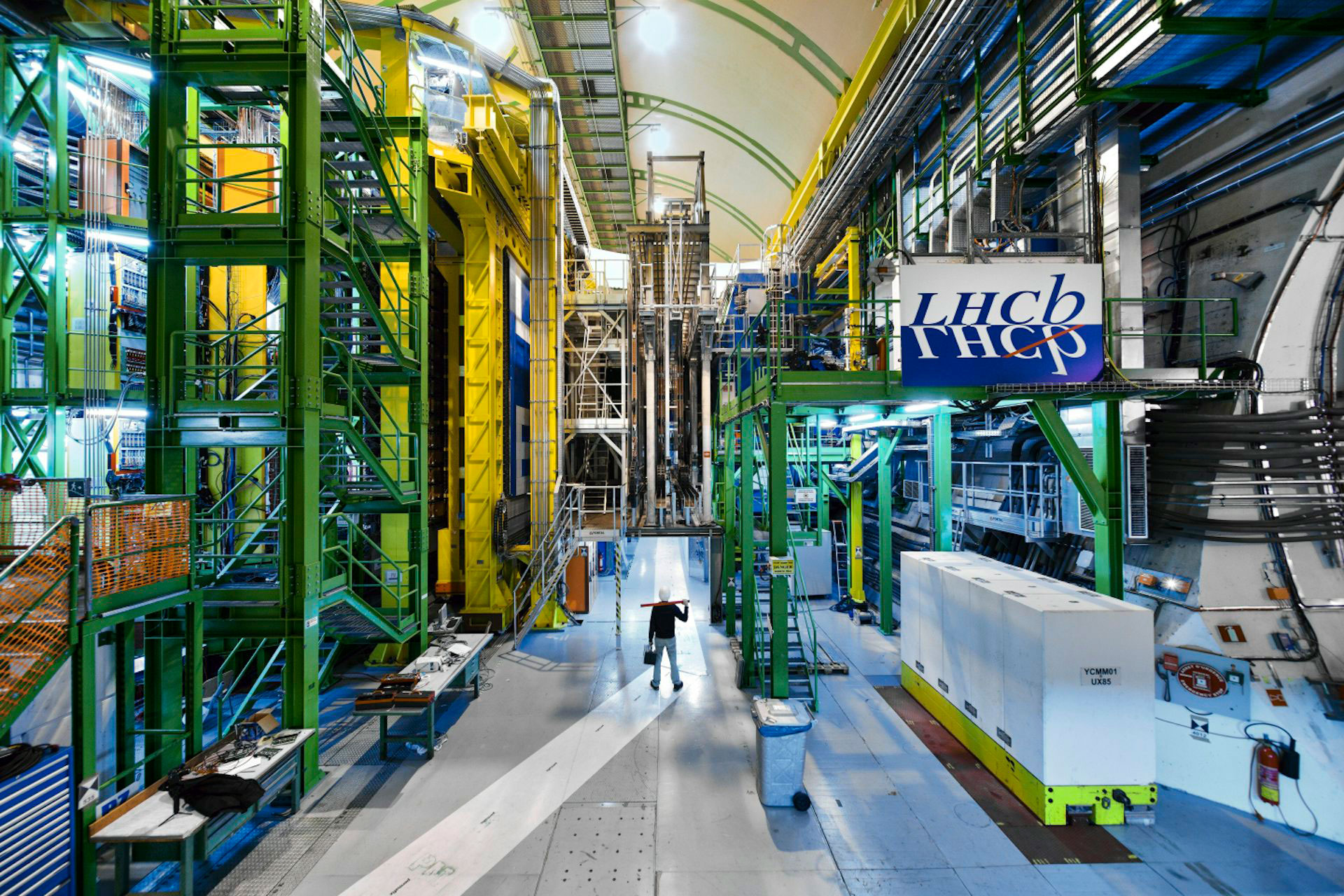
Precise investigations of decays like this are one of the primary goals of the LHCb experiment, and have been since its inception in 1994. Penguin processes are uniquely sensitive to the effects of potentially very heavy new particles that cannot be created directly at the LHC.
Such particles may still exert a measurable influence on these decays over the small Standard Model contribution. This kind of indirect observation is not new. For example, radioactivity was discovered 80 years before the fundamental particles that are responsible for it (the W bosons) were directly seen.
New data will test the anomaly
Our studies of rare processes let us explore parts of nature that may otherwise only become accessible using particle colliders planned for the 2070s. There is a wide range of potential new theories that can explain our findings. Many contain new particles called “leptoquarks” that unite the two different types of matter: “leptons” and “quarks.”
Other potential theories contain particles that are heavier analogs of those already found in the Standard Model. The new results constrain the form of these models and will direct future searches for them.
Despite our excitement, open theoretical questions remain that prevent us from definitively claiming that physics beyond the Standard Model has been observed. The most serious question arises from so-called “charming penguins,” a set of processes present in the Standard Model, whose contributions are extremely tricky to predict. Recent estimates of these charming penguins suggest their effects are not large enough to explain our data.
Furthermore, a combination of a theoretical model and experimental data from LHCb suggests that the charming penguins (and therefore, the Standard Model) struggle to explain the anomalous results.
New data already collected will let us confirm the situation in the coming years: in our current work, we studied approximately 650 billion B meson decays recorded between 2011 and 2018 to find these penguin decays. Since then, the LHCb experiment has recorded three times as many B mesons.
Further advances are planned for the 2030s to exploit future upgrades to the LHC and accrue a dataset 15 times larger again. This ultimate step will allow definitive claims to be made, potentially unlocking a new understanding of how the universe works at the most elementary level.
Reference: “A comprehensive analysis of the 𝐵0→𝐾*0𝜇+𝜇−decay” by LHCb collaboration, 19 December 2025, arXiv.
DOI: 10.48550/arXiv.2512.18053
Adapted from an article originally published in The Conversation.
Never miss a breakthrough: Join the SciTechDaily newsletter.
Follow us on Google and Google News.
12 Comments
thanks for this
Thanks to this information
Why not use all the other data from 2018 onwards rught now?
“The dataset used corresponds to an integrated luminosity of 8.4 fb^−1 of proton-proton collisions collected by the LHCb experiment during 2011, 2012, and 2016–2018. Throughout this Letter charge-conjugate processes are implied unless otherwise stated.”
The earlier analysis was from the two first data sets. The remaining data is different, maybe that is why (Google search):
“* Run 1 (2011–2012): This dataset comprises approximately 800 terabytes of proton-proton collision information at center-of-mass energies of 7 TeV and 8 TeV. The entire Run 1 dataset has been released to the public on the CERN Open Data Portal.
* Run 2 (2015–2018): Data collected at 13 TeV, with an integrated luminosity of 9 \(\text{fb}^{-1}\) (combined with Run 1 for some analyses).
* Run 3 (2022–Present): Features a “triggerless” system, allowing the detector to read out data at 40 MHz, with software-based selection on GPUs. Data is recorded at 13.6 TeV.
Oops. This site moderates comments with long quotes. Here is a shorter version:
“The dataset used corresponds to an integrated luminosity of 8.4 fb^−1 of proton-proton collisions collected by the LHCb experiment during 2011, 2012, and 2016–2018. Throughout this Letter charge-conjugate processes are implied unless otherwise stated.”
The earlier analysis was from the two first data sets. The remaining data from 2022-present is different (says Google search).
Surely there is new physics. None of the particles formed in the LHC are fundamental. These are unstable structures created when stable particles collide and disintegrate. Particles of light are the real fundamental particles. Light is streams of rotating particle-pairs. A photon is a packet of such moving pairs, held together as a unit, and has a fixed length dimension.
The description of the 4 sigma result reminds of p-hacking – this work adds a lot of innovations, one of which push the often seen and acceptable 2-3 sigma tensions to 4 sigma. But overall the result validates the SM model: “The measurements of the CP-averaged observables and the branching fractions continue to exhibit the pattern of tensions with the Standard Model predictions that have been seen in previous analyses that use part
of the dataset considered in this study. The extracted CP-asymmetry observables
show no significant deviations from zero.”
If 4 sigma tension can be verified by other groups, notably it is not uncommon that they go away later. Google search:
Prominent Examples of Disappeared 4-Sigma+ Results:
* 750 GeV Diphoton Anomaly (2015-2016): Perhaps the most prominent recent example, both ATLAS and CMS at the LHC observed a 3-4 \(\sigma \) excess of photon pairs with a combined mass of 750 GeV in 2015 data. It triggered roughly 500 theoretical papers but vanished entirely when 2016 data was added.
* LEP Higgs-like Excess (1996): Before the Higgs was discovered at the LHC, the Large Electron-Positron Collider (LEP) at CERN saw an excess of events that reached nearly 4 \(\sigma \) in significance. The signal disappeared with more data.
* The “Superjets” at Tevatron (1998): Fermilab’s Tevatron observed an anomaly in referred to as “superjets” with a high 6-sigma significance. This effect never reappeared, making it a “stunning” false alarm.
* Pentaquarks (2004): A pentaquark particle was observed at HERA (DESY) with 6-\(\sigma \) significance. The signal later disappeared, although genuine pentaquarks were eventually discovered at the LHC in 2015.
* Faster-than-light Neutrinos (2011): The OPERA experiment reported that neutrinos traveled faster than the speed of light, a 6.2-\(\sigma \) result that was later found to be caused by a faulty cable.
Philosophy, and expressed in Russian no less, are not always well seen. Specifically it has no bearing on the science described in the article, which is on proton-proton collisions.
The description of the 4 sigma result reminds of p-hacking – this work adds a lot of innovations, one of which push the often seen and acceptable 2-3 sigma tensions to 4 sigma. But overall the result validates the SM model: “The measurements of the CP-averaged observables and the branching fractions continue to exhibit the pattern of tensions with the Standard Model predictions that have been seen in previous analyses that use part of the dataset considered in this study. The extracted CP-asymmetry observables show no significant deviations from zero.”
If 4 sigma tension can be verified by other groups, notably it is not uncommon that they go away later. By Google search I found 5 notable such results since 1996 that had up to 6+ sigma.
New physics? Great! Here comes the Warp drive!
What humanity fails to understand is the hidden hand of the God that created all what we are looking for. Dark matter ain’t really dark but a force in hell form which is proving hard to detect as it lurks in-between particles without revealing itself when gelling or in break formation. It is allover us. It is in hiding as machine has yet been invented to solve its existence. It is responsible for expansion of the universe and the collapse of it. The only time it can be measured is at this very moment when the universe collapses. No one would be here to investigate nor measure the God gell wave holding us here. In fact this process has occurred a billion trillion times unknown to humanity. As such, the measurements of age of the universe is totally wrong. We are in an endless cycle of creation and destruction than man can imagine. This stage of the universe is not the first nor the last. It is an indefinite process beyond comprehension. 🤣🤣🤣🤣🤣🤣🤣🤣🤣🤣🤣🤣🤣🤣🤣🤣🤣😜
Gell form not hell form I meant to say.