
Close Menu
    Facebook X (Twitter) Instagram
    SciTechDaily
    • Biology
    • Chemistry
    • Earth
    • Health
    • Physics
    • Science
    • Space
    • Technology
    Facebook X (Twitter) Pinterest YouTube RSS
    SciTechDaily
    Home»Physics»Physicists Use Cheap Colliders to Probe for Heavy Photons
    Physics

    Physicists Use Cheap Colliders to Probe for Heavy Photons

    By SciTechDailyApril 3, 2012No Comments2 Mins Read
    Facebook Twitter Pinterest Telegram LinkedIn WhatsApp Email Reddit
    Share
    Facebook Twitter LinkedIn Pinterest Telegram Email Reddit
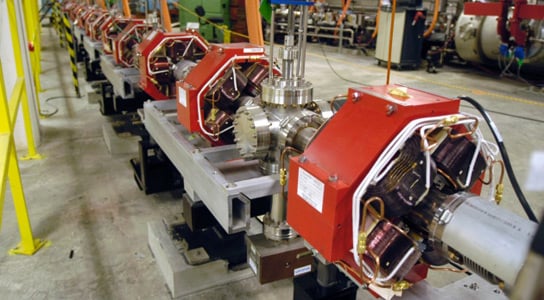
    thomas-jefferson-lab-accelerator
    Thomas Jefferson National Accelerator

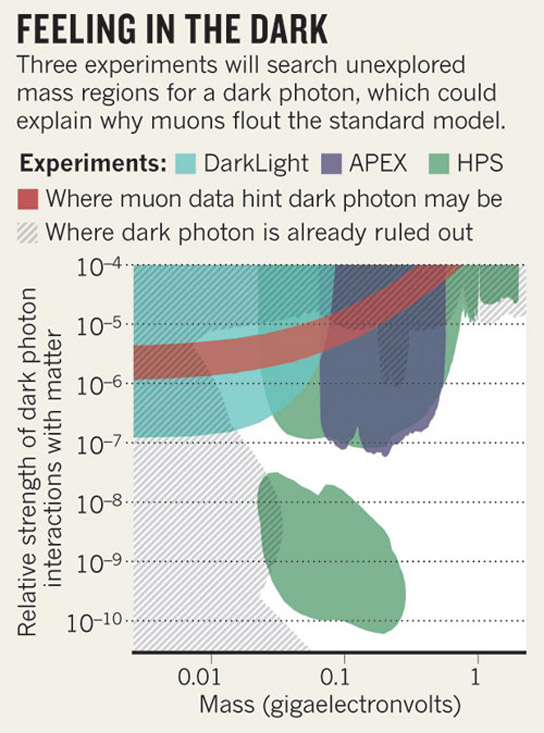
    A three-week experiment is set to start on April 24th at the Thomas Jefferson National Accelerator Facility in Newport News, Virginia, in which electrons will crash into a thin tungsten target 500 million times a second that will create a cascade of short-lived particles. Physicists of the Heavy Photon Search (HPS) are hoping to finds signs of a heavy or dark photon.

    If discovered, this would lead to world of dark forces and atoms that have been speculated for a long time, but not yet proven. It might also help pin down dark matter, which is thought to comprise 85% of the matter in the Universe.
    dark-photon-search

    The researchers concede that this might be a long shot, but it took only $3 million to build and run the HPS detector. Dark photons, unlike normal photons, are supposed to have mass that is only indirectly detectable, after they have decayed into electrons and positrons. Dark photons would carry a new fundamental force, analogous to the electromagnetic force that photons carry. This could lead to a plethora of undiscovered particles and matter, which would include dark matter.

    It was hoped that the Large Hadron Collider, the highest-energy and most expensive particle accelerator at CERN would lead to supersymmetry, which could resolve some of the problems of the Standard Model of particle physics.

    A dark matter particle from the dark sector, a name referring to dark energy and dark matter, which are two distinct phenomena that seem to have no direct connection, as of yet, could only be seen through the decay of a force-carrying dark photon, which would make positrons, not antiprotons.

    While the beams at the Jefferson Lab aren’t the most powerful, they are extremely intense. The main lab has got a 6-gigaelectronvolt electron beam and has the right energy to probe for the likely mass range of a heavy photon. The beam will shut down after three weeks for an upgrade that will double its energy.

    Never miss a breakthrough: Join the SciTechDaily newsletter.
    Follow us on Google and Google News.

    Dark Matter Dark Photon Heavy Photon Particle Physics Popular Quantum Physics Thomas Jefferson National Laboratory
    Share. Facebook Twitter Pinterest LinkedIn Email Reddit

    Related Articles

    Levitation: Classic Magic Trick May Enable Quantum Computing

    Quantum Crystal With “Time Reversal” Could Be a New Dark Matter Sensor

    New CERN Study Suggests Subatomic Particles Could Defy the Standard Model

    Experiment Using Photons Could Detect Quantum-Scale Black Holes

    Photons Traverse Optical Obstacles as Both a Wave and Particle Simultaneously

    Dark Matter in Form of WIMPs Hits Humans Once a Minute

    Quantum Interference Shown Experimentally in Larger Molecules

    Evidence of Elusive Majorana Fermions Raises Possibilities for Quantum Computing

    Higgs Boson Signals Gain Strength at Large Hadron Collider

    Leave A Reply Cancel Reply

    • Facebook
    • Twitter
    • Pinterest
    • YouTube

    Don't Miss a Discovery

    Subscribe for the Latest in Science & Tech!

    Trending News

    Millions of People Have Osteopenia Without Realizing It – Here’s What You Need To Know

    Researchers Discover Boosting a Single Protein Helps the Brain Fight Alzheimer’s

    World-First Study Reveals Human Hearts Can Regenerate After a Heart Attack

    Why Your Dreams Feel So Real Sometimes and So Strange Other Times

    This Simple Home Device May Boost Brain Power in Adults Over 40

    Enormous Prehistoric Insects Puzzle Scientists

    Scientists Develop Bioengineered Chewing Gum That Could Help Fight Oral Cancer

    After 37 Years, the World’s Longest-Running Soil Warming Experiment Uncovers a Startling Climate Secret

    Follow SciTechDaily
    • Facebook
    • Twitter
    • YouTube
    • Pinterest
    • Newsletter
    • RSS
    SciTech News
    • Biology News
    • Chemistry News
    • Earth News
    • Health News
    • Physics News
    • Science News
    • Space News
    • Technology News
    Recent Posts
    • After 100 Years, Scientists Uncover Hidden Rule Governing Cosmic Rays
    • The Milky Way Has a Hidden Edge and Scientists Finally Mapped It
    • Scientists Stunned by New Organic Molecules Found on Mars
    • Scientists Discover Evolution’s 120-Million-Year-Old “Cheat Sheet”
    • This New “Sound Laser” Could Measure Gravity With Stunning Precision
    Copyright © 1998 - 2026 SciTechDaily. All Rights Reserved.
    • Science News
    • About
    • Contact
    • Editorial Board
    • Privacy Policy
    • Terms of Use

    Type above and press Enter to search. Press Esc to cancel.