
Close Menu
    Facebook X (Twitter) Instagram
    SciTechDaily
    • Biology
    • Chemistry
    • Earth
    • Health
    • Physics
    • Science
    • Space
    • Technology
    Facebook X (Twitter) Pinterest YouTube RSS
    SciTechDaily
    Home»Space»20 New Moons Discovered Orbiting Saturn – You Can Help Name Them [Video]
    Space

    20 New Moons Discovered Orbiting Saturn – You Can Help Name Them [Video]

    By Carnegie Institution for ScienceOctober 7, 20192 Comments5 Mins Read
    Facebook Twitter Pinterest Telegram LinkedIn WhatsApp Email Reddit
    Share
    Facebook Twitter LinkedIn Pinterest Telegram Email Reddit
    New Saturnian Moons
    This is an artist’s conception of the 20 newly discovered moons orbiting Saturn. These discoveries bring the planet’s total moon count to 82, surpassing Jupiter for the most in our Solar System. Studying these moons can reveal information about their formation and about the conditions around Saturn at the time. Credit: Illustration is courtesy of the Carnegie Institution for Science. Saturn image is courtesy of NASA/JPL-Caltech/Space Science Institute. Starry background courtesy of Paolo Sartorio.

    Move over Jupiter; Saturn is the new moon king.

    A team led by Carnegie’s Scott S. Sheppard has found 20 new moons orbiting Saturn. This brings the ringed planet’s total number of moons to 82, surpassing Jupiter, which has 79. The discovery was announced Monday by the International Astronomical Union’s Minor Planet Center.

    Each of the newly discovered moons is about five kilometers, or three miles, in diameter. Seventeen of them orbit the planet backward, or in a retrograde direction, meaning their movement is opposite of the planet’s rotation around its axis. The other three moons orbit in the prograde—the same direction as Saturn rotates.

    Two of the prograde moons are closer to the planet and take about two years to travel once around Saturn. The more-distant retrograde moons and one of the prograde moons each take more than three years to complete an orbit.

    “Studying the orbits of these moons can reveal their origins, as well as information about the conditions surrounding Saturn at the time of its formation,” Sheppard explained.

    The outer moons of Saturn appear to be grouped into three different clusters in terms of the inclinations of the angles at which they are orbiting around the planet. Two of the newly discovered prograde moons fit into a group of outer moons with inclinations of about 46 degrees called the Inuit group, as they are named after Inuit mythology. These moons may have once comprised a larger moon that was broken apart in the distant past. Likewise, the newly announced retrograde moons have similar inclinations to other previously known retrograde Saturnian moons, indicating that they are also likely fragments from a once-larger parent moon that was broken apart. These retrograde moons are in the Norse group, with names coming from Norse mythology. One of the newly discovered retrograde moons is the farthest known moon around Saturn.
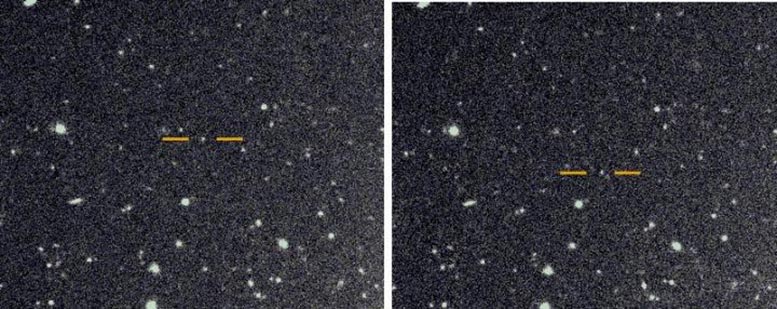
    Saturnian Moon Discovery
    These are the discovery images for the newly found very distant prograde moon of Saturn. They were taken on the Subaru telescope with about one hour between each image. The background stars and galaxies do not move, while the newly discovered Saturnian moon, highlighted with an orange bar, shows motion between the two images. Credit: Scott Sheppard

    “This kind of grouping of outer moons is also seen around Jupiter, indicating violent collisions occurred between moons in the Saturnian system or with outside objects such as passing asteroids or comets,” explained Sheppard.

    The other newly found prograde moon has an inclination near 36 degrees, which is similar to the other known grouping of inner prograde moons around Saturn called the Gallic group. But this new moon orbits much farther away from Saturn than any of the other prograde moons, indicating it might have been pulled outwards over time or might not be associated with the more inner grouping of prograde moons.

    If a significant amount of gas or dust were present when a larger moon broke apart and created these clusters of smaller moon fragments, there would have been strong frictional interactions between the smaller moons and the gas and dust, causing them to spiral into the planet.
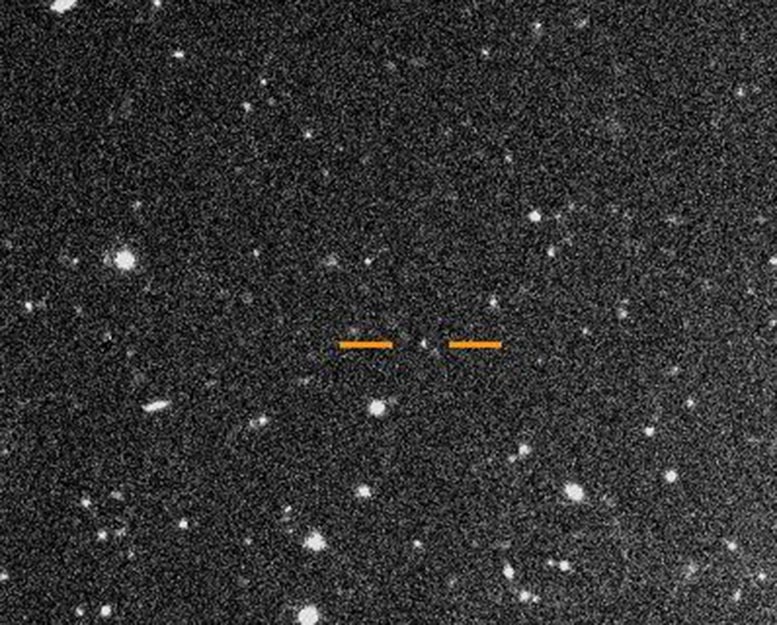
    How a Moon of Saturn Is Discovered
    A gif of the discovery images for the newly found very distant prograde moon of Saturn. They were taken on the Subaru telescope with about one hour between each image. The background stars and galaxies do not move, while the newly discovered Saturnian moon, highlighted with an orange bar, shows motion between the two images. Credit: Scott Sheppard

    “In the Solar System’s youth, the Sun was surrounded by a rotating disk of gas and dust from which the planets were born. It is believed that a similar gas-and-dust disk surrounded Saturn during its formation,” Sheppard said. “The fact that these newly discovered moons were able to continue orbiting Saturn after their parent moons broke apart indicates that these collisions occurred after the planet-formation process was mostly complete and the disks were no longer a factor.”

    The new moons were discovered using the Subaru telescope atop Mauna Kea in Hawaii. The observing team included Sheppard, David Jewitt of UCLA, and Jan Kleyna of the University of Hawaii.
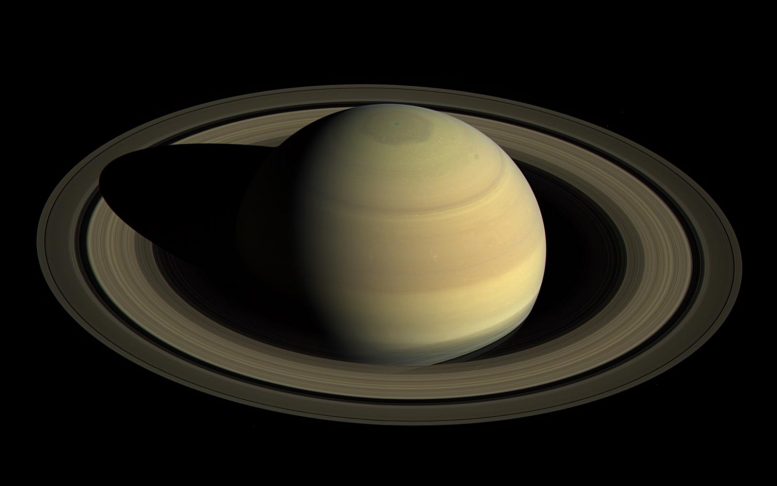
    Saturn
    Saturn. Credit: NASA/JPL-Caltech/Space Science Institute.

    “Using some of the largest telescopes in the world, we are now completing the inventory of small moons around the giant planets,” says Scott Sheppard. “They play a crucial role in helping us determine how our Solar System’s planets formed and evolved.”

    Last year, Sheppard discovered 12 new moons orbiting Jupiter and Carnegie hosted an online contest to name five of them.

    “I was so thrilled with the amount of public engagement over the Jupiter moon-naming contest that we’ve decided to do another one to name these newly discovered Saturnian moons,” Sheppard said. “This time, the moons must be named after giants from Norse, Gallic, or Inuit mythology.”

    ###

    Contest details are available here.

    Never miss a breakthrough: Join the SciTechDaily newsletter.
    Follow us on Google and Google News.

    Astronomy Carnegie Institution for Science Moons Popular Saturn Subaru Telescope
    Share. Facebook Twitter Pinterest LinkedIn Email Reddit

    Related Articles

    Titan’s Methane Mysteries: Unraveling Atmospheric Secrets of Saturn’s Largest Moon

    62 New Moons Discovered Orbiting Saturn Using Innovative Astronomy

    “Stealth” Ocean Worlds: Evidence Uncovered for an Internal Ocean in Small Saturn Moon

    Possible Signs of Alien Life? Methane in the Plumes of Saturn’s Moon Enceladus

    Worlds With Underground Oceans – Like Europa, Titan, and Enceladus – May Be More Conducive to Supporting Life Than Earth

    Two Scientists Have Figured Out What Caused Saturn’s Tilt

    Kraken Mare – a Sea of Liquid Methane on Saturn’s Largest Moon, Titan – Estimated to Be 1,000 Feet Deep

    An Additional Planet Between Saturn and Uranus Was Kicked Out of the Solar System

    NASA Discovers “Very Weird” Molecule in Titan’s Atmosphere

    2 Comments

    1. gianna king on October 10, 2019 6:24 am

      If I could choose I would name it Cleopatris.
      -Gianna age 9

      Reply
    2. Kellie on December 7, 2019 3:11 am

      I know what you are attempting to indicate and your point does make sense but
      I can’t say I totally agree with you. You see, there may be some complications in regards to the issues you have
      said. But I enjoy the time you invested in explaining your opinion. I am interested in this
      subject and will certainly dig deeper into this situation.

      Reply
    Leave A Reply Cancel Reply

    • Facebook
    • Twitter
    • Pinterest
    • YouTube

    Don't Miss a Discovery

    Subscribe for the Latest in Science & Tech!

    Trending News

    Breakthrough Bowel Cancer Trial Leaves Patients Cancer-Free for Nearly 3 Years

    Natural Compound Shows Powerful Potential Against Rheumatoid Arthritis

    100,000-Year-Old Neanderthal Fossils in Poland Reveal Unexpected Genetic Connections

    Simple “Gut Reset” May Prevent Weight Gain After Ozempic or Wegovy

    2.8 Days to Disaster: Scientists Warn Low Earth Orbit Could Suddenly Collapse

    Common Food Compound Shows Surprising Power Against Superbugs

    5 Simple Ways To Remember More and Forget Less

    The Atomic Gap That Could Cost the Semiconductor Industry Billions

    Follow SciTechDaily
    • Facebook
    • Twitter
    • YouTube
    • Pinterest
    • Newsletter
    • RSS
    SciTech News
    • Biology News
    • Chemistry News
    • Earth News
    • Health News
    • Physics News
    • Science News
    • Space News
    • Technology News
    Recent Posts
    • After 37 Years, the World’s Longest-Running Soil Warming Experiment Uncovers a Startling Climate Secret
    • NASA Satellite Captures First-Ever High-Res View of Massive Pacific Tsunami
    • ADHD Isn’t Just a Deficit: Study Reveals Powerful Hidden Strengths
    • Scientists Uncover “Astonishing” Hidden Property of Light
    • Scientists Discover Stem Cells That Could Regrow Teeth and Bone
    Copyright © 1998 - 2026 SciTechDaily. All Rights Reserved.
    • Science News
    • About
    • Contact
    • Editorial Board
    • Privacy Policy
    • Terms of Use

    Type above and press Enter to search. Press Esc to cancel.