
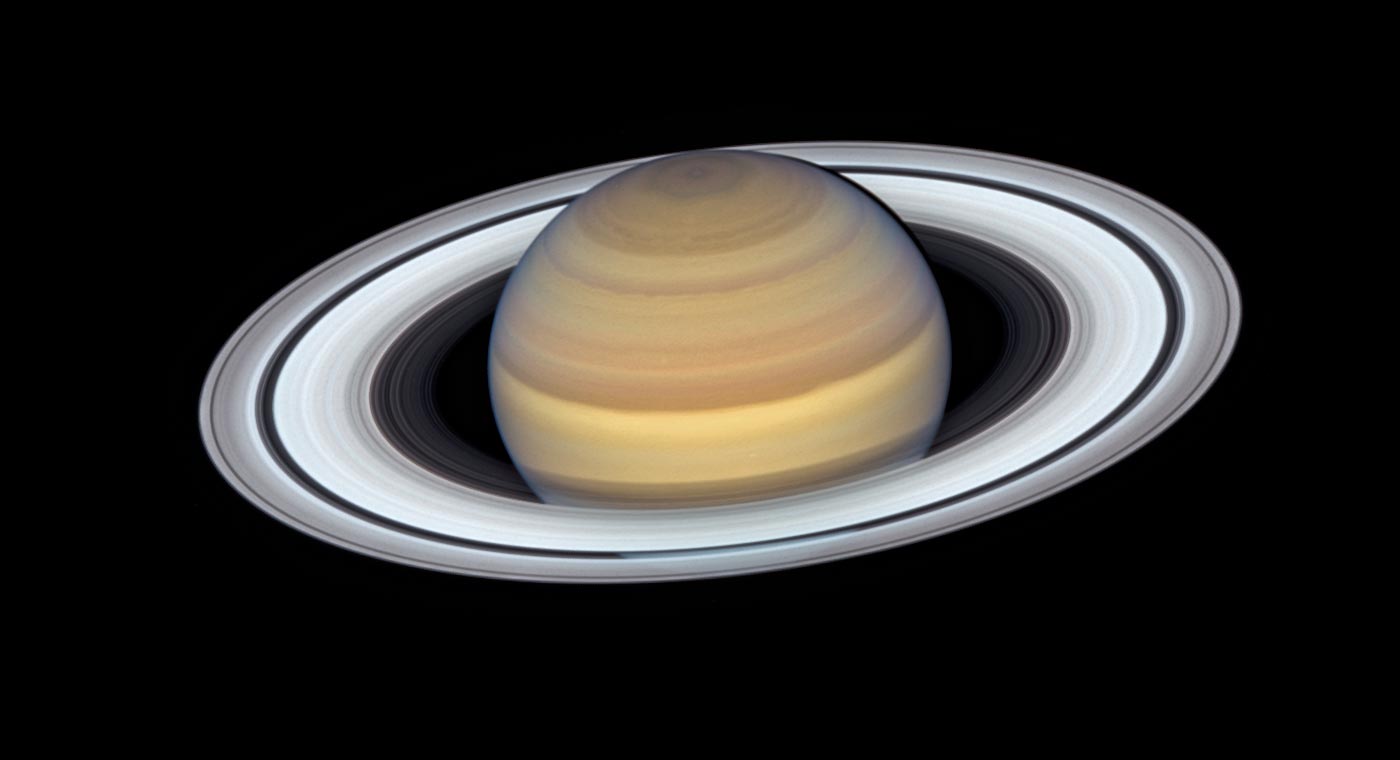
An international team of astronomers has found 62 new moons around Saturn using an innovative technique. These irregular moons contribute to Saturn’s total moon count of 145, surpassing Jupiter, and provide insights into the planet’s moon system’s collisional history.
The work of an international team of astronomers has resulted in the announcement of 62 new moons of Saturn, catapulting it back into first place of the ‘moon race’ around the giant planets of our Solar System. The team is led by Edward Ashton (currently a postdoctoral fellow at Taiwan’s Academia Sinica Institute of Astronomy and Astrophysics) and includes Professor Brett Gladman (Department of Physics & Astronomy at the University of British Columbia), Mike Alexandersen (Harvard Smithsonian Center for Astrophysics), Jean-Marc Petit (Observatoire de Besancon), and Matthew Beaudoin (University of British Columbia).
Over the past two decades, Saturn’s surroundings have been repeatedly examined for moons with increasing sensitivity. In this latest study, Dr. Ashton’s team used a technique known as ‘shift and stack’ in order to find fainter (and thus smaller) Saturnian moons. This method has been used for moon searches around Neptune and Uranus, but never for Saturn. Shifting a set of sequential images at the rate that the moon is moving across the sky results in enhancement of the moon’s signal when all the data is combined, allowing moons that were too faint to be seen in individual images to become visible in the `stacked’ image. The team used data taken using the Canada-France-Hawaii Telescope (CFHT) on top of Mauna Kea, Hawaii between 2019 and 2021. By shifting and stacking many sequential images taken during 3-hour spans, they were able to detect moons of Saturn down to about 2.5 kilometers in diameter.
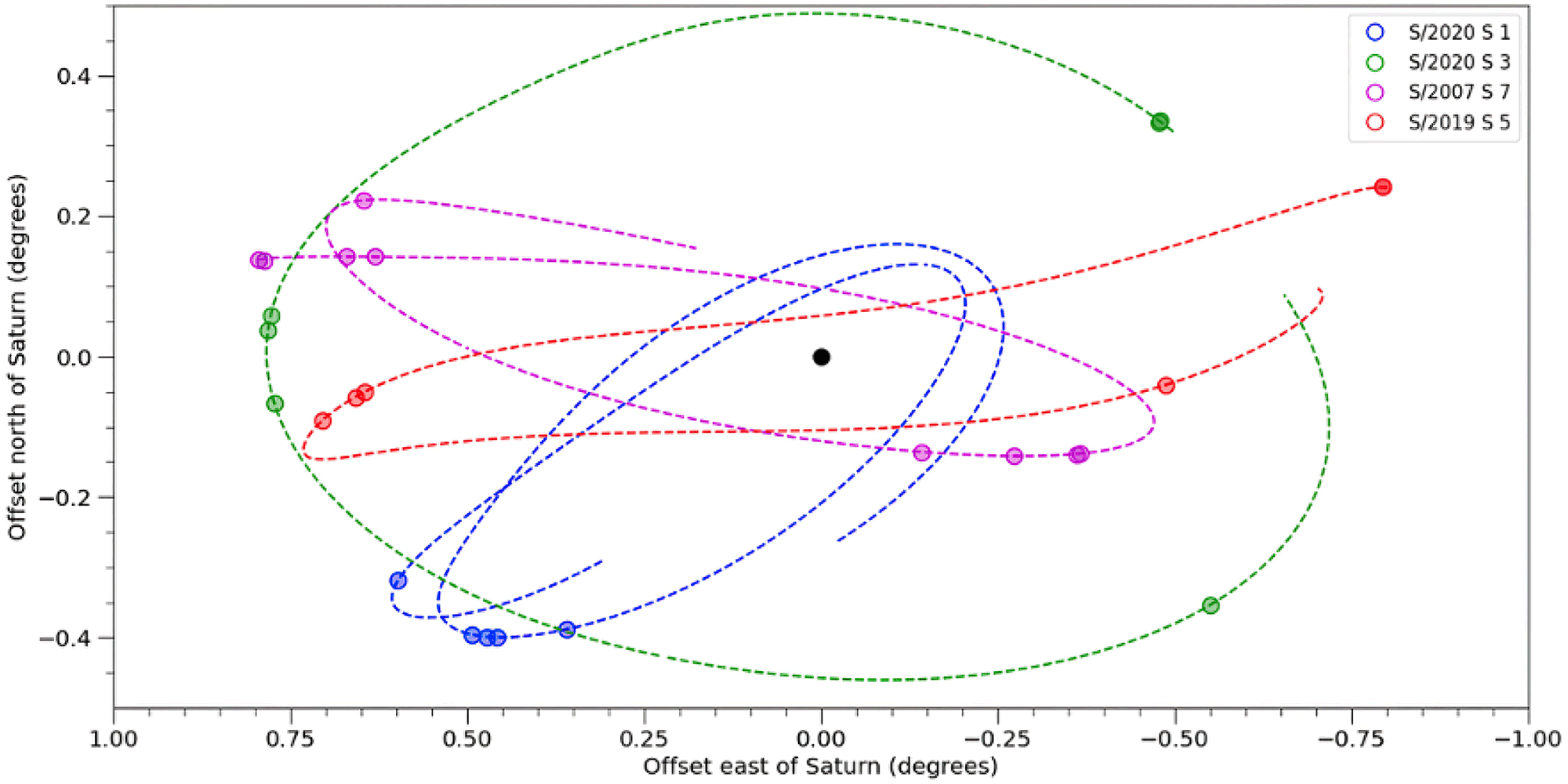
The original discovery search was done in 2019 when Ashton and Beaudoin were students at the University of British Columbia, uncovering the moons in a meticulous search of the deep CFHT imaging acquired that year. But just finding an object close to Saturn on the sky is insufficient to say for certain that it is a moon; it could in principle be an asteroid that just happened to be passing close to the planet (although this is unlikely). To be absolutely sure, the object must be tracked for several years before one can establish that it is certainly orbiting the planet. After painstakingly matching objects detected on different nights over two years, the team has managed to track 63 objects, thus confirming them as new moons. One of the new moons, designated S/2019 S 1, was announced back in 2021, with the rest being announced over the last couple of weeks. Some of the team’s linked orbits were identified with past observations from many years ago that briefly glimpsed some of these moons (but were not tracked long enough to establish their orbit around Saturn).
“Tracking these moons makes me recall playing the kid’s game Dot-to-Dot, because we have to connect the various appearances of these moons in our data with a viable orbit,” explains Edward Ashton, “but with about 100 different games on the same page and you don’t know which dot belongs to which puzzle.”
Irregular Moons: Clues to Saturn’s Dynamic History
All of the new moons are in the class of irregular moons, which are thought to be initially captured by their host planet long ago. Irregular moons are characterized by their large, elliptical, and inclined orbits compared to regular moons. The number of known Saturnian irregular moons has more than doubled to 121, with 58 previously known before the search began. Including the 24 regular moons, there is now a total of 145 recognized (by the International Astronomical Union) moons orbiting Saturn. The new discoveries have resulted in multiple milestones for the ringed planet. Saturn has not only regained its crown for having the most known moons (overtaking Jupiter with 95 recognized moons), it is also the first planet to have over 100 discovered moons in total.
The irregular moons tend to clump together into orbital groups based on the tilt of their orbits. In the Saturnian system, there are 3 such groups whose names are drawn from different mythologies: there is the Inuit group, the Gallic group, and the much more populated Norse group. For example, three new discoveries fall in the Inuit group: S/2019 S 1, S/2020 S 1 and S/2005 S 4 have very small orbits tilted similarly to that of the previously known larger irregulars Kiviuq and Ijiraq. All of the new moons fall into one of the three known groups, with the Norse group again being the most populated amongst the new moons. The groups are thought to be the result of collisions, where the current moons in a group are remnants of one or more collisions on the originally-captured moons. A better understanding of the orbital distribution thus provides insight into the collisional history of the irregular moon system of Saturn.
A Recent Cosmic Collision in Saturn’s History
Based on their past studies of these moons, this team has suggested that the large number of small moons on retrograde orbits is the result of a relatively recent (in astronomical terms, being in the last 100 million years) disruption of a moderately sized irregular moon that is now broken into the many fragments that are being cataloged in the Norse group.
As Professor Gladman explains, “as one pushes to the limit of modern telescopes, we are finding increasing evidence that a moderate-sized moon orbiting backward around Saturn was blown apart something like 100 million years ago.”
Never miss a breakthrough: Join the SciTechDaily newsletter.
Follow us on Google and Google News.
2 Comments
Great commentary, and thanks to Ashton, Beaudoin, Gladman, Petit, Alexandersen, et al for compiling the observable evidence and forming a logical theory for the detritus.
Sadly, ‘logic’ has been missing from astronomical/geophysical theories for some time.
Cheers Steve.
‘As Professor Gladman explains, “as one pushes to the limit of modern telescopes, we are finding increasing evidence that a moderate-sized moon orbiting backward around Saturn was blown apart something like 100 million years ago.”’
Which brings up the “Chrysalis/missing moon” hypothesis featured above the comments.