
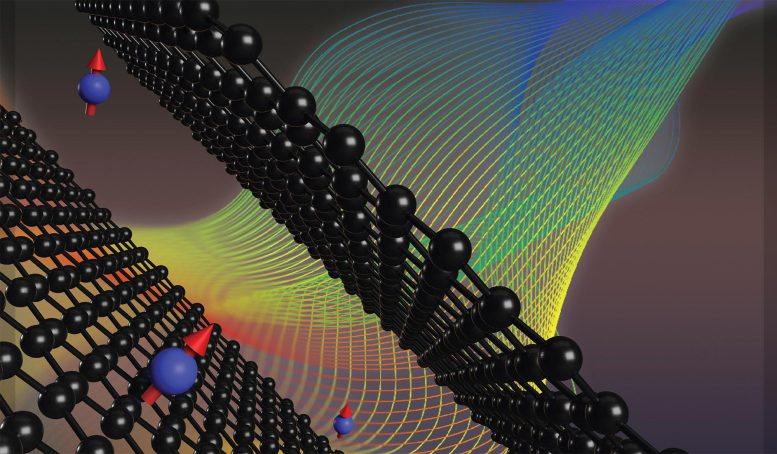
By observing spin structure in “magic-angle” graphene, a team of scientists led by Brown University researchers has found a workaround for a long-standing roadblock in the field of two-dimensional electronics.
Physicists have struggled for two decades to directly manipulate electron spin in 2D materials like graphene, which could unlock advances in 2D electronics. The standard measurement technique for electron spin typically fails in 2D materials, hampering technological progress. However, a team led by Brown University researchers has found a solution, as reported in Nature Physics. The study demonstrates the first direct interaction between electrons spinning in a 2D material and microwave radiation photons, establishing a new experimental technique to study electron spin properties in 2D quantum materials. This technique could pave the way for computational and communicational technologies based on 2D materials.
For two decades, physicists have tried to directly manipulate the spin of electrons in 2D materials like graphene. Doing so could spark key advances in the burgeoning world of 2D electronics, a field where super-fast, small and flexible electronic devices carry out computations based on quantum mechanics.
Standing in the way is that the typical way in which scientists measure the spin of electrons — an essential behavior that gives everything in the physical universe its structure — usually doesn’t work in 2D materials. This makes it incredibly difficult to fully understand the materials and propel forward technological advances based on them. But a team of scientists led by Brown University researchers believes they now have a way around this longstanding challenge. They describe their solution in a new study published on May 11 in the journal Nature Physics.
In the study, the team — which also include scientists from the Center for Integrated Nanotechnologies at Sandia National Laboratories, and the University of Innsbruck — describe what they believe to be the first measurement showing direct interaction between electrons spinning in a 2D material and photons coming from microwave radiation. Called a coupling, the absorption of microwave photons by electrons establishes a novel experimental technique for directly studying the properties of how electrons spin in these 2D quantum materials — one that could serve as a foundation for developing computational and communicational technologies based on those materials, according to the researchers.
“Spin structure is the most important part of a quantum phenomenon, but we’ve never really had a direct probe for it in these 2D materials,” said Jia Li, an assistant professor of physics at Brown and senior author of the research. “That challenge has prevented us from theoretically studying spin in these fascinating material for the last two decades. We can now use this method to study a lot of different systems that we could not study before.”
Magic-Angle Twisted Bilayer Graphene
The researchers made the measurements on a relatively new 2D material called “magic-angle” twisted bilayer graphene. This graphene-based material is created when two sheets of ultrathin layers of carbon are stacked and twisted to just the right angle, converting the new double-layered structure into a superconductor that allows electricity to flow without resistance or energy waste. Just discovered in 2018, the researchers focused on the material because of the potential and mystery surrounding it.
“A lot of the major questions that were posed in 2018 have still yet to be answered,” said Erin Morissette, a graduate student in Li’s lab at Brown who led the work.
Physicists usually use nuclear magnetic resonance or NMR to measure the spin of electrons. They do this by exciting the nuclear magnetic properties in a sample material using microwave radiation and then reading the different signatures this radiation causes to measure spin.
The challenge with 2D materials is that the magnetic signature of electrons in response to the microwave excitation is too small to detect. The research team decided to improvise. Instead of directly detecting the magnetization of the electrons, they measured subtle changes in electronic resistance, which were caused by the changes in magnetization from the radiation using a device fabricated at the Institute for Molecular and Nanoscale Innovation at Brown. These small variations in the flow of the electronic currents allowed the researchers to use the device to detect that the electrons were absorbing the photos from the microwave radiation.
Antiferromagnetic-Like Behavior
The researchers were able to observe novel information from the experiments. The team noticed, for instance, that interactions between the photons and electrons made electrons in certain sections of the system behave as they would in an anti-ferromagnetic system — meaning the magnetism of some atoms was canceled out by a set of magnetic atoms that are aligned in a reverse direction.
The new method for studying spin in 2D materials and the current findings won’t be applicable to technology today, but the research team sees potential applications the method could lead to in the future. They plan to continue to apply their method to twisted bilayer graphene but also expand it to other 2D material.
“It’s a really diverse toolset that we can use to access an important part of the electronic order in these strongly correlated systems and in general to understand how electrons can behave in 2D materials,” Morissette said.
Reference: “Dirac revivals drive a resonance response in twisted bilayer graphene” by Erin Morissette, Jiang-Xiazi Lin, Dihao Sun, Liangji Zhang, Song Liu, Daniel Rhodes, Kenji Watanabe, Takashi Taniguchi, James Hone, Johannes Pollanen, Mathias S. Scheurer, Michael Lilly, Andrew Mounce and J. I. A. Li, 11 May 2023, Nature Physics.
DOI: 10.1038/s41567-023-02060-0
The experiment was carried out remotely in 2021 at the Center for Integrated Nanotechnologies in New Mexico. Mathias S. Scheurer from University of Innsbruck provided theoretical support for modeling and understanding the result. The work included funding from the National Science Foundation, the U.S. Department of Defense and the U.S. Department of Energy’s Office of Science.
Never miss a breakthrough: Join the SciTechDaily newsletter.
Follow us on Google and Google News.