
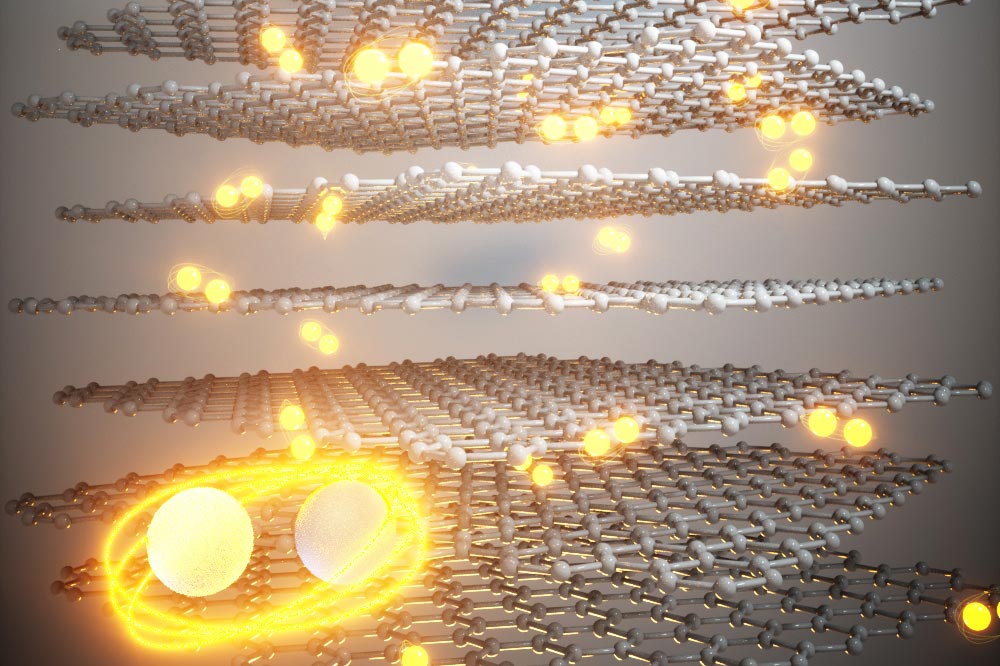
The discovery could inform the design of practical superconducting devices.
When it comes to graphene, it appears that superconductivity runs in the family.
Graphene is a single-atom-thin 2D material that can be produced by exfoliation from the same graphite that is found in pencil lead. The ultrathin material is composed entirely of carbon atoms that are arranged in a simple hexagonal pattern, similar to that of chicken wire. Since its first isolation in 2004, scientists have discovered that graphene embodies numerous remarkable properties in its single-layer form.
Graphene, a single layer of carbon atoms arranged in a two-dimensional honeycomb lattice nanostructure is one of the most well-known 2D-materials. When you take two stacked layers of graphene and twist them at the magic angle, all kinds of powerful properties can emerge such as superconductivity and ferromagnetism.
In 2018, MIT scientists discovered that if two graphene layers are stacked at a very specific “magic” angle, the twisted bilayer structure could exhibit robust superconductivity. In this widely sought material state, an electrical current can flow through with zero energy loss. Recently, the same group of researchers found a similar superconductive state exists in twisted trilayer graphene — a structure made from three graphene layers stacked at a precise, new magic angle.
Now the research team reports that — you guessed it — four and five graphene layers can be twisted and stacked at new magic angles to elicit robust superconductivity at low temperatures. This latest discovery, published on July 7, 2022, in the journal Nature Materials, establishes the various twisted and stacked configurations of graphene as the first known “family” of multilayer magic-angle superconductors. The team also identified similarities and differences between graphene family members.
This new discovery could serve as a blueprint for designing practical, room-temperature superconductors. If the properties among family members could be replicated in other, naturally conductive materials, they could be harnessed, for instance, to deliver electricity without dissipation losses or build magnetically levitating trains that run with no friction.
“The magic-angle graphene system is now a legitimate ‘family,’ beyond a couple of systems,” says lead author Jeong Min (Jane) Park, a graduate student in MIT’s Department of Physics. “Having this family is particularly meaningful because it provides a way to design robust superconductors.”
Park’s MIT co-authors include Yuan Cao, Li-Qiao Xia, Shuwen Sun, and Pablo Jarillo-Herrero, the Cecil and Ida Green Professor of Physics, along with Kenji Watanabe and Takashi Taniguchi of the National Institute for Materials Science in Tsukuba, Japan.
“No Limit”
Jarillo-Herrero’s group was the first to discover magic-angle graphene, in the form of a bilayer structure of two graphene sheets placed one atop the other and slightly offset at a precise angle of 1.1 degrees. This twisted configuration, known as a moiré superlattice, transformed the material into a strong and persistent superconductor at ultralow temperatures.
The researchers also found that the material exhibited a type of electronic structure known as a “flat band,” in which the material’s electrons have the same energy, regardless of their momentum. In this flat band state, and at ultracold temperatures, the normally frenetic electrons collectively slow down enough to pair up in what are known as Cooper pairs — essential ingredients of superconductivity that can flow through the material without resistance.
While the researchers observed that twisted bilayer graphene exhibited both superconductivity and a flat band structure, it wasn’t clear whether the former arose from the latter.
“There was no proof a flat band structure led to superconductivity,” Park says. “Other groups since then have produced other twisted structures from other materials that have some flattish band, but they didn’t really have robust superconductivity. So we wondered: Could we produce another flat band superconducting device?”
As they considered this question, a group from Harvard University derived calculations that confirmed mathematically that three graphene layers, twisted at 1.6 degrees, would exhibit also flat bands, and suggested they may superconduct. They went on to show there should be no limit to the number of graphene layers that exhibit superconductivity, if stacked and twisted in just the right way, at angles they also predicted. Finally, they proved they could mathematically relate every multilayer structure to a common flat band structure — strong proof that a flat band may lead to robust superconductivity.
“They worked out there may be this entire hierarchy of graphene structures, to infinite layers, that might correspond to a similar mathematical expression for a flat band structure,” Park says.
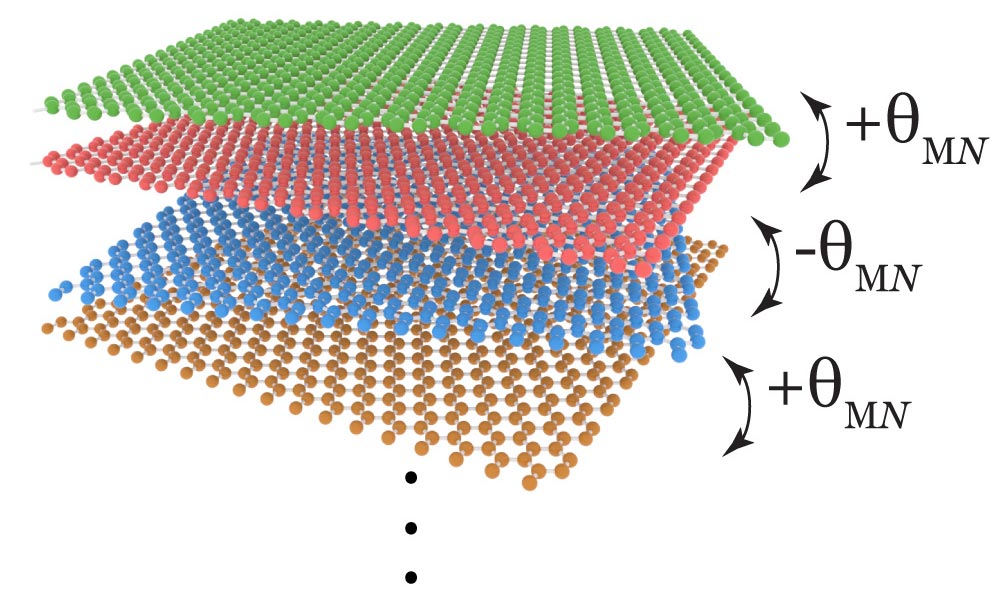
Shortly after that work, Jarillo-Herrero’s group found that, indeed, superconductivity and a flat band emerged in twisted trilayer graphene — three graphene sheets, stacked like a cheese sandwich, the middle cheese layer shifted by 1.6 degrees with respect to the sandwiched outer layers. But the trilayer structure also showed subtle differences compared to its bilayer counterpart.
“That made us ask, where do these two structures fit in terms of the whole class of materials, and are they from the same family?” Park says.
An Unconventional Family
In the current study, the team looked to level up the number of graphene layers. They fabricated two new structures, made from four and five graphene layers, respectively. Each structure is stacked alternately, similar to the shifted cheese sandwich of twisted trilayer graphene.
The team kept the structures in a refrigerator below 1 kelvin (about -273 degrees Celsius or -458 degrees Fahrenheit), ran electrical current through each structure, and measured the output under various conditions, similar to tests for their bilayer and trilayer systems.
Overall, they found that both four- and five-layer twisted graphene also exhibit robust superconductivity and a flat band. The structures also shared other similarities with their three-layer counterpart, such as their response under a magnetic field of varying strength, angle, and orientation.
These experiments showed that twisted graphene structures could be considered a new family, or class of common superconducting materials. The experiments also suggested there may be a black sheep in the family: The original twisted bilayer structure, while sharing key properties, also showed subtle differences from its siblings. For instance, the group’s previous experiments showed the structure’s superconductivity broke down under lower magnetic fields and was more uneven as the field rotated, compared to its multilayer siblings.
The team carried out simulations of each structure type, seeking an explanation for the differences between family members. They concluded that the fact that twisted bilayer graphene’s superconductivity dies out under certain magnetic conditions is simply because all of its physical layers exist in a “nonmirrored” form within the structure. In other words, there are no two layers in the structure that are mirror opposites of each other, whereas graphene’s multilayer siblings exhibit some sort of mirror symmetry. These findings suggest that the mechanism driving electrons to flow in a robust superconductive state is the same across the twisted graphene family.
“That’s quite important,” Park notes. “Without knowing this, people might think bilayer graphene is more conventional compared to multilayer structures. But we show that this entire family may be unconventional, robust superconductors.”
Reference: “Robust superconductivity in magic-angle multilayer graphene family” by Jeong Min Park, Yuan Cao, Li-Qiao Xia, Shuwen Sun, Kenji Watanabe, Takashi Taniguchi and Pablo Jarillo-Herrero, 7 July 2022, Nature Materials.
DOI: 10.1038/s41563-022-01287-1
This research was supported, in part, by the U.S. Department of Energy, the National Science Foundation, the Air Force Office of Scientific Research, the Gordon and Betty Moore Fundation, the Ramon Areces Foundation, and the CIFAR Program on Quantum Materials.
Never miss a breakthrough: Join the SciTechDaily newsletter.
Follow us on Google and Google News.
5 Comments
Wonder if this could lead to better solid State Batteries and Super Caps, Not to mention a new family of Magnets ?
Do any of them interact differently with gravity fields?
Could materials or components be 3-d printed with stacked graphene?
How does graphene interact with our environment? Is it safe around living things? How does it interact with sound? Light? In a vacuum? Around vibration? Could it amplify bio energy, maybe be used with artificial limbs or equipment.? It’s fascinating and packed with endless possibilities.
How close are you to being able to 3D print a 1 atom thick layer of graphine?
Laymens question. How would finding effect electrical transformers that we see on telephone poles.
Fascinating!