
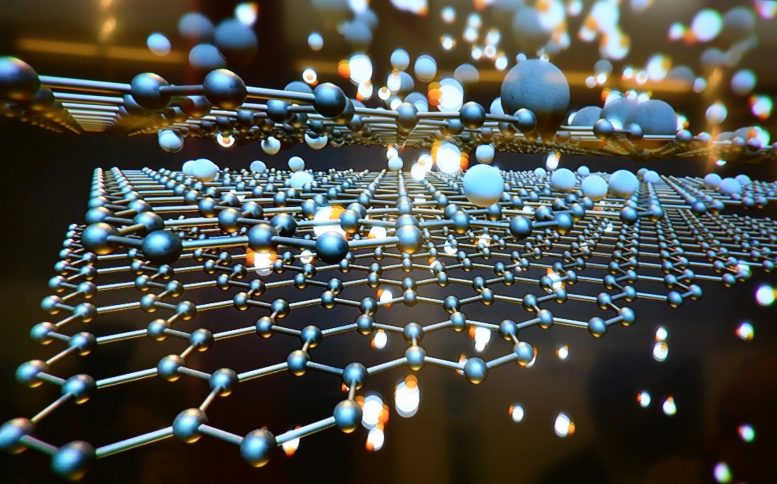
Study suggests potential role for graphene in moving electricity.
Researchers at The Ohio State University, in collaboration with scientists around the world, have made a discovery that could provide new insights into how superconductors might move energy more efficiently to power homes, industries and vehicles.
Their work, published last week in the journal Science Advances, showed that graphene — a material composed of a single layer of carbon atoms — is more likely to become a superconductor than originally thought possible.
“Graphene by itself can conduct energy, as a normal metal is conductive, but it is only recently that we learned it can also be a superconductor, by making a so-called ‘magic angle’ — twisting a second layer of graphene on top of the first,” said Jeanie Lau, a professor of physics at Ohio State and lead author of the paper. “And that opens possibilities for additional research to see if we can make this material work in the real world.”
Unlike most conventional conductors, superconductors are metals that can conduct electricity without resistance, thus suffering no loss of energy.
Graphene is a two-dimensional crystal — a perfectly flat piece of carbon — and, as a single layer, is not a superconductor. But earlier this year, scientists at the Massachusetts Institute of Technology published research that showed that graphene could become a superconductor if one piece of graphene were laid on top of another piece and the layers twisted to a specific angle — what they termed “the magic angle.”
That magic angle, scientists thought, was between 1 degree and 1.2 degrees — a very precise angle.
“The question is, the magic angle, how magic does it have to be?” said Emilio Codecido, a graduate student in Lau’s lab and a co-author on the paper.
The Ohio State team found that the magic angle appears to be less magical than originally thought. Their work found that graphene layers still superconducted at a smaller angle, around 0.9 degrees. It is a small distinction, but it could open the possibility of new experiments to investigate graphene as a potential superconductor in the real world. So far, superconducting is limited outside of scientific laboratories because in order to superconduct electricity, the electric lines must be kept at extremely low temperatures.
“This research pushed our understanding of superconductors and the magic angle a little further than the theory and prior experiments might have expected,” said Marc Bockrath, a co-author of the paper and physics professor at Ohio State.
“Superconductivity could revolutionize many industries — electric transmission lines, communication lines, transportation, trains,” Codecido said. “Superconductivity in twisted bilayer graphene will teach us about superconductivity at much higher temperatures, temperatures that will be useful for real-world applications. That’s where future work will be focused.”
###
For this study, the Ohio State researchers collaborated with researchers at the University of Texas, Dallas, and the National Institute for Materials Science in Japan.
Reference: “Correlated insulating and superconducting states in twisted bilayer graphene below the magic angle” by Emilio Codecido, Qiyue Wang, Ryan Koester, Shi Che, Haidong Tian, Rui Lv, Son Tran, Kenji Watanabe, Takashi Taniguchi, Fan Zhang, Marc Bockrath1 and Chun Ning Lau, 27 September 2019, Science Advances.
DOI: 10.1126/sciadv.aaw9770
Never miss a breakthrough: Join the SciTechDaily newsletter.
Follow us on Google and Google News.