
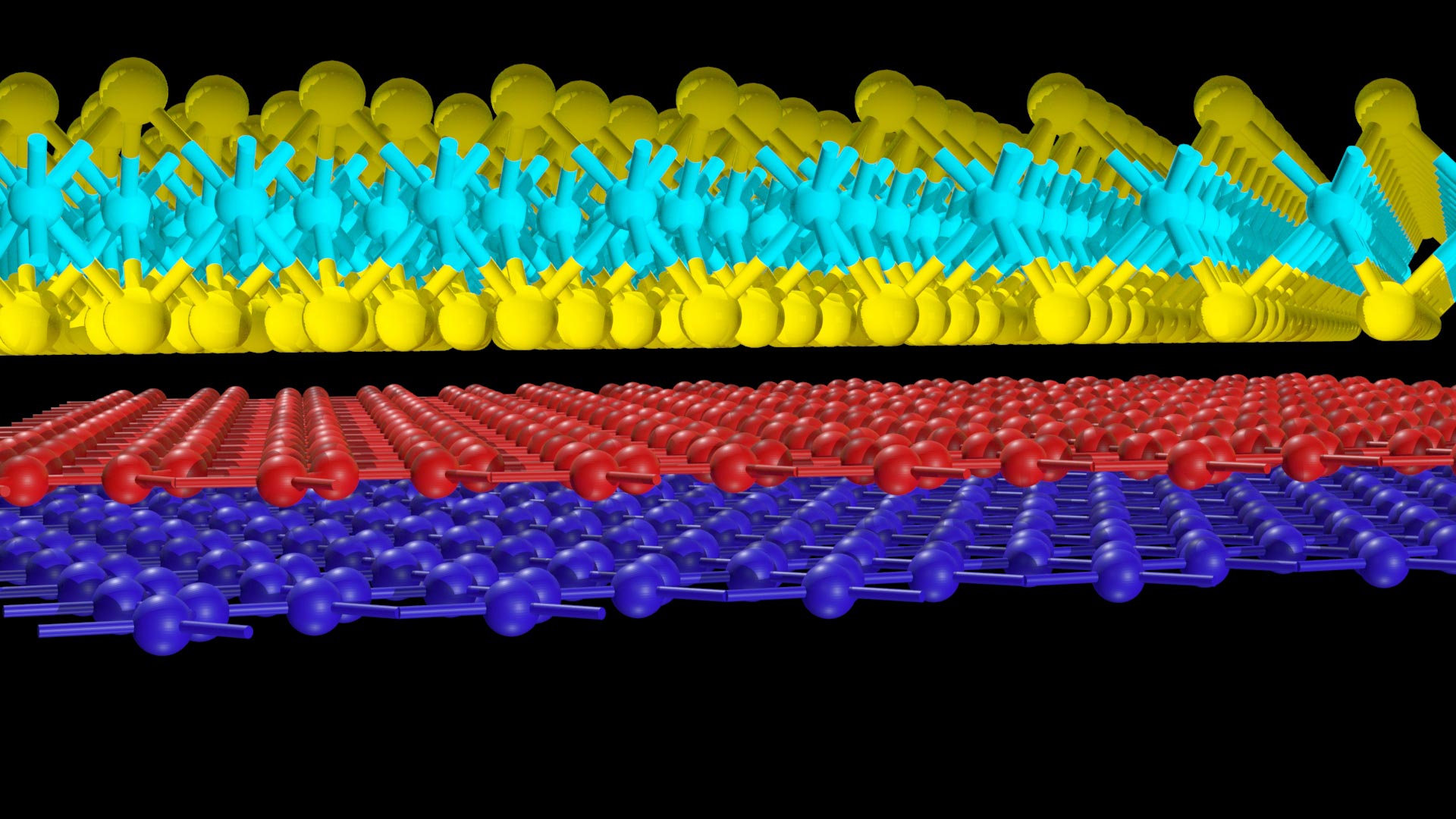
Magnets and superconductors don’t normally get along, but Brown University researchers show that ‘magic-angle’ graphene is capable of producing both superconductivity and ferromagnetism, which could open up new applications in technology and quantum computing.
When two sheets of the carbon nanomaterial graphene are stacked together at a particular angle with respect to each other, it gives rise to some fascinating physics. For instance, when this so-called “magic-angle graphene” is cooled to near absolute zero, it suddenly becomes a superconductor, meaning it conducts electricity with zero resistance.
Now, a research team from Brown University has found a surprising new phenomenon that can arise in magic-angle graphene. In research published in the journal Science, the team showed that by inducing a phenomenon known as spin-orbit coupling, magic-angle graphene becomes a powerful ferromagnet.
“Magnetism and superconductivity are usually at opposite ends of the spectrum in condensed matter physics, and it’s rare for them to appear in the same material platform,” said Jia Li, an assistant professor of physics at Brown and senior author of the research. “Yet we’ve shown that we can create magnetism in a system that originally hosts superconductivity. This gives us a new way to study the interplay between superconductivity and magnetism, and provides exciting new possibilities for quantum science research.”
The Quantum Potential of Magic-Angle Graphene
Magic-angle graphene has caused quite a stir in physics in recent years. Graphene is a two-dimensional material made of carbon atoms arranged in a honeycomb-like pattern. Single sheets of graphene are interesting on their own — displaying remarkable material strength and extremely efficient electrical conductance. But things get even more interesting when graphene sheets are stacked. Electrons begin to interact not only with other electrons within a graphene sheet, but also with those in the adjacent sheet. Changing the angle of the sheets with respect to each other changes those interactions, giving rise to interesting quantum phenomena like superconductivity.
This new research adds a new wrinkle — spin-orbit coupling — to this already interesting system. Spin-orbit coupling is a state of electron behavior in certain materials in which each electron’s spin — its tiny magnetic moment that points either up or down — becomes linked to its orbit around the atomic nucleus.
“We know that spin-orbit coupling gives rise to a wide range of interesting quantum phenomena, but it’s not normally present in magic-angle graphene,” said Jiang-Xiazi Lin, a postdoctoral researcher at Brown and the study’s lead author. “We wanted to introduce spin-orbit coupling, and then see what effect it had on the system.”
To do that, Li and his team interfaced magic-angle graphene with a block of tungsten diselenide, a material that has strong spin-orbit coupling. Aligning the stack precisely induces spin-orbit coupling in the graphene. From there, the team probed the system with external electrical currents and magnetic fields.
The experiments showed that an electric current flowing in one direction across the material in the presence of an external magnetic field produces a voltage in the direction perpendicular to the current. That voltage, known as the Hall effect, is the tell-tale signature of an intrinsic magnetic field in the material.
Unexpected Magnetic Control Through Spin-Orbit Coupling
Much to the research team’s surprise, they showed that the magnetic state could be controlled using an external magnetic field, which is oriented either in the plane of the graphene or out-of-plane. This is in contrast with magnetic materials without spin-orbit coupling, where the intrinsic magnetism can be controlled only when the external magnetic field is aligned along the direction of the magnetism.
“This observation is an indication that spin-orbit coupling is indeed present and provided the clue for building a theoretical model to understand the influence of the atomic interface,” said Yahui Zhang, a theoretical physicist from Harvard University who worked with the team at Brown to understand the physics associated with the observed magnetism.
“The unique influence of spin-orbit coupling gives scientists a new experimental knob to turn in the effort to understand the behavior of magic-angle graphene,” said Erin Morrissette, a Brown graduate student who performed some of the experimental work. “The findings also have the potential for new device applications.”
Potential Applications in Computing and Quantum Devices
One possible application is in computer memory. The team found that the magnetic properties of magic-angle graphene can be controlled with both external magnetic fields and electric fields. That would make this two-dimensional system an ideal candidate for a magnetic memory device with flexible read/write options.
Another potential application is in quantum computing, the researchers say. An interface between a ferromagnet and a superconductor has been proposed as a potential building block for quantum computers. The problem, however, is that such an interface is difficult to create because magnets are generally destructive to superconductivity. But a material that’s capable of both ferromagnetism and superconductivity could provide a way to create that interface.
“We are working on using the atomic interface to stabilize superconductivity and ferromagnetism at the same time,” Li said. “The coexistence of these two phenomena is rare in physics, and it will certainly unlock more excitement.”
Reference: “Spin-orbit–driven ferromagnetism at half moiré filling in magic-angle twisted bilayer graphene” by Jiang-Xiazi Lin, Ya-Hui Zhang, Erin Morissette, Zhi Wang, Song Liu, Daniel Rhodes, K. Watanabe, T. Taniguchi, James Hone and J. I. A. Li, 6 January 2022, Science.
DOI: 10.1126/science.abh2889
The research was primarily supported by Brown University. Additional co-authors are Ya-Hui Zhang, Zhi Wang, Song Liu, Daniel Rhodes, Kenji Watanabe, Takashi Taniguchi and James Hone.
Never miss a breakthrough: Join the SciTechDaily newsletter.
Follow us on Google and Google News.