
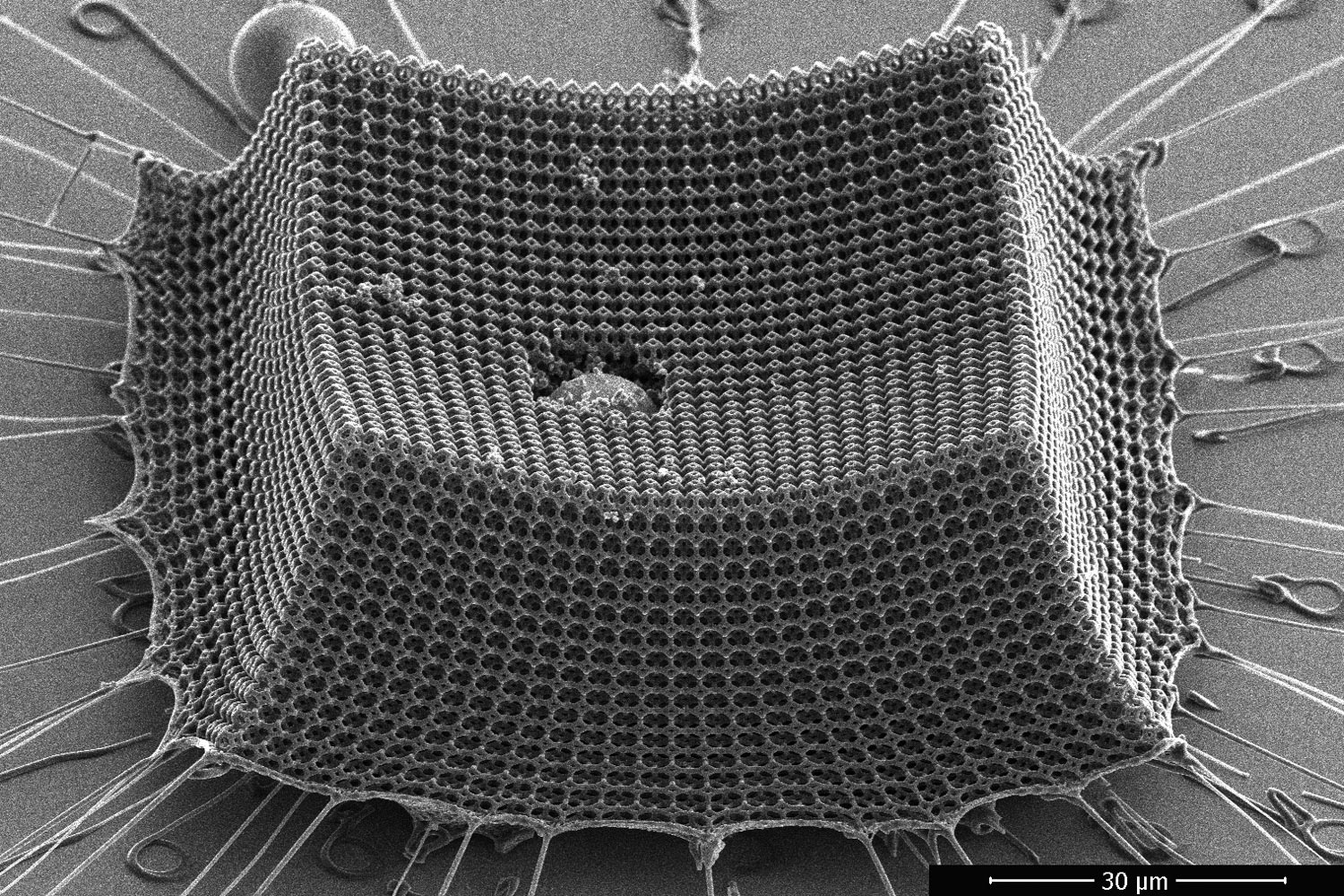
The new carbon-based material could be a basis for lighter, tougher alternatives to Kevlar and steel.
A new study by engineers at MIT, Caltech, and ETH Zürich shows that “nanoarchitected” materials — materials designed from precisely patterned nanoscale structures — may be a promising route to lightweight armor, protective coatings, blast shields, and other impact-resistant materials.
The researchers have fabricated an ultralight material made from nanometer-scale carbon struts that give the material toughness and mechanical robustness. The team tested the material’s resilience by shooting it with microparticles at supersonic speeds, and found that the material, which is thinner than the width of a human hair, prevented the miniature projectiles from tearing through it.
The researchers calculate that compared with steel, Kevlar, aluminum, and other impact-resistant materials of comparable weight, the new material is more efficient at absorbing impacts.
“The same amount of mass of our material would be much more efficient at stopping a projectile than the same amount of mass of Kevlar,” says the study’s lead author, Carlos Portela, assistant professor of mechanical engineering at MIT.
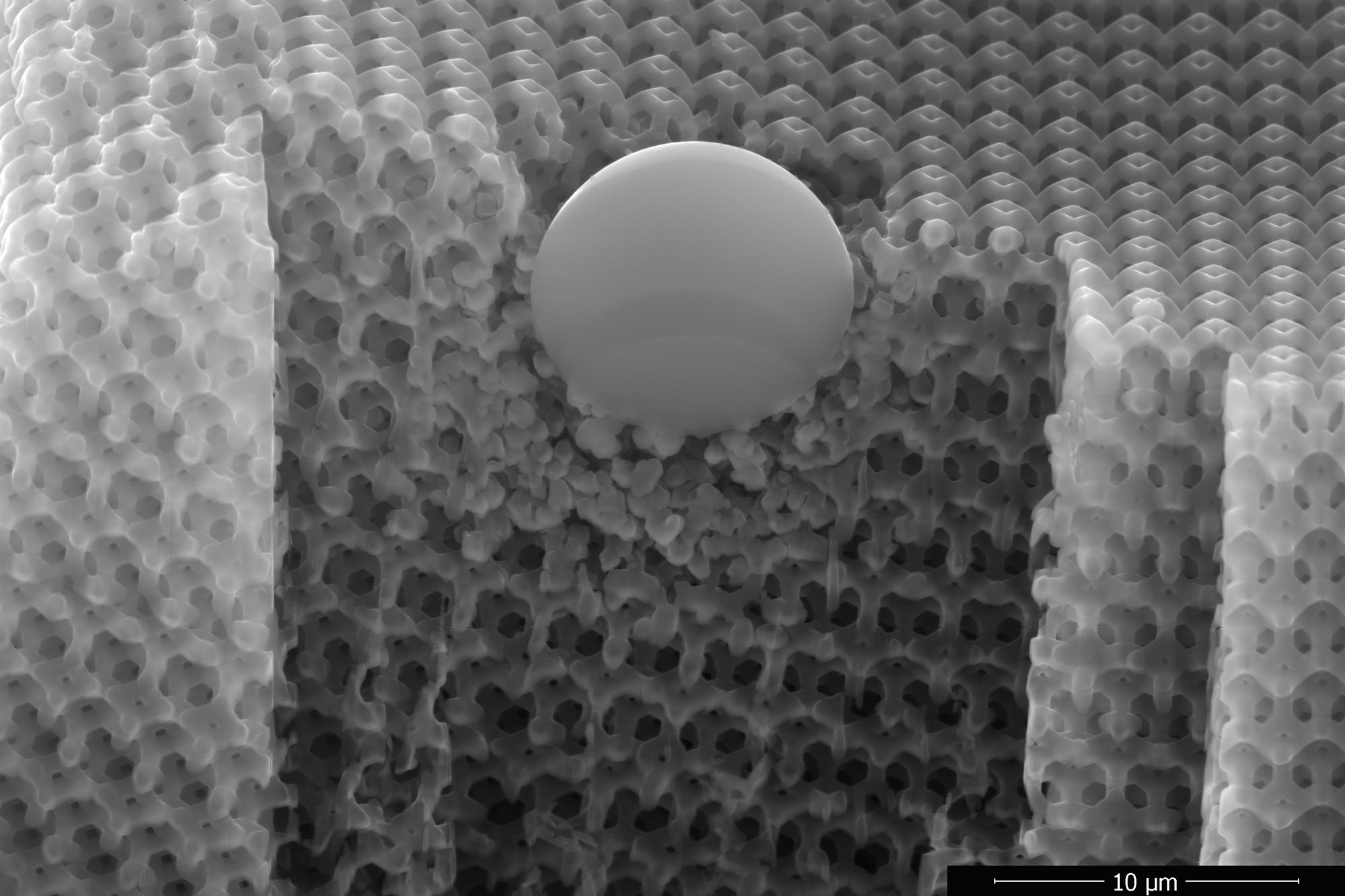
If produced on a large scale, this and other nanoarchitected materials could potentially be designed as lighter, tougher alternatives to Kevlar and steel.
“The knowledge from this work… could provide design principles for ultra-lightweight impact resistant materials [for use in] efficient armor materials, protective coatings, and blast-resistant shields desirable in defense and space applications,” says co-author Julia R. Greer, a professor of materials science, mechanics, and medical engineering at Caltech, whose lab led the material’s fabrication.
The team, which published its results on June 24, 2021, in the journal Nature Materials, includes David Veysset, Yuchen Sun, and Keith A. Nelson, of MIT’s Institute for Soldier Nanotechnologies and the Department of Chemistry, and Dennis M. Kochmann of ETH Zürich.
From Brittle to Bendy
A nanoarchitected material consists of patterned nanometer-scale structures that, depending on how they are arranged, can give materials unique properties such as exceptional lightness and resilience. As such, nanoarchitected materials are seen as potentially lighter, tougher impact-resistant materials. But this potential has largely been untested.
“We only know about their response in a slow-deformation regime, whereas a lot of their practical use is hypothesized to be in real-world applications where nothing deforms slowly,” Portela says.
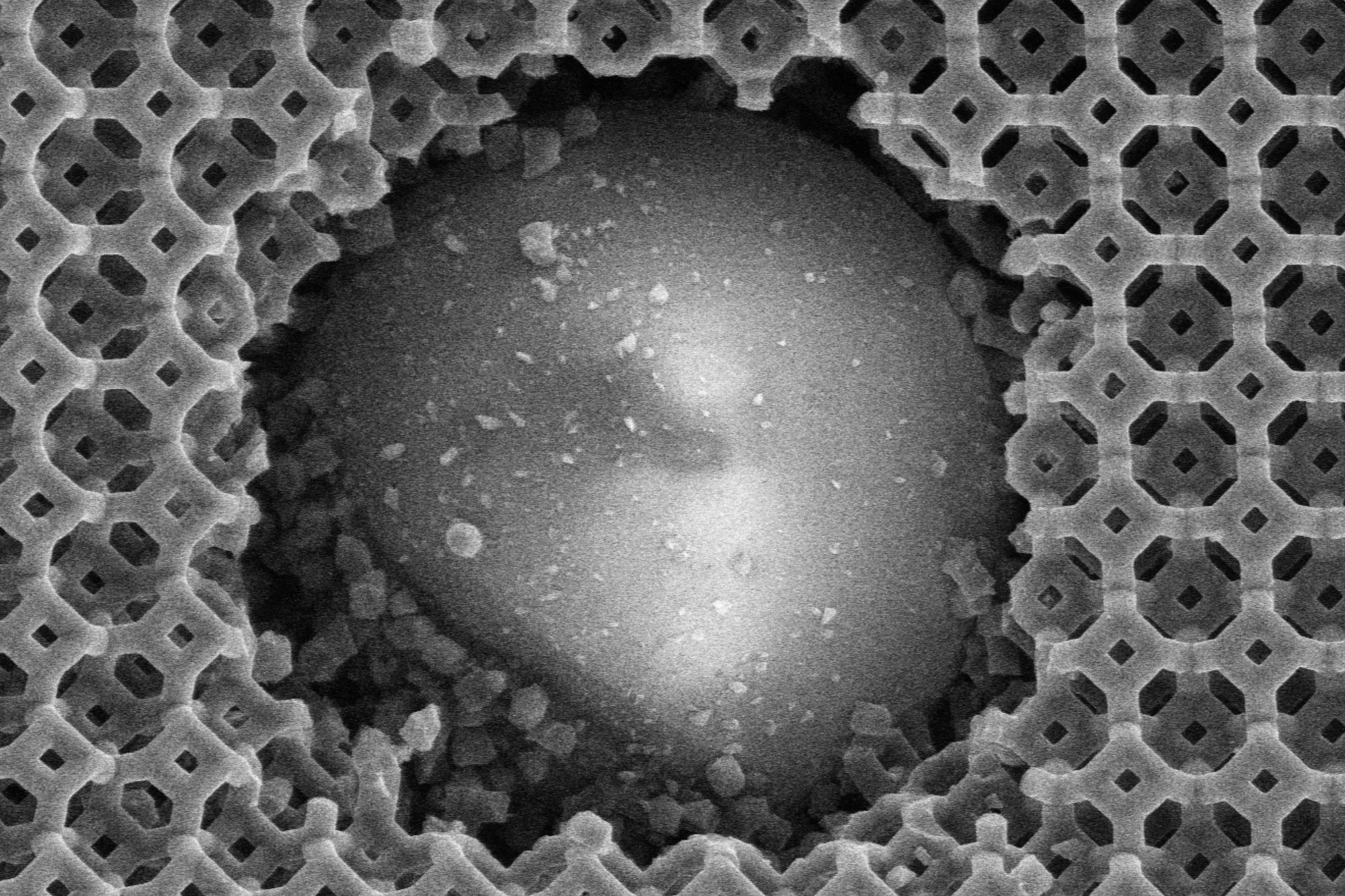
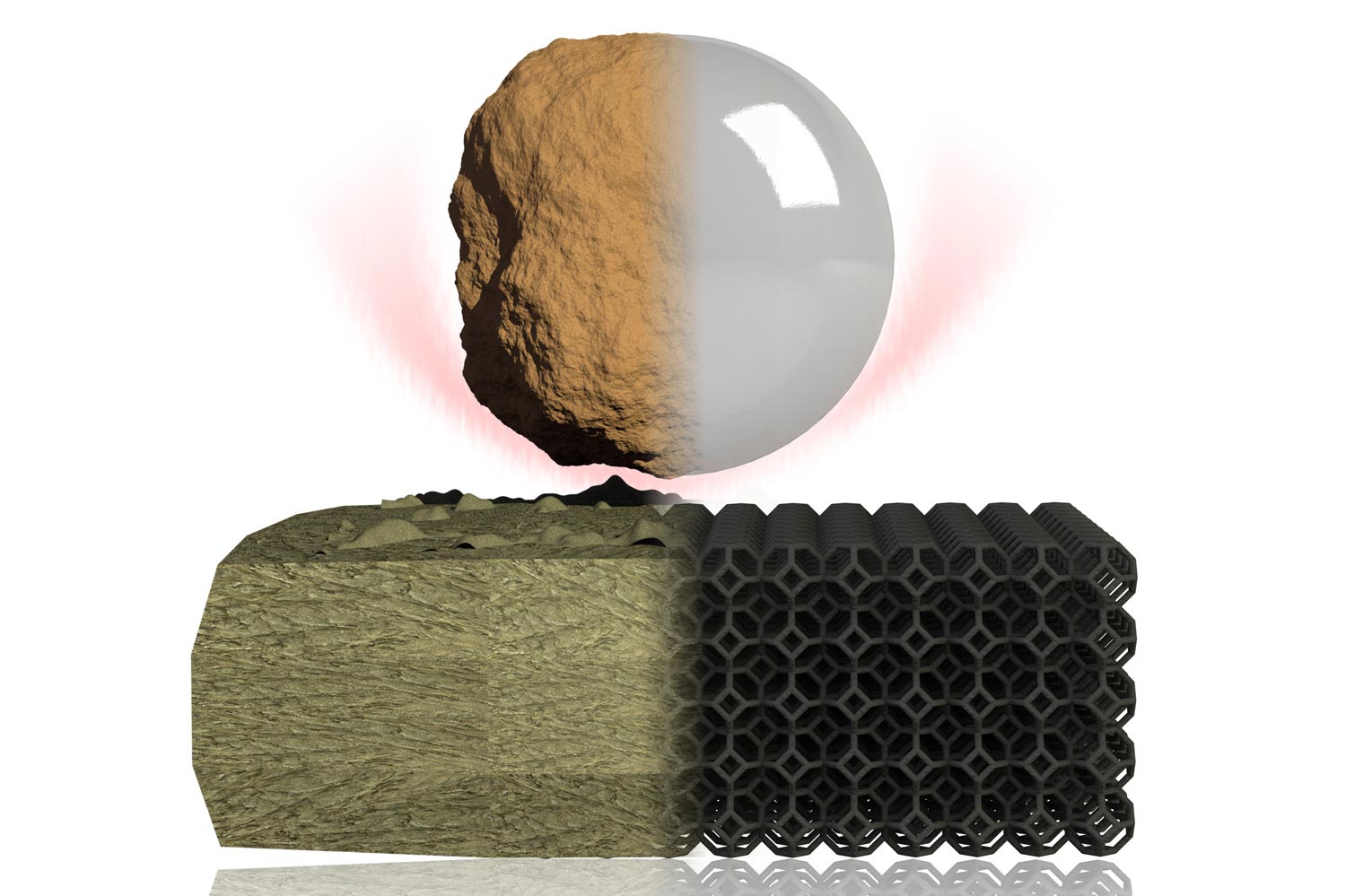
The team set out to study nanoarchitected materials under conditions of fast deformation, such as during high-velocity impacts. At Caltech, they first fabricated a nanoarchitected material using two-photon lithography, a technique that uses a fast, high-powered laser to solidify microscopic structures in a photosensitive resin. The researchers constructed a repeating pattern known as a tetrakaidecahedron — a lattice configuration composed of microscopic struts.
“Historically this geometry appears in energy-mitigating foams,” says Portela, who chose to replicate this foam-like architecture in a carbon material at the nanoscale, to impart a flexible, impact-absorbing property to the normally stiff material. “While carbon is normally brittle, the arrangement and small sizes of the struts in the nanoarchitected material gives rise to a rubbery, bending-dominated architecture.”
After patterning the lattice structure, the researchers washed away the leftover resin and placed it in a high-temperature vacuum furnace to convert the polymer into carbon, leaving behind an ultralight, nanoarchitected carbon material.
Faster Than the Speed of Sound
To test the material’s resilience to extreme deformation, the team performed microparticle impact experiments at MIT using laser-induced particle impact tests. The technique aims an ultrafast laser through a glass slide coated with a thin film of gold, which itself is coated with a layer of microparticles — in this case, 14-micron-wide silicon oxide particles. As the laser passes through the slide, it generates a plasma, or a rapid expansion of gas from the gold, which pushes the silicon oxide particles out in the direction of the laser. This causes the microparticles to rapidly accelerate toward the target.
The researchers can adjust the laser’s power to control the speed of the microparticle projectiles. In their experiments, they explored a range of microparticle velocities, from 40 to 1,100 meters (130 to 3,600 feet) per second, well within the supersonic range.
“Supersonic is anything above approximately 340 meters (1,115 feet) per second, which is the speed of sound in air at sea level,” Portela says. “So, some experiments achieved twice the speed of sound, easily.”
Using a high-speed camera, they captured videos of the microparticles making impact with the nanoarchitected material. They had fabricated material of two different densities — the less dense material had struts slightly thinner than the other. When they compared both materials’ impact response, they found the denser one was more resilient, and microparticles tended to embed in the material rather than tear straight through.
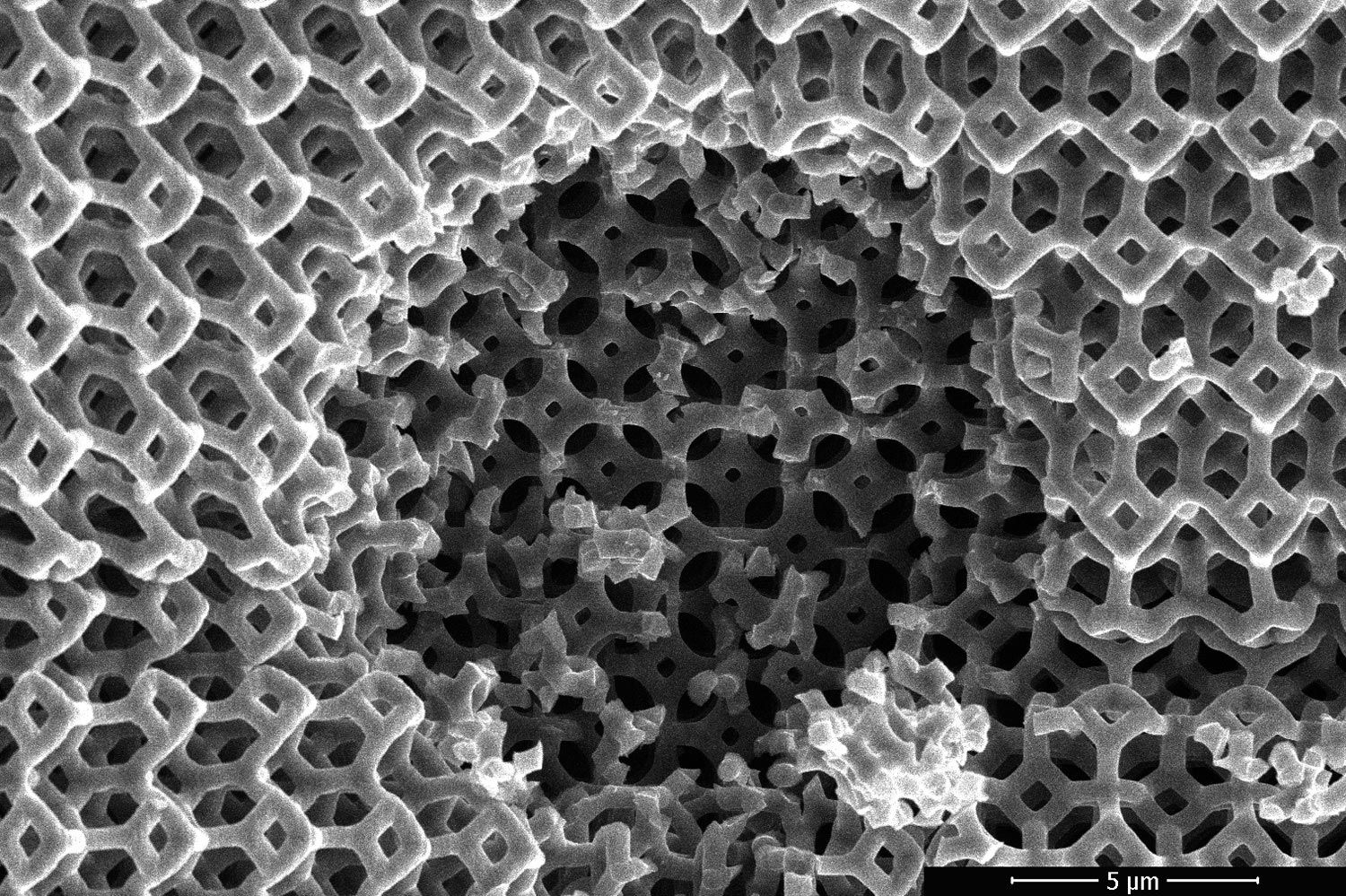
To get a closer look, the researchers carefully sliced through the embedded microparticles and the materials, and found in the region just below an embedded particle the microscopic struts and beams had crumpled and compacted in response to the impact, but the surrounding architecture remained intact.
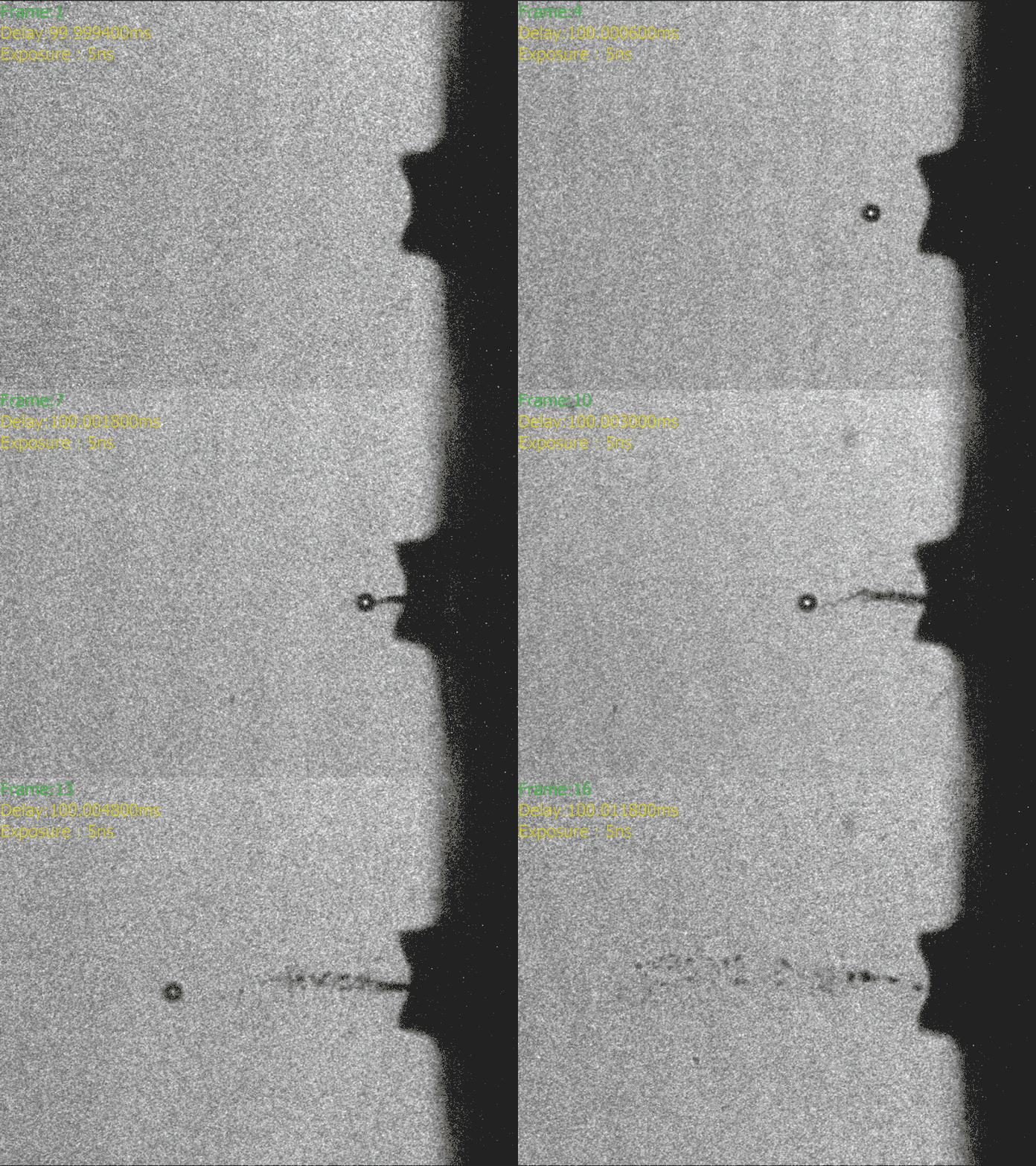

“We show the material can absorb a lot of energy because of this shock compaction mechanism of struts at the nanoscale, versus something that’s fully dense and monolithic, not nanoarchitected,” Portela says.
Interestingly, the team found they could predict the kind of damage the material would sustain by using a dimensional analysis framework for characterizing planetary impacts. Using a principle known as the Buckingham-Π theorem, this analysis accounts for various physical quantities, such as a meteor’s velocity and the strength of a planet’s surface material, to calculate a “cratering efficiency,” or the likelihood and extent to which a meteor will excavate a material.
When the team adapted the equation to the physical properties of their nanoarchitected film and the microparticles’ size and velocities, they found the framework could predict the kind of impacts that their experimental data showed.
Going forward, Portela says the framework can be used to predict the impact resilience of other nanoarchitected materials. He plans to explore various nanostructured configurations, as well as other materials beyond carbon, and ways to scale up their production — all with the goal of designing tougher, lighter protective materials.
“Nanoarchitected materials truly are promising as impact-mitigating materials,” Portela says. “There’s a lot we don’t know about them yet, and we’re starting this path to answering these questions and opening the door to their widespread applications.”
Reference: “Supersonic impact resilience of nanoarchitected carbon” by Carlos M. Portela, Bryce W. Edwards, David Veysset, Yuchen Sun, Keith A. Nelson, Dennis M. Kochmann and Julia R. Greer, 24 June 2021, Nature Materials.
DOI: 10.1038/s41563-021-01033-z
This research was supported, in part, by the U.S. Office of Naval Research, the Vannevar Bush Faculty Fellowship, and the U.S. Army Research Office through the Institute for Soldier Nanotechnologies at MIT.
Never miss a breakthrough: Join the SciTechDaily newsletter.
Follow us on Google and Google News.
7 Comments
Next to get it repair itself. This would be great to use for materials on spacesuits and spacecraft.
Condoms
You want a real test make me a pair of boots. Trust me that would be the ultimate test. How long it takes me to destroy them through normal use. Yes how long, not if. 3 months and I’d be impressed.
I wish I had a suit of this before my body got destroyed 😪
You can be sure Biden will night hippo and give it to the Chinese… You know, out ‘pals.”)
So it’s a mini cardboard box.
Imagine having a phone screen out of this material, you would never have to worry about dropping your phone or screen protectors.