
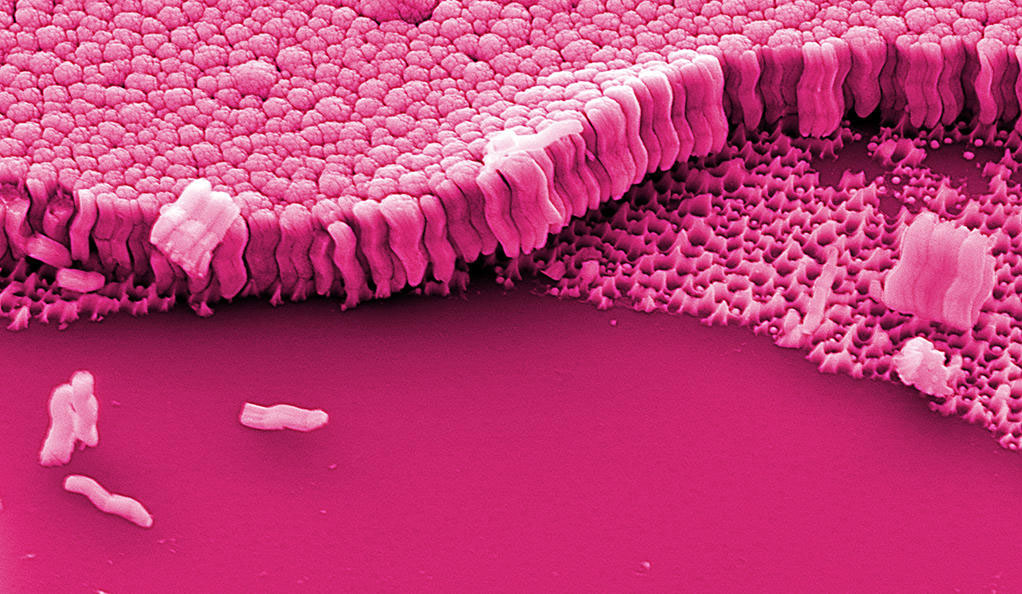
By shrinking samples of metallic glass to nanoscale size, Yale scientists have discovered they can create new materials with potentially new applications.
The research, published today in Nature Communications, was conducted as part of Yale’s Center for Research on Interface Structures and Phenomena (CRISP), and led by Judy Cha, the Carol and Douglas Melamed Assistant Professor of Mechanical Engineering & Materials Science, and Jan Schroers, professor of mechanical engineering & materials science.
Metallic glasses are a relatively new class of materials made from complex, multicomponent alloys. They have the moldable pliability of plastics, but the strengths of metals. When metallic glasses cool from a liquid to a solid, their atoms settle into a random arrangement and do not crystallize the way traditional metals do. Cha said they discovered a new form of metallic glasses by making metallic-glass rods so small that there is no room for the nuclei — a phenomenon the researchers call “nucleus starvation” — leading to a new crystalline phase. The rods are less than 35 nanometers in diameter, more than 2,000 times smaller than a human hair.
“This gives us a handle to control the number of nuclei we provide in the sample,” said Cha, who works in the Energy Sciences Institute on Yale’s West Campus. “When it doesn’t have any nuclei — despite the fact that nature tells us that there should be one — it generates this brand new crystalline phase that we’ve never seen before. It’s a way to create a new material out of the old.”
The researchers used the Transmission Electron Microscope at the Yale Institute for Nanoscience and Quantum Engineering to observe the crystallization process in the materials. By controlling the diameter of the metallic-glass nanorods, the researchers were able to tune the number of nuclei present and tailor the crystalline phases.
“As we were doing this, more and more interesting phenomena popped up,” Cha said. “We’re unearthing all these interesting phenomena that occur at the nanoscale.”
Metallic glasses are already being used for a number of applications, including phone casings and golf clubs, but there is still much for researchers to learn about these materials. Cha said one of the next steps is to learn more about this new crystalline phase, how to better control it, and what kinds of properties can result from it. The discovery also opens up new possibilities for different chemical compounds that have already been developed by conventional methods, she said.
“We don’t really know a lot about these systems, and when we work with them in smaller, nanometer scales, then a new science and a new physics emerge,” she said. “That’s exciting because it tells us that there are these new playgrounds emerging that we simply haven’t paid much attention to before, and that there is still more to be explored.”
The study’s other authors are Sungwoo Sohn, Yujun Xie, and Yeonwoong Jung, all from Yale.
Reference: “Tailoring crystallization phases in metallic glass nanorods via nucleus starvation” by Sungwoo Sohn, Yujun Xie, Yeonwoong Jung, Jan Schroers and Judy J. Cha, 7 December 2017, Nature Communications.
DOI: 10.1038/s41467-017-02153-4
Never miss a breakthrough: Join the SciTechDaily newsletter.
Follow us on Google and Google News.
2 Comments
If the number of nuclei is reduced then don’t those that remain have to support more electrons? Do the remaining nuclei obtain a corresponding number of additional protons? It seems this would result in completely new atoms with fundamentally different properties.
Metallic glasses are a relatively new class.