
Close Menu
    Facebook X (Twitter) Instagram
    SciTechDaily
    • Biology
    • Chemistry
    • Earth
    • Health
    • Physics
    • Science
    • Space
    • Technology
    Facebook X (Twitter) Pinterest YouTube RSS
    SciTechDaily
    Home»Space»NASA’s Solar Dynamics Observatory Captures Filament Explosion
    Space

    NASA’s Solar Dynamics Observatory Captures Filament Explosion

    By SciTechDailySeptember 5, 20122 Comments2 Mins Read
    Facebook Twitter Pinterest Telegram LinkedIn WhatsApp Email Reddit
    Share
    Facebook Twitter LinkedIn Pinterest Telegram Email Reddit
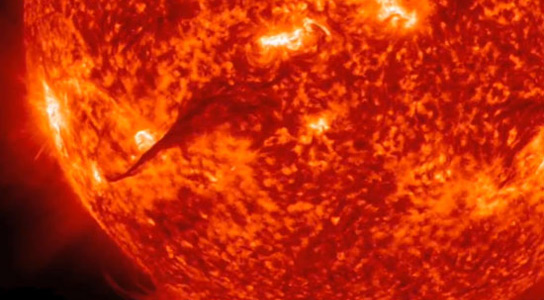
    filament-eruption-aug-31-2012
    Filament eruption from the Sun.

    NASA’s Solar Dynamics Observatory has captured a spectacular video of a filament eruption from Sol, which occurred on August 31st. The segment is in red, and while the video lasts only a few seconds, the actual time period is about three hours.

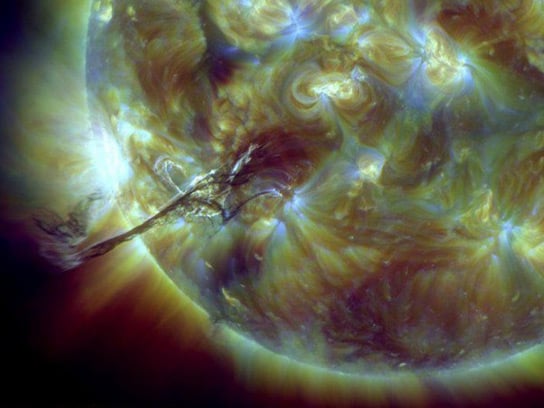
    The rest of the video is shown in extreme ultraviolet light to showcase the explosive event. These kinds of solar filaments are caused when the magnetic field in the solar atmosphere holds solar plasma between the chromosphere into the corona.
    extreme-uv-still-solar-flare

    Despite what looks like a massive filament explosion, the NOAA space weather prediction center expected only a minor to moderate resulting geomagnetic storm when the radiation cloud hit Earth. That happened during the Labor Day holiday (September 3), and it turned out to be an accurate prediction.

    The filament came from Sunspot AR1560 and the coronal mass ejection (CME) was a C8-class solar flare, which traveled faster than 500 km/s (1.1 million mph). The cloud wasn’t directly heading toward Earth.

    The explosion occurred in Sol’s southeast quadrant. The solar X-ray flux values almost reached the M-class flare threshold. There could be another M-class flare soon. NOAA/SWPC forecasters that there’s a 40% chance for more flares. The most active sunspots are AR 1560 and AR 1563.


    On August 31, 2012, a filament collapsed in a spectacular way and I caught the action in dramatic detail in extreme ultraviolet light. Long filaments like this one have been known to collapse with explosive results when they hit the stellar surface below. The segment in the 304 angstroms wavelength (red Sun) covers almost 3 hours. Credit: NASA SDO

    Never miss a breakthrough: Join the SciTechDaily newsletter.
    Follow us on Google and Google News.

    Astronomy Coronal Mass Ejections NASA Space Weather Sun
    Share. Facebook Twitter Pinterest LinkedIn Email Reddit

    Related Articles

    NASA’s ACE Mission: Total Solar Eclipses Shine a Light on the Solar Wind

    Solar Orbiter Images First Coronal Mass Ejections – See the Stunning Videos From Multiple Instruments

    NASA’s SDO Reveals Images of X4.9-Class Solar Flare

    Sun’s Magnetic Field Weaker Than a Normal Fridge Magnet

    NASA Looks at the Impacts of Strong Solar Flares

    NASA Captures Image of an M6.5 Class Flare

    Image of Magnetic Loops on the Sun

    New Light Shed on the Origins of Extreme Space Storms

    Two Coronal Mass Ejections Strongly Compressed the Magnetopause

    2 Comments

    1. Vidmate on August 24, 2020 3:04 am

      But with gender norms and stereotypes becoming less and less relevant, there’s no better time to ask out that long-legged lady.

      Reply
    2. TutuApp on August 24, 2020 3:05 am

      One lasting dating taboo is that a man should always be taller than his partner–or, at the very least, the same height.

      Reply
    Leave A Reply Cancel Reply

    • Facebook
    • Twitter
    • Pinterest
    • YouTube

    Don't Miss a Discovery

    Subscribe for the Latest in Science & Tech!

    Trending News

    The Universe Is Expanding Too Fast and Scientists Can’t Explain Why

    “Like Liquid Metal”: Scientists Create Strange Shape-Shifting Material

    Early Warning Signals of Esophageal Cancer May Be Hiding in Plain Sight

    Common Blood Pressure Drug Shows Surprising Power Against Deadly Antibiotic-Resistant Superbug

    Scientists Uncover Dangerous Connection Between Serotonin and Heart Valve Disease

    Scientists Discover a “Protector” Protein That Could Help Reverse Hair Loss

    Bone-Strengthening Discovery Could Reverse Osteoporosis

    Scientists Uncover Hidden Trigger Behind Stem Cell Aging

    Follow SciTechDaily
    • Facebook
    • Twitter
    • YouTube
    • Pinterest
    • Newsletter
    • RSS
    SciTech News
    • Biology News
    • Chemistry News
    • Earth News
    • Health News
    • Physics News
    • Science News
    • Space News
    • Technology News
    Recent Posts
    • Forgotten Medicinal Plant Shows Promise in Fighting Dangerous Superbugs
    • Millions Take These IBS Drugs, But a New Study Finds Serious Risks
    • 5 Common Myths About Learning a New Language, Debunked
    • The Neanderthal “Love Story” Isn’t What It Seems
    • Scientists Unlock Hidden Secrets of 2,300-Year-Old Mummies Using Cutting-Edge CT Scanner
    Copyright © 1998 - 2026 SciTechDaily. All Rights Reserved.
    • Science News
    • About
    • Contact
    • Editorial Board
    • Privacy Policy
    • Terms of Use

    Type above and press Enter to search. Press Esc to cancel.