
Close Menu
    Facebook X (Twitter) Instagram
    SciTechDaily
    • Biology
    • Chemistry
    • Earth
    • Health
    • Physics
    • Science
    • Space
    • Technology
    Facebook X (Twitter) Pinterest YouTube RSS
    SciTechDaily
    Home»Physics»Chinese Breakthrough in High-Pressure Superconducting Magnetic Detection
    Physics

    Chinese Breakthrough in High-Pressure Superconducting Magnetic Detection

    By Chinese Academy of SciencesMarch 23, 2023No Comments3 Mins Read
    Facebook Twitter Pinterest Telegram LinkedIn WhatsApp Email Reddit
    Share
    Facebook Twitter LinkedIn Pinterest Telegram Email Reddit
    Breakthrough in High-Pressure Magnetic Detection
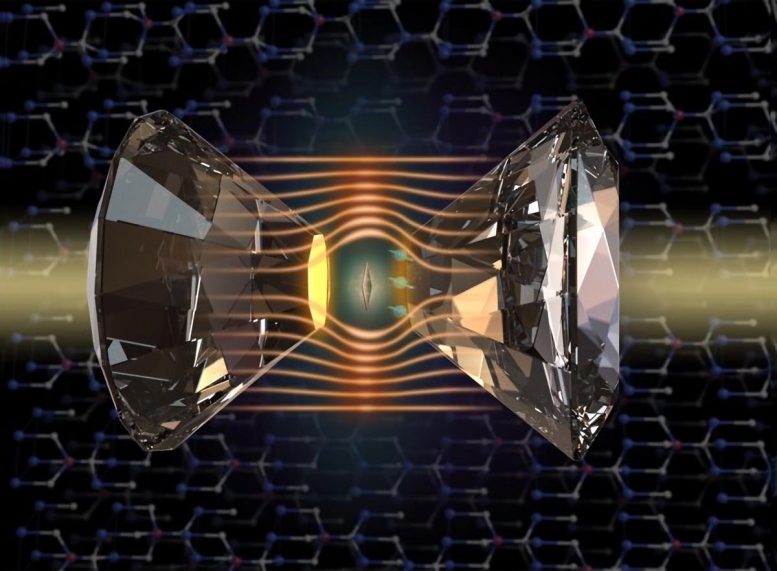
    A joint research team has created a platform to investigate superconducting magnetic detection and magnetic phase transitions in hydrides under high pressure. Credit: HFIPS

    Silicon carbide VSi defects allow for highly accurate in-situ magnetic detection at high pressure, facilitating breakthroughs in the analysis of superconductivity and magnetic phase transitions, while resolving temperature sensitivity challenges inherent in diamond NV centers.

    A collaborative research team has developed a research platform to study superconducting magnetic detection and magnetic phase transitions of hydrides under high pressure. This is according to a study published today (March 23) in the journal Nature Materials, with the scientists hailing from the Hefei Institutes of Physical Science of the Chinese Academy of Sciences (CAS) and the University of Science and Technology of China.

    High-resolution in-situ magnetic measurement under high pressure has been a challenge. It has limited the progress of research on the Meissner effect of superconductivity and on magnetic phase transition behavior under high pressure. Using the optically detected magnetic resonance (ODMR) technique on diamond nitrogen vacancy (NV) centers has helped in-situ detection of pressure-induced magnetic phase transitions. However, it is not convenient to analyze and interpret the measured ODMR spectra because the NV center has four axial directions and zero-field splitting is temperature dependent.

    Silicon Vacancy Defects: A Novel Approach

    In this study, the researchers have for the first time realized high-pressure in-situ quantum magnetic detection based on the silicon vacancy (VSi) defects in silicon carbide and solved the problem of high-pressure magnetic detection.
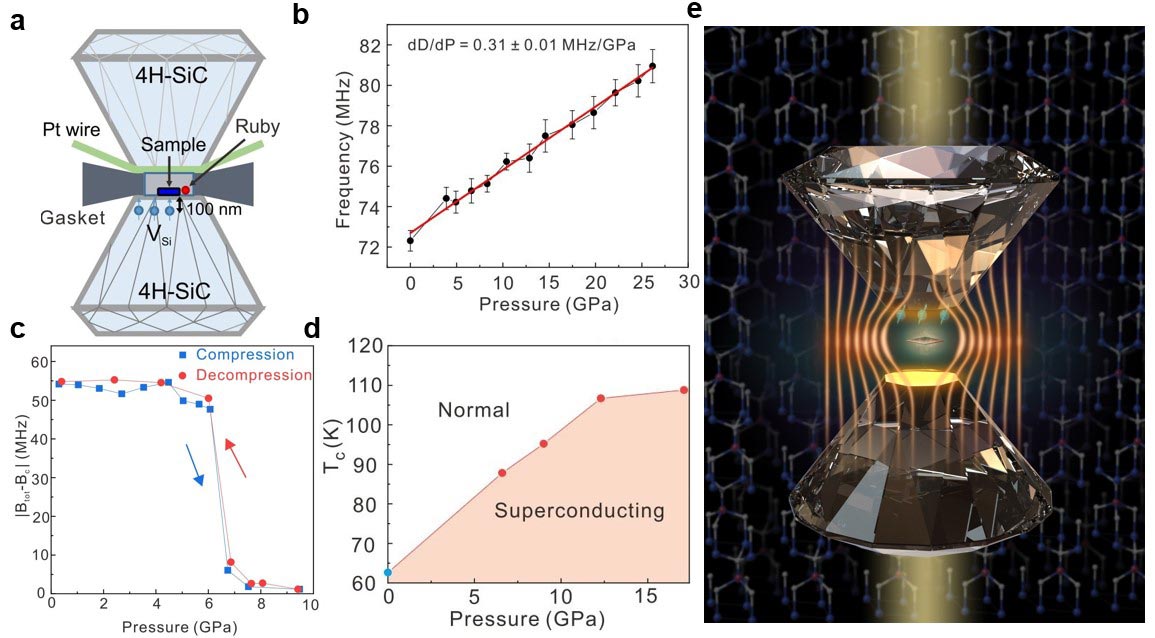
    Designed Silicon Vacancy in Moissanite Anvil Cell
    a. Schematic diagram of moissanite anvil cell and detection of magnetic samples by shallow silicon vacancy defects; b. Relationship of zero-field splitting of silicon vacancy defects with pressure; c. Magnetic phase transition detection of Nd2Fe14b materials; d. Tc-P phase diagram of YBCO superconducting material; e. Illustration of high-pressure in-situ magnetic detection based on silicon vacancy defects in silicon carbide. Credit: HFIPS

    The researchers used ion implantation to generate shallow VSi defects on the surface of a processed silicon carbide anvil cell. VSi defects in silicon carbide have only one axial direction. Due to the special symmetry of silicon carbide’s electronic structure, zero-field splitting is insensitive to temperature, thus the problem of temperature variations in high-pressure sensing can be avoided.

    Stability and Sensitivity of VSi Defects

    The researchers found that the spectrum of VSi defects shifted blue and the zero-field splitting value varied little with pressure (0.31 MHz/GPa)—much less than the slope of diamond NV centers (14.6 MHz/GPa). This is helpful for the measurement and analysis of ODMR spectra under high pressure.

    By using ODMR technology on VSi defects, the researchers observed the pressure-induced magnetic phase transition of Nd2Fe14B magnets at about seven GPa, and measured the critical temperature-pressure phase diagram of the YBa2Cu3O6.6 superconductor.

    This technique is of great significance to the field of high-pressure superconductivity and magnetic materials, according to the researchers.

    By demonstrating the use of room-temperature spin-defects in silicon carbide as in-situ high pressure sensors, this work opens the door to new studies of quantum materials using Moissanite anvil cells.

    Reference: “Magnetic detection under high pressures using designed silicon vacancy centres in silicon carbide” by Jun-Feng Wang, Lin Liu, Xiao-Di Liu, Qiang Li, Jin-Ming Cui, Di-Fan Zhou, Ji-Yang Zhou, Yu Wei, Hai-An Xu, Wan Xu, Wu-Xi Lin, Jin-Wei Yan, Zhen-Xuan He, Zheng-Hao Liu, Zhi-He Hao, Hai-Ou Li, Wen Liu, Jin-Shi Xu, Eugene Gregoryanz, Chuan-Feng Li and Guang-Can Guo, 23 March 2023, Nature Materials.
    DOI: 10.1038/s41563-023-01477-5

    This study was supported by the National Natural Science Foundation of China, the Youth Promotion Association of CAS, and the Innovation Foundation of CAS, among others.

    Never miss a breakthrough: Join the SciTechDaily newsletter.
    Follow us on Google and Google News.

    Chinese Academy of Sciences Materials Science Popular Quantum Materials Superconductivity
    Share. Facebook Twitter Pinterest LinkedIn Email Reddit

    Related Articles

    Decoding Superconductivity: Quantum Simulator Unlocks Antiferromagnetic Mystery

    Shattered Dreams: Scientists Debunk LK-99 Room Temperature Superconductivity Myth

    Physicists Uncover New Mechanism Enabling Magnetism and Superconductivity to Co-exist in the Same Material

    Scientists Overhear Two Atoms Chatting: Magnetic Quantum Interactions

    Signs of a Puzzling State of Matter Discovered in a Superconductor

    A New Class of Superconductors: Commonly Mistaken Name Leads to Discovery

    A New Kind of Magnetism Formed by “Magnetic Graphene” – Could Reveal Secrets of Superconductivity

    “The Biggest Bang” – Physicists Create Tunable Superconductivity in Twisted Graphene “Nanosandwich”

    New Insights Into How Superconducting Materials Interact With Magnetic Ones

    Leave A Reply Cancel Reply

    • Facebook
    • Twitter
    • Pinterest
    • YouTube

    Don't Miss a Discovery

    Subscribe for the Latest in Science & Tech!

    Trending News

    Largest-Ever Study Finds Medicinal Cannabis Ineffective for Anxiety, Depression, PTSD

    250-Million-Year-Old Egg Solves One of Evolution’s Biggest Mysteries

    Living With Roommates Might Be Changing Your Gut Microbiome Without You Knowing

    Century-Old Cleaning Chemical Linked to 500% Increased Risk of Parkinson’s Disease

    What if Your Memories Never Happened? Physicists Take a New Look at the Boltzmann Brain Paradox

    One of the Universe’s Largest Stars May Be Getting Ready To Explode

    Scientists Discover Enzyme That Could Supercharge Ozempic-Like Weight Loss Drugs

    Popular Sweetener Linked to DNA Damage – “It’s Something You Should Not Be Eating”

    Follow SciTechDaily
    • Facebook
    • Twitter
    • YouTube
    • Pinterest
    • Newsletter
    • RSS
    SciTech News
    • Biology News
    • Chemistry News
    • Earth News
    • Health News
    • Physics News
    • Science News
    • Space News
    • Technology News
    Recent Posts
    • What Did Prehistoric Europeans Eat? Scientists Uncover Surprising Answers
    • Scientists Say This Overlooked Organ Could Hold the Key to Longer Life
    • Want Less Stress? Landmark Study Points to a Simple Habit
    • Scientists Reveal Eating Fruits and Vegetables May Increase Your Risk of Lung Cancer
    • AI Reveals Explosive Growth of Floating Algae Across the World’s Oceans
    Copyright © 1998 - 2026 SciTechDaily. All Rights Reserved.
    • Science News
    • About
    • Contact
    • Editorial Board
    • Privacy Policy
    • Terms of Use

    Type above and press Enter to search. Press Esc to cancel.