
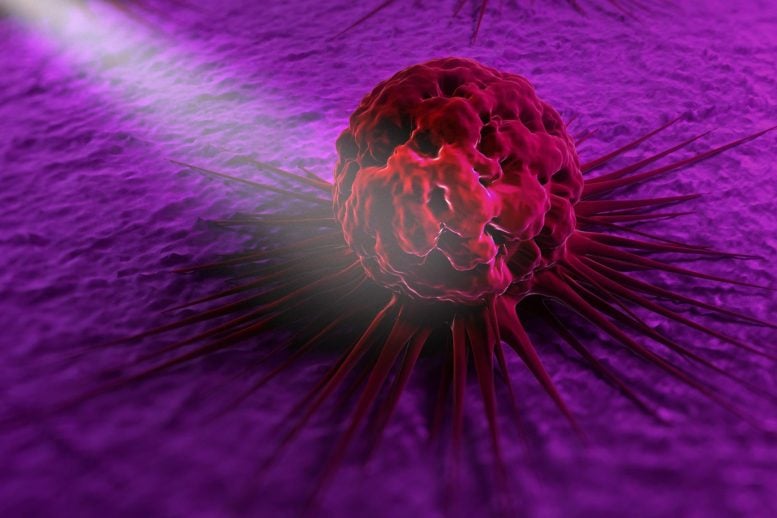
Light-activated immunotherapies may revolutionize cancer treatment by targeting only tumor cells with minimal side effects.
Scientists at the University of East Anglia (UEA) are a step closer to creating a new generation of light-activated cancer treatments.
The futuristic-sounding treatment would work by switching on LED lights embedded close to a tumor, which would then activate biotherapeutic drugs.
These new treatments would be highly targeted and more effective than current state-of-the-art cancer immunotherapies.
New research published today reveals the science behind this innovative idea.
It shows how the UEA team has engineered antibody fragments — which not only ‘fuse’ with their target but are also light activated.
It means that in the future, immunotherapy treatments could be engineered to attack tumors more precisely than ever before.
The principal scientist for this study, Dr. Amit Sachdeva, from UEA’s School of Chemistry, said: “Current cancer treatments like chemotherapy kill cancer cells, but they can also damage healthy cells in your body such as blood and skin cells.
“This means that they can cause side effects including hair loss, feeling tired and sick, and they also put patients at increased risk of picking up infections.
“There has therefore been a very big drive to create new treatments that are more targeted and don’t have these unwanted side-effects.
“Several antibodies and antibody fragments have already been developed to treat cancer. These antibodies are much more selective than the cytotoxic drugs used in chemotherapy, but they can still cause severe side effects, as antibody targets are also present on healthy cells.”
Light-Activated Antibody Fragments
Now, the UEA team has engineered one of the first antibody fragments that binds to, and forms a covalent bond with, its target — upon irradiation with UV light of a specific wavelength.
Dr. Sachdeva said: “A covalent bond is a bit like melting two pieces of plastic and fusing them together. It means that drug molecules could for example be permanently fixed to a tumor.
“We hope that our work will lead to the development of a new class of highly targeted light-responsive biotherapeutics. This would mean that antibodies could be activated at the site of a tumor and covalently stick to their target upon light activation.
“In other words, you could activate antibodies to attack tumor cells by shining light – either directly onto the skin, in the case of skin cancer, or using small LED lights that could be implanted at the site of a tumor inside the body.
“This would allow cancer treatment to be more efficient and targeted because it means that only molecules in the vicinity of the tumor would be activated, and it wouldn’t affect other cells.
“This would potentially reduce side effects for patients, and also improve antibody residence time in the body.”
Applications and Future Directions
“It would work for cancers like skin cancer, or where there is a solid tumor – but not for blood cancers like leukemia.
“Development of these antibody fragments would not have been possible without pioneering work from several other research groups across the globe who developed and optimized methods for site-specific incorporation of non-natural amino acids into proteins expressed in live cells.
“We employed some of these methods to site-specifically install unique light-sensitive amino acids into antibody fragments.”
If the researchers are successful in the next stages of their work, they hope to see the ‘next generation’ light-activated immunotherapies being used to treat cancer patients within five to 10 years.
Reference: “Site-specific encoding of photoactivity and photoreactivity into antibody fragments” by Thomas Bridge, Udo Wegmann, Jason C. Crack, Kate Orman, Saher A. Shaikh, William Farndon, Carlo Martins, Gerhard Saalbach and Amit Sachdeva, 16 February 2023, Nature Chemical Biology.
DOI: 10.1038/s41589-022-01251-9
This research was funded by the Biotechnology and Biological Sciences Research Council (BBSRC) and the Wellcome Trust. It was led by the University of East Anglia with assistance from the proteomics facility at the John Innes Centre.
Never miss a breakthrough: Join the SciTechDaily newsletter.
Follow us on Google and Google News.