

A new quantum-inspired algorithm is reshaping how scientists approach some of the most complex materials known, enabling rapid analysis of structures that were previously beyond computational reach.
Quantum technologies, including quantum computers, rely on materials that display unusual quantum effects under specific conditions. Researchers have found that these properties can also be engineered by adjusting a material’s structure. For example, stacking and slightly twisting layers of graphene creates a moiré pattern that can transform the material into a superconductor.
As scientists build increasingly intricate layered systems, they reach structures such as quasicrystals and super-moiré materials. The challenge is predicting which designs will be useful. Modeling these materials requires calculating vast amounts of data. In the case of quasicrystals, this can involve more than a quadrillion numbers, far exceeding the limits of even the most powerful supercomputers.
A Quantum-Inspired Breakthrough
Researchers at Aalto University’s Department of Applied Physics have introduced a quantum-inspired algorithm that can handle these massive, non-periodic systems with remarkable speed. According to Assistant Professor Jose Lado, this work also highlights a growing feedback loop in quantum technology.
“Crucially, these new quantum algorithms can enable the development of new quantum materials to build new paradigms of quantum computers, creating a productive two-way feedback loop between quantum materials and quantum computers,” he explains.
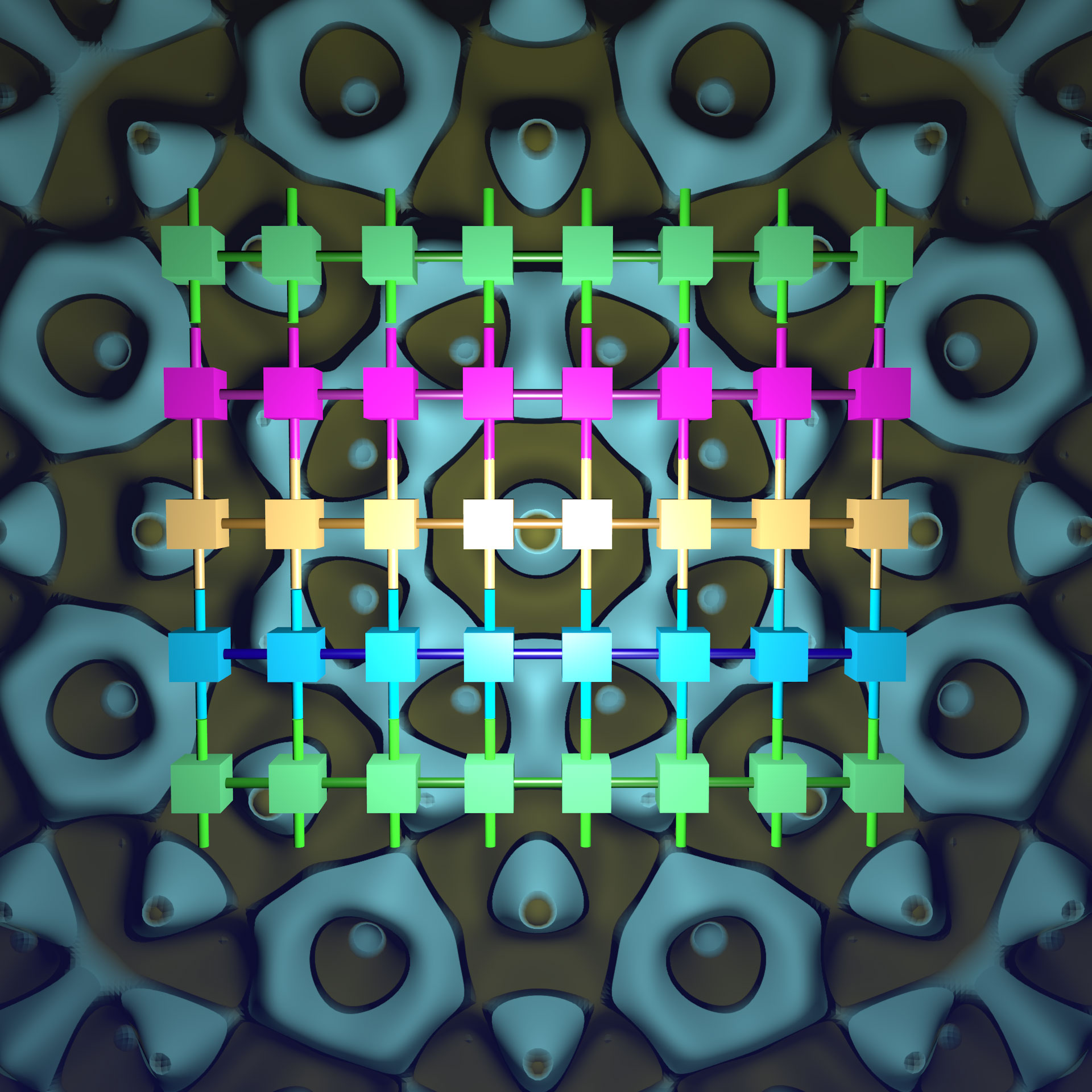
Tensor networks play a central role in this approach, as they can represent functions across extremely fine computational grids. This makes them well-suited for analyzing large-scale quantum materials. The findings could lead to dissipationless electronics, which may help reduce the heat generated by AI-driven data centers.
The research team was led by Lado and included doctoral researcher Tiago Antão, the study’s lead author, along with QDOC doctoral researcher Yitao Sun and Academy Research Fellow Adolfo Fumega. Their results were published in Physical Review Letters as an Editor’s Suggestion.
Scattered Complexity in Quasicrystals
The study focused on topological quasicrystals, which host unusual quantum excitations. These excitations help maintain electrical conductivity by protecting it from noise and interference. However, they are distributed unevenly throughout the material, making them difficult to analyze.
Rather than attempting to model the full structure directly, the researchers reformulated the problem using principles similar to those used in quantum computing.
“Quantum computers work in exponentially large computational spaces, so we used a special family of algorithms to encode those spaces, known as tensor networks, to compute a quasicrystal with over 268 million sites. Our algorithm shows how colossal problems in quantum materials can be directly solved with the exponential speed-up that comes from encoding the problem as a quantum many-body system,” Antão says.
The method has so far been tested through simulations, but experimental validation may follow.
“The quantum-inspired algorithm we demonstrated enables us to create super-moiré quasicrystals several orders of magnitude above the capabilities of conventional methods. That is an instrumental step towards designing topological qubits with super-moiré materials for use in quantum computers, for example,” Lado says.
Toward Real Quantum Computing Applications
According to Lado, the team’s algorithm could be adapted to be injected into a quantum computer.
Lado notes that the algorithm could eventually run on actual quantum computers.
“Our method can be adapted to run on real quantum computers, once they reach necessary scale and fidelity. In particular, the new AaltoQ20 and the Finnish Quantum Computing Infrastructure can play a significant role for future demonstrations,” Lado says.
The findings suggest that designing and understanding complex quantum materials could become one of the first practical uses of quantum algorithms. This work also connects two major areas of quantum research in Finland: materials science and algorithm development.
Reference: “Tensor Network Method for Real-Space Topology in Quasicrystal Chern Mosaics” by Tiago V. C. Antão, Yitao Sun, Adolfo O. Fumega and Jose L. Lado, 13 April 2026, Physical Review Letters.
DOI: 10.1103/hhdf-xpwg
The study is part of Lado’s ERC Consolidator Grant ULTRATWISTROICS, which focuses on creating topological qubits using van der Waals materials. It also contributes to the Center of Excellence in Quantum Materials (QMAT), which aims to advance quantum technologies in the coming decades.
Never miss a breakthrough: Join the SciTechDaily newsletter.
Follow us on Google and Google News.
2 Comments
R
thanks for this