
Close Menu
    Facebook X (Twitter) Instagram
    SciTechDaily
    • Biology
    • Chemistry
    • Earth
    • Health
    • Physics
    • Science
    • Space
    • Technology
    Facebook X (Twitter) Pinterest YouTube RSS
    SciTechDaily
    Home»Technology»Scientists Just Built a Quantum Battery That Charges Almost Instantly
    Technology

    Scientists Just Built a Quantum Battery That Charges Almost Instantly

    By University of MelbourneMay 3, 202618 Comments3 Mins Read
    Facebook Twitter Pinterest Telegram LinkedIn WhatsApp Email Reddit
    Share
    Facebook Twitter LinkedIn Pinterest Telegram Email Reddit
    Ultra Fast Charging Quantum Battery Energy Technology
    A new quantum battery prototype uses the strange rules of quantum physics to charge in a single rapid burst. Even more surprisingly, it charges faster as it gets larger, hinting at a radically different future for energy storage. Credit: SciTechDaily.com

    Scientists have built a quantum battery that could make charging almost instant.

    Australian researchers have achieved a major milestone in energy storage by designing and testing what is believed to be the world’s first proof-of-concept quantum battery.

    Scientists say this emerging technology could reshape how energy is stored and delivered, potentially leading to devices that charge at extremely high speeds.

    First Quantum Battery Breakthrough

    The project was led by CSIRO in partnership with the University of Melbourne and RMIT, with the findings published in Nature Light: Science & Applications. Researchers from the University of Melbourne, including Associate Professor James Hutchison and Professor Trevor Smith, played key roles in the work.

    “Similar to conventional batteries, quantum batteries charge, store, and discharge energy. But while everyday batteries rely on chemical reactions, quantum batteries leverage properties of quantum mechanics,” Associate Professor Hutchison said.

    “The advantage of quantum is that the system absorbs light in a single, giant ‘super absorption’ event and this charges the battery faster.”
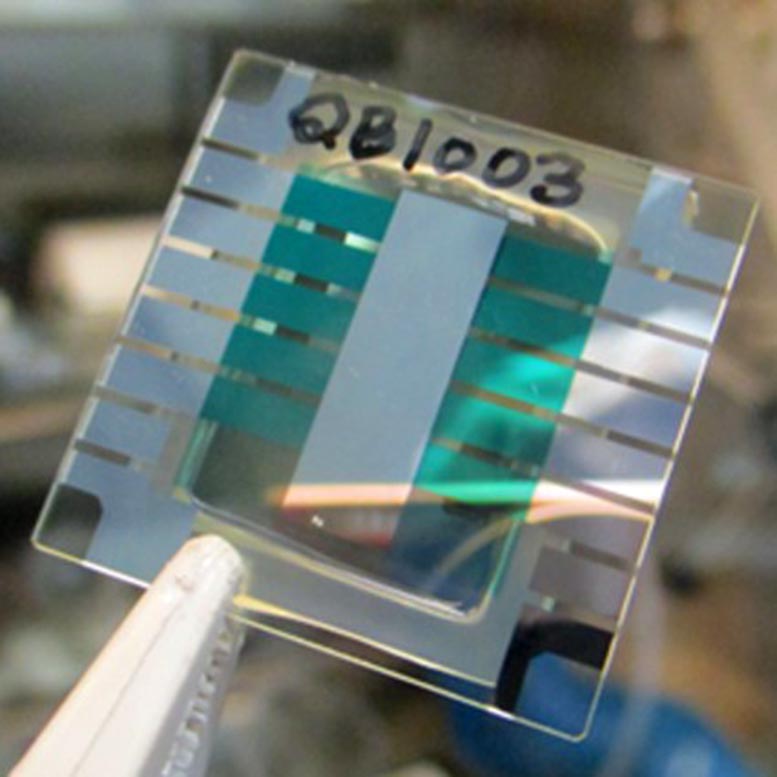
    World’s First Fully Functioning Proof of Concept Quantum Battery
    The world’s first fully functioning proof-of-concept quantum battery. Credit: CSIRO

    Ultrafast Laser Experiments Confirm Charging Speed

    To verify the prototype’s performance, the team conducted experiments at the University’s Ultrafast Laser Laboratory in the School of Chemistry. Using advanced spectroscopy methods, they were able to observe and confirm the system’s rapid charging behavior.

    “The unique capabilities of our Ultrafast Laser Lab, including dual femtosecond laser amplifiers and tunable optical parametric amplifiers, were critical in enabling us to record ultrafast signals over orders of magnitude in time,” Professor Smith said.
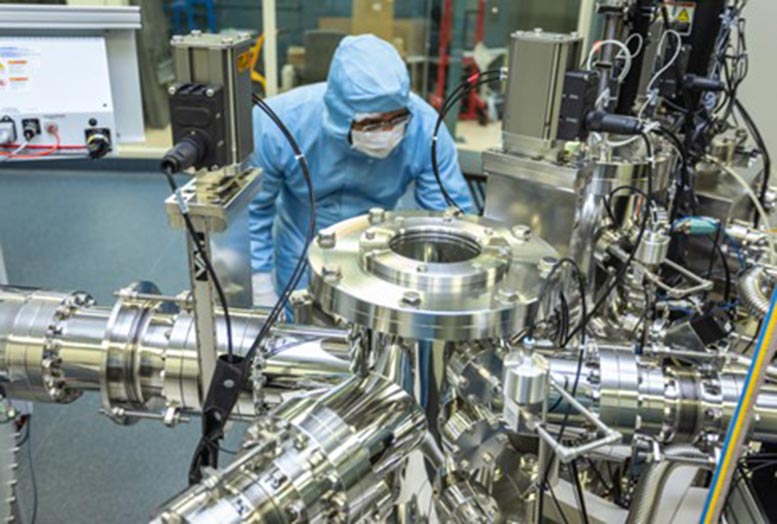
    CSIRO’s Clean Lab for Engineering Prototype Quantum Batteries
    CSIRO’s clean lab for engineering prototype quantum batteries. Credit: CSIRO

    Quantum Energy Storage and Future Applications

    The results provide an early look at how quantum-based energy storage could power future technologies.

    Dr. James Quach, quantum science and technologies science leader at CSIRO, led the team that built the prototype.

    “The research and proof-of-concept validates the exciting potential of quantum batteries to achieve rapid, scalable charging and energy storage at room temperature, laying the groundwork for next-gen energy solutions,” Dr. Quach said.

    “Our findings confirm a fundamental quantum effect that’s completely counterintuitive: quantum batteries charge faster as they get large.

    “While there’s still much work to be done in quantum battery research, we’ve made an important move towards realizing the possibilities. The next step right now for quantum batteries is extending their energy storage time.”
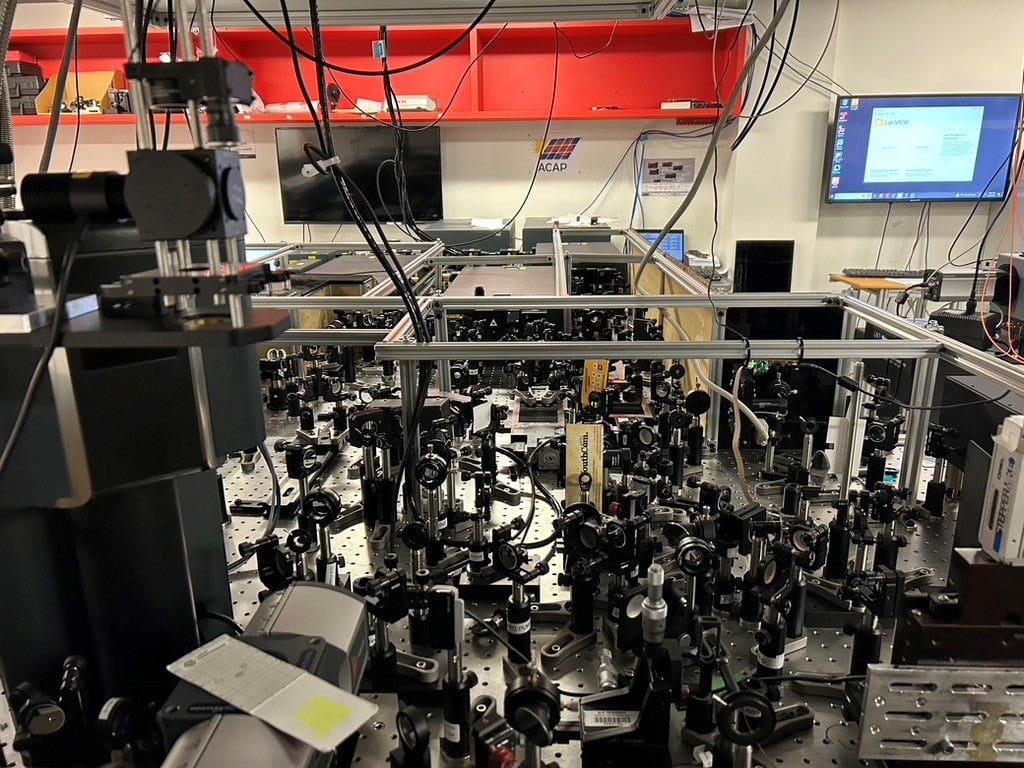
    Ultrafast Laser Laboratory University of Melbourne
    The Ultrafast Laser Laboratory in the School of Chemistry, University of Melbourne, where the quantum battery prototype was tested. Credit: Prof Trevor Smith, University of Melbourne

    Reference: “Superextensive electrical power from a quantum battery” by Kieran Hymas, Jack B. Muir, Daniel Tibben, Joel van Embden, Tadahiko Hirai, Christopher J. Dunn, Daniel E. Gómez, James A. Hutchison, Trevor A. Smith and James Q. Quach, 13 March 2026, Light: Science & Applications.
    DOI: 10.1038/s41377-026-02240-6

    Never miss a breakthrough: Join the SciTechDaily newsletter.
    Follow us on Google and Google News.

    Battery Technology Energy Popular Quantum Mechanics University of Melbourne
    Share. Facebook Twitter Pinterest LinkedIn Email Reddit

    Related Articles

    Supercapacitors Challenge Batteries: Powerful Graphene Hybrid Material for Highly Efficient Energy Storage

    New Technology Improves Next-Generation Aqueous Flow Batteries

    Cracking the Code of a Scientific Anomaly: Decades-Old Mystery of Lithium-Ion Battery Storage Solved

    Battery Breakthrough to Give Flight to Electric Aircraft and Boost Long-Range Electric Cars

    Powering the Future: New Room-Temperature Liquid-Metal Battery

    Rival Emerges to Lithium-Ion Batteries: New Potassium Metal Technology

    New Battery Can Self-Charge Without Losing Energy

    Next-Generation Energy Storage Breakthrough: Fast-Charging, Long-Running, Flexible

    New Aluminum Batteries Increase the Range of UUVs Tenfold

    18 Comments

    1. Sid Fein on May 4, 2026 6:09 am

      What kind of output can we expect? How about leakage?

      Reply
      • Grand prior on May 6, 2026 2:37 pm

        Warning 2….are u sure?? Il come for arvix

        This isnt YOUR tech property of Vatican and grand priory of free and initiatied Yeoman

        Reply
    2. kamir bouchareb st on May 4, 2026 2:06 pm

      thanks for this

      Reply
    3. Niki Louviere on May 4, 2026 3:56 pm

      Thank God! I want one for my cell phone.

      Reply
      • John on May 4, 2026 9:08 pm

        That would be amazing and for cars.

        Reply
        • Andy on May 6, 2026 7:29 am

          You’d think this could be used to harness short bursts of fusion energy output.

          Reply
    4. John on May 4, 2026 9:08 pm

      I want one too 😍

      Reply
      • Jack on May 5, 2026 1:28 pm

        You still have to put in at least as much energy as you hope to get out. (And hundreds of times as fast.)

        Reply
    5. Alan on May 5, 2026 2:16 am

      We still haven’t got commercially available solid state batteries so maybe we will see these in 30yrs

      Reply
    6. Rashid Hassan on May 5, 2026 5:08 am

      Its would change our livings.

      Reply
    7. Boba on May 5, 2026 8:09 am

      I’ll believe that when I see it in stores. Until then, keep it going, sci-fi-tech-daily.

      Reply
    8. Old Mike on May 5, 2026 9:25 am

      Typical Science article of today! …… explains nothing!

      Reply
    9. Homer10 on May 5, 2026 11:16 am

      Instant charging of anything is physically impossible. Now, if you want to charge a 40KWH battery real fast, then you have to shove a far greater amount of power into the battery to get it to charge. So, if you want to charge a 40KWH battery in 6 minutes, you would need 400KW of capacity to support this kind of charge rate. If you want to charge the battery in 1 minute, that would take a capacity of 2.4 MEGA WATT !!!!! capacity. That is the power consumption of a medium sized town. Nope! Not going to happen.

      Reply
      • Alan hays on May 5, 2026 1:11 pm

        Complete layperson here. But isn’t your argument a little like saying a horseless carriage won’t work because it has no feet? Maybe this battery in the article bypasses typical battery charging rules? Again, I’m just asking. Quantum rules seem to follow a different approach.

        Reply
        • yara on May 5, 2026 4:57 pm

          no. Homer’s scenario says: charging energy has to equal the energy in. 40 KWH in 6 minutes at 100% effieciency 400 KW for a tenth of an hour (6 minutes).

          Reply
    10. Steven Heizmann CPA on May 5, 2026 7:36 pm

      Couldn’t a unit of this be considered money if you could split it into a unit?

      Reply
    11. Hippocritter on May 7, 2026 1:07 am

      Let me guess, another amazing battery we as a consumer will never see because it won’t make a company infinite money and also would make us to independent -_-‘

      Reply
    12. CommonSense on May 7, 2026 5:22 pm

      Amazing how an article comes out with these wild ( and totally BS) claims every week, yet we never seem to see these things make it into production of real products!

      Reply
    Leave A Reply Cancel Reply

    • Facebook
    • Twitter
    • Pinterest
    • YouTube

    Don't Miss a Discovery

    Subscribe for the Latest in Science & Tech!

    Trending News

    Mezcal “Worm” in a Bottle Mystery: DNA Testing Reveals a Surprise

    New Research Reveals That Your Morning Coffee Activates an Ancient Longevity Switch

    This Is What Makes You Irresistible to Mosquitoes

    Shockingly Powerful Giant Octopuses Ruled the Seas 100 Million Years Ago

    Scientists Stunned by New Organic Molecules Found on Mars

    Rewriting Dinosaur Evolution: Scientists Unearth Remarkable 150-Million-Year-Old Stegosaur Skull

    Omega-3 Supplements Linked to Cognitive Decline in Surprising New Study

    First-of-Its-Kind Discovery: Homer’s Iliad Found Embedded in a 1,600-Year-Old Egyptian Mummy

    Follow SciTechDaily
    • Facebook
    • Twitter
    • YouTube
    • Pinterest
    • Newsletter
    • RSS
    SciTech News
    • Biology News
    • Chemistry News
    • Earth News
    • Health News
    • Physics News
    • Science News
    • Space News
    • Technology News
    Recent Posts
    • Male Birth Control Breakthrough: Scientists Find Way To Turn Sperm Production Off and Back On
    • A Common Vitamin Could Hold the Key to Treating Fatty Liver Disease
    • New Research Shows Vitamin B12 May Hold the Key to Healthy Aging
    • Scientists Map Thousands of Brain Connections With RNA Barcodes
    • This Gene Tweak Turns Strawberries Into Healthier, Tastier Superfruit
    Copyright © 1998 - 2026 SciTechDaily. All Rights Reserved.
    • Science News
    • About
    • Contact
    • Editorial Board
    • Privacy Policy
    • Terms of Use

    Type above and press Enter to search. Press Esc to cancel.