
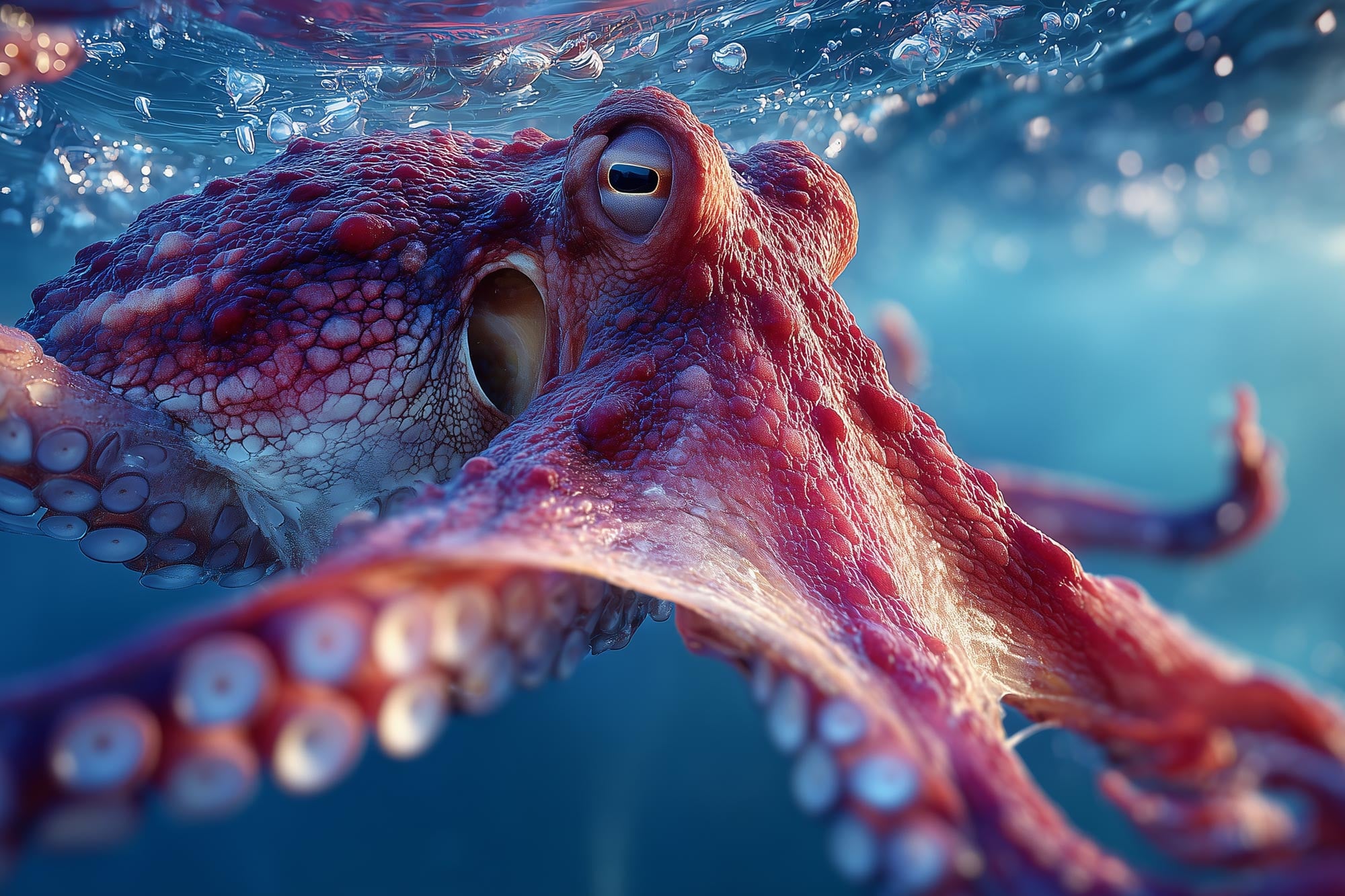
Giant, intelligent octopuses may have once ruled the ancient seas.
Modern octopuses are known for their intelligence and flexibility, living in reefs, squeezing into crevices, or drifting through deep ocean waters. However, new research suggests their earliest ancestors played a much more dominant role in marine ecosystems. A study led by Hokkaido University reports that the first known octopuses were massive predators that occupied the very top of the food chain, alongside large marine vertebrates. The findings were published in Science on 23 April 2026.
Because octopuses lack hard parts like bones or shells, they rarely leave behind fossils. This has made it difficult to trace their evolutionary history. To address this, researchers focused on fossilized jaws, which are more likely to be preserved, to better understand early octopus evolution.
Using high resolution grinding tomography and an artificial intelligence model, the team identified fossil jaws embedded in rock samples from the Late Cretaceous period, dating from 100 to 72 million years ago. These specimens, discovered in Japan and Vancouver Island, were preserved in calm seafloor sediments and retained detailed wear marks that provided insight into feeding behavior.
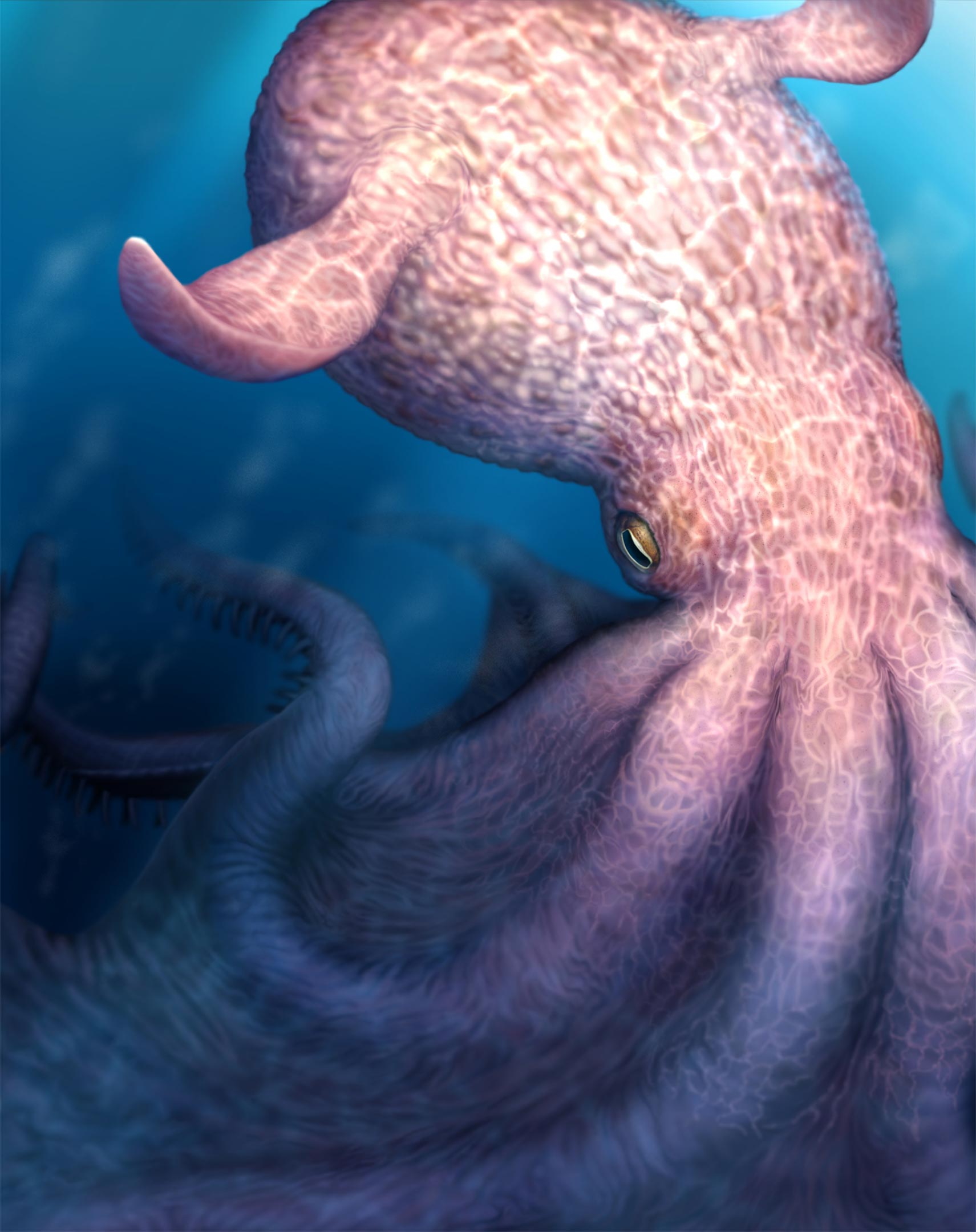
Giant Predators with Powerful Jaws
The fossils came from an extinct group of finned octopuses called Cirrata. By studying the size, shape, and wear patterns of the jaws, researchers determined that these animals were active predators that likely crushed hard prey with strong bites.
“Our findings suggest that the earliest octopuses were gigantic predators that occupied the top of the marine food chain in the Cretaceous,” says Professor Yasuhiro Iba of Hokkaido University. “Based on exceptionally well-preserved fossil jaws, we show that these animals reached total lengths of up to nearly 20 meters, which may have surpassed the size of large marine reptiles of the same age.”
“The most surprising finding perhaps was the extent of wear on the jaws,” says Iba. The fossils showed heavy chipping, scratching, cracking, and polishing, all evidence of powerful biting.
“In well-grown specimens, up to 10% of the jaw tip relative to the total jaw length had been worn away, which is larger than that seen in modern cephalopods that feed on hard-shelled prey. This indicates repeated, forceful interactions with their prey, revealing an unexpectedly aggressive feeding strategy.” These results point to ancient octopuses as strong, active hunters that consumed plentiful prey.
Digital fossil-mining of an octopus jaw fossil that enabled precise visualization of its fine structures by using zero-shot learning AI. Credit: Shin Ikegami, Kanta Sugiura, Yasuhiro Iba, Jörg Mutterlose, Yusuke Takeda, Mehmet Oguz Derin, Aya Kubota, Kazuki Tainaka, Harufumi Nishida
Evolutionary Impact and Behavioral Complexity
This discovery reshapes scientific understanding of early octopus evolution. The fossils push back the earliest record of finned octopuses by about 15 million years and extend the broader octopus timeline by roughly 5 million years, placing their origins around 100 million years ago.
Another notable finding was uneven wear on the jaws. In the two species studied, one side of the biting surface showed more wear than the other, suggesting these animals may have favored one side when feeding. This type of asymmetry, known as lateralization, is linked in modern animals to advanced neural processing. The findings indicate that early octopuses may already have exhibited complex, intelligence-related behavior.
For many years, scientists believed ancient marine ecosystems were dominated by vertebrate predators, with invertebrates occupying lower positions in the food chain. These results challenge that view by showing that giant octopuses were an exception, rising to the highest level of the food web and competing with large vertebrates.
“This study provides the first direct evidence that invertebrates could evolve into giant, intelligent apex predators in ecosystems that have been dominated by vertebrates for about 400 million years. Our findings show that powerful jaws and the loss of superficial skeletons, common characteristics of octopuses and marine vertebrates, were essential to becoming huge, intelligent marine predators” says Iba.
Future Discoveries and Ecosystem Insights
This research opens new possibilities for reconstructing ancient marine ecosystems in greater detail. By combining digital fossil mining with artificial intelligence, scientists expect to uncover many more hidden fossils.
Reference: “Earliest octopuses were giant top predators in Cretaceous oceans” by Shin Ikegami, Jörg Mutterlose, Kanta Sugiura, Yusuke Takeda, Mehmet Oguz Derin, Aya Kubota, Kazuki Tainaka, Takahiro Harada, Harufumi Nishida and Yasuhiro Iba, 23 April 2026, Science.
DOI: 10.1126/science.aea6285
This work was supported by Japan Society for the Promotion of Science grants 22J13936, 23K17274, 19H02010, 22H02937, 23H02544, and 25K22459; Japan Aerospace Exploration Agency grant JX-PSPC-540452; and The Canon Foundation 2
Never miss a breakthrough: Join the SciTechDaily newsletter.
Follow us on Google and Google News.
4 Comments
Could there still be bigger octopus that live in remote places, given how little of the ocean has been explored
“Could” only implies a low-probability event that is not impossible. If there are, why would they stay there? If the populations expand, which is common for successful species, it would be reasonable that some individuals would venture beyond their refugia in a search for more abundant prey. Even if the population were stable, every individual will eventually die. Some of those may float out of their ‘hiding place,’ thus revealing their existence. Considering that none have been found floating on the surface, stranded on beaches, or present in trawler nets, it seems unlikely that your speculation is valid.
I think that where “jaws” is used, it should be replaced by “beaks.”
I love octopus. Takoyaki is delicious!