
Close Menu
    Facebook X (Twitter) Instagram
    SciTechDaily
    • Biology
    • Chemistry
    • Earth
    • Health
    • Physics
    • Science
    • Space
    • Technology
    Facebook X (Twitter) Pinterest YouTube RSS
    SciTechDaily
    Home»Biology»Discovery of ‘Bird-Dinosaur’ Eosinopteryx Challenges Bird Evolution Theory
    Biology

    Discovery of ‘Bird-Dinosaur’ Eosinopteryx Challenges Bird Evolution Theory

    By University of SouthamptonJanuary 24, 2013No Comments3 Mins Read
    Facebook Twitter Pinterest Telegram LinkedIn WhatsApp Email Reddit
    Share
    Facebook Twitter LinkedIn Pinterest Telegram Email Reddit
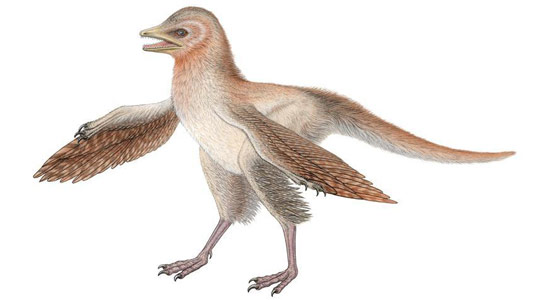
    Eosinopteryx
    Eosinopteryx. Credit: Royal Belgian Institute of Natural Sciences

    Findings related to the newly discovered ‘bird-dinosaur’ Eosinopteryx suggest that the origin of flight was much more complex than previously thought.

    The discovery of a new bird-like dinosaur from the Jurassic period challenges widely accepted theories on the origin of flight.

    Co-authored by Dr. Gareth Dyke, Senior Lecturer in Vertebrate Palaeontology at the University of Southampton, the paper describes a new feathered dinosaur about 30 cm (12 in) in length which pre-dates bird-like dinosaurs that birds were long thought to have evolved from.

    Over many years, it has become accepted among paleontologists that birds evolved from a group of dinosaurs called theropods from the Early Cretaceous period of Earth’s history, around 120-130 million years ago. Recent discoveries of feathered dinosaurs from the older Middle-Late Jurassic period have reinforced this theory.

    The new ‘bird-dinosaur’ Eosinopteryx described in Nature Communications this week provides additional evidence of this effect.

    “This discovery sheds further doubt on the theory that the famous fossil Archaeopteryx – or “first bird” as it is sometimes referred to – was pivotal in the evolution of modern birds,” says Dr. Dyke, who is based at the National Oceanography Center, Southampton.

    “Our findings suggest that the origin of flight was much more complex than previously thought.”

    The fossilized remains found in north-eastern China indicate that, while feathered, this was a flightless dinosaur, because of its small wingspan and a bone structure that would have restricted its ability to flap its wings.

    The dinosaur also had toes suited to walking along the ground and fewer feathers on its tail and lower legs, which would have made it easier to run.

    Reference: “Reduced plumage and flight ability of a new Jurassic paravian theropod from China” by Pascal Godefroit, Helena Demuynck, Gareth Dyke, Dongyu Hu, François Escuillié and Philippe Claeys, 22 January 2013, Nature Communications.
    DOI: 10.1038/ncomms2389

    Dr. Gareth Dyke is also the Program Leader for a new one-year MRes in Vertebrate Palaeontology, which offers potential students the chance to study the evolution and anatomy of vertebrates, in order to inform and increase our understanding of the workings of modern-day creatures.

    Dr. Dyke’s co-authors are Pascal Godefroit of the Royal Belgian Institute of Natural Sciences, Helena Demuynck of Earth System Science Vrije Universiteit Brussel, Dongyu Hu of Paleontological Institute Shenyang Normal University China and Key Laboratory of Vegetation Ecology Northeast Normal University China, François Escuillié of Eldonia France and Philippe Claeys of Jilin University Geological Museum China.

    Never miss a breakthrough: Join the SciTechDaily newsletter.
    Follow us on Google and Google News.

    Dinosaurs Evolutionary Biology Fossils Paleontology Popular University of Southampton
    Share. Facebook Twitter Pinterest LinkedIn Email Reddit

    Related Articles

    New Insight Into the Evolution of Sight From 54 Million Year-Old Fossil

    New Dinosaur Species Discovered in Mongolia, Gobiraptor Minutus

    Burnt Toast and Dinosaur Bones Have a Common Trait

    Dinosaur Egg Color Had a Single Evolutionary Origin

    Paleontologists Discover First North American Co-occurrence of Hadrosaur and Therizinosaur Tracks

    Newly Discovered Dinosaur (Mansourasaurus shahinae) Links Africa and Europe

    Pentecopterus – A Giant Sea Scorpion from the Prehistoric Seas

    New Species of Horned Dinosaur – Regaliceratops Peterhewsi

    Pegomastax Africanus, A Miniature Dinosaur That Thrived in Southern Africa

    Leave A Reply Cancel Reply

    • Facebook
    • Twitter
    • Pinterest
    • YouTube

    Don't Miss a Discovery

    Subscribe for the Latest in Science & Tech!

    Trending News

    New “Nanozyme Hypothesis” Could Rewrite the Story of Life’s Origins

    Anatomy Isn’t Finished: The Human Body Still Holds Secrets

    “Pretty Close to Home”: The Hidden Earthquake Threat Beneath Seattle

    The Surprising Reason You Might Want To Sleep Without a Pillow

    Scientists Say This Natural Hormone Reverses Obesity by Targeting the Brain

    35-Million-Year-Old Mystery: Strange Arachnid Discovered Preserved in Amber

    Is AI Really Just a Tool? It Could Be Altering How You See Reality

    JWST Reveals a “Forbidden” Planet With a Baffling Composition

    Follow SciTechDaily
    • Facebook
    • Twitter
    • YouTube
    • Pinterest
    • Newsletter
    • RSS
    SciTech News
    • Biology News
    • Chemistry News
    • Earth News
    • Health News
    • Physics News
    • Science News
    • Space News
    • Technology News
    Recent Posts
    • Scientists Unveil Microscopy Breakthrough That Reveals “Invisible” Molecular States
    • Scientists Finally Crack the Mystery of Water’s Strangest Behavior After Decades of Research
    • What If Consciousness Exists Beyond Your Brain
    • Scientists Finally Crack the 100-Million-Year Evolutionary Mystery of Squid and Cuttlefish
    • This Algae Could One Day Pull Microplastics out of Your Drinking Water
    Copyright © 1998 - 2026 SciTechDaily. All Rights Reserved.
    • Science News
    • About
    • Contact
    • Editorial Board
    • Privacy Policy
    • Terms of Use

    Type above and press Enter to search. Press Esc to cancel.