
The fine structure constant is a fundamental constant of nature and its measurement is crucial in physics. Recently, researchers at TU Wien have discovered a unique way of measuring it.
The value of one over 137, also known as the fine structure constant, is considered a crucial number in physics. It plays a significant role in atomic and particle physics.
While traditionally the fine structure constant is measured indirectly through calculations and measurements of other physical quantities, researchers at TU Wien have developed an experiment that allows for the direct measurement of the fine structure constant in the form of an angle.
1/137 — the Secret Code of the Universe
The fine structure constant describes the strength of the electromagnetic interaction. It indicates how strongly charged particles such as electrons react to electromagnetic fields. If the fine structure constant had a different value, our universe would look completely different — atoms would have a different size, so all chemistry would work differently, and nuclear fusion in the stars would be completely different as well.
A much-discussed question is whether the fine structure constant is actually constant, or whether it could possibly have changed its value a little over billions of years.
Direct Measurements Instead of Calculations
“Most important physical constants have a specific unit — for example, the speed of light, which can be given in the unit of meters per second,” says Professor Andrei Pimenov from the Institute of Solid State Physics at TU Wien. “It’s different with the fine structure constant. It has no unit, it is simply a number – it is dimensionless.”
But usually, when the fine structure is measured, various quantities with different physical units have to be measured, and then the value of the fine structure constant is inferred from these results. “In our experiment, on the other hand, the fine structure constant itself becomes directly visible,” says Andrei Pimenov.
A Thin Film That Rotates the Light
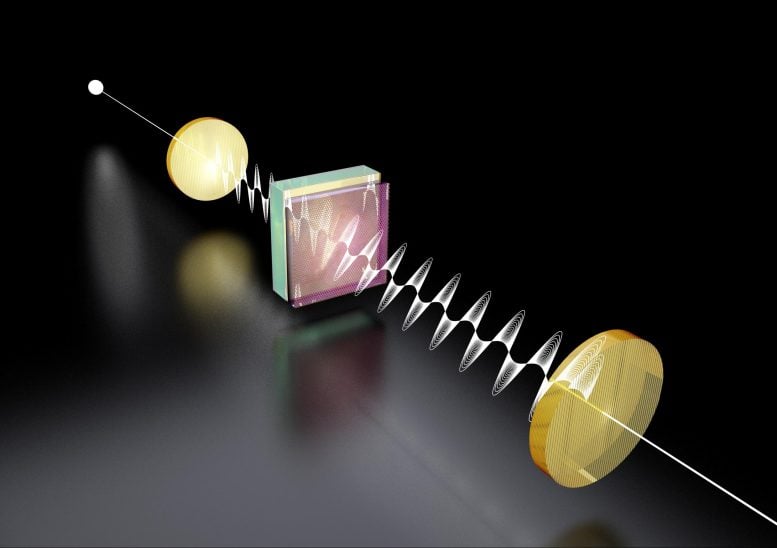
A laser beam is polarized linearly — the light oscillates exactly in the vertical direction. Then the beam hits a layer of a special material that is only a few nanometers thick. This material has the property of changing the polarization direction of the light.
“A material rotating the polarization of a laser beam is, by itself, nothing unusual. Different materials can do this; the thicker the material layer, the more the polarization of the laser is rotated. But we are dealing with a completely different effect here,” explains Andrei Pimenov. “In our case, the polarization is not rotated continuously — it jumps.”
When passing through the thin film, the polarization direction of the light performs a quantum jump. After passing through, the light wave oscillates in a different direction than before. And when the size of this jump is calculated, an astonishing result appears: the quantum of this angular change is exactly the fine structure constant.
“We thus have direct access to something quite unusual: a quantum of rotation,” says Andrei Pimenov. “The fine structure constant becomes immediately visible as an angle.”
Reference: “Universal rotation gauge via quantum anomalous Hall effect” by Alexey Shuvaev, Lei Pan, Lixuan Tai, Peng Zhang, Kang L. Wang and Andrei Pimenov, 7 November 2022, Applied Physics Letters.
DOI: 10.1063/5.0105159
Never miss a breakthrough: Join the SciTechDaily newsletter.
Follow us on Google and Google News.
4 Comments
“Different materials can do this; the thicker the material layer, the more the polarization of the laser is rotated. But we are dealing with a completely different effect here,” explains Andrei Pimenov. “In our case, the polarization is not rotated continuously — it jumps.””
I can’t think of a reason for the rotation to not jump for any rotatory material as the thickness of the material varies in terms of numbers of atoms.
To be clear, in this case the shift in polarization is independent of the material thickness, whereas the common effect is that the size of the shift has a linear relationship with the thickness of the shift-inducing material?
According to the topological vortex field theory, if there is no interaction and mediation between dark matter and dark energy vortex, as a microscopic particle, light cannot form and propagate.
Description of the experiment with arrangements are required for more understanding òf the result.No doubt is present in this context.