
Close Menu
    Facebook X (Twitter) Instagram
    SciTechDaily
    • Biology
    • Chemistry
    • Earth
    • Health
    • Physics
    • Science
    • Space
    • Technology
    Facebook X (Twitter) Pinterest YouTube RSS
    SciTechDaily
    Home»Chemistry»Extraordinary Discovery May Substantially Change Our Understanding of the Mechanism of Photosynthesis
    Chemistry

    Extraordinary Discovery May Substantially Change Our Understanding of the Mechanism of Photosynthesis

    By Dalian Institute of Chemical Physics, Chinese Academy SciencesJanuary 15, 20234 Comments3 Mins Read
    Facebook Twitter Pinterest Telegram LinkedIn WhatsApp Email Reddit
    Share
    Facebook Twitter LinkedIn Pinterest Telegram Email Reddit
    Light-Driven CO2 Assimilation by Photosystem II
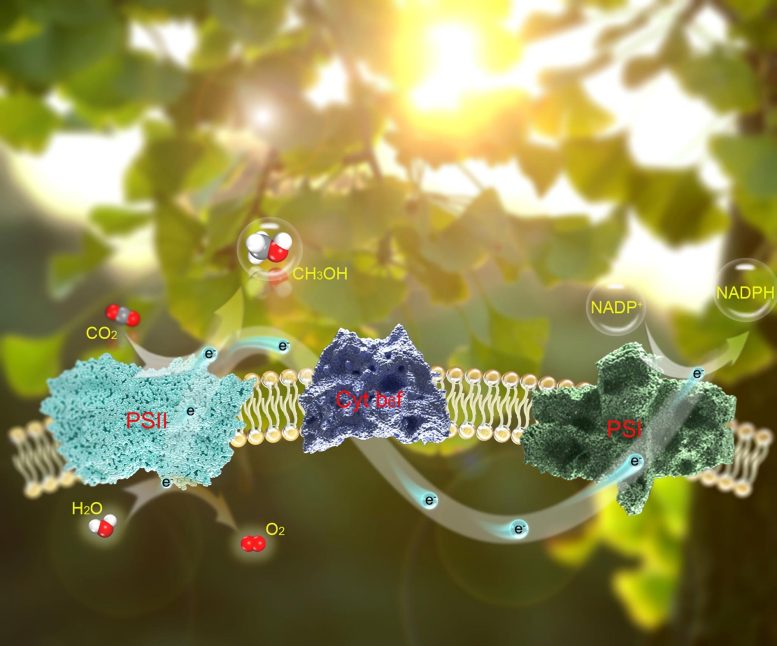
    Photosynthesis is the greatest natural process on Earth. It has been widely accepted that CO2 assimilation takes place in light-independent reactions, for example, through the Calvin-Benson Cycle in the stroma. Here, an unusual light-driven CO2 assimilation (into methanol) by the PSII core complex in photosynthesis was reported. The extraordinary finding is likely to be a simultaneous event along with the usual electron transfer occurring in normal light-independent assimilation. Credit: Chinese Journal of Catalysis

    Light-Driven CO2 Assimilation by Photosystem II and Its Relation to Photosynthesis

    Photosynthesis is the greatest natural process converting sunlight into chemical energy on a massive scale and maintaining life on Earth. There are basically two successive stages of oxygenic photosynthesis, of which the light-dependent reactions in photosystem II (PSII), and in photosystem I (PSI), enable the oxidation of H2O into molecular oxygen, and production of reducing power (NADPH and ATP), while CO2 assimilation is generally known to take place long after oxygen evolution and NADP+ reduction, via light-independent reactions in the stroma.

    Meanwhile, there is wide consensus that during light-dependent reactions CO2 (or bicarbonate) is not reduced as a substrate, but plays a unique stimulatory role in O2 evolution, namely the so-called “bicarbonate effect.” The role of bicarbonate effect as well as the bicarbonate binding sites in PSII have been intensively studied since the 1970s, with some important conclusions reached thus far. However, CO2 (or bicarbonate) in PSII is thought to only play supporting roles during water oxidation, rather than being “assimilated” by PSII.

    Light-Driven CO2 Assimilation in PSII

    Recently, a team of researchers, for the first time, reported a light-driven CO2 assimilation by PSII core complex, where the formation of methanol (CH3OH), along with the oxygen evolution, is validated by in-situ mass spectrometry, gas chromatography, and isotopic labeling experiments.

    The team included scientists from Dalian University of Technology, Dalian Institute of Chemical Physics, Chinese Academy of Sciences, China, and the University of Illinois at Urbana-Champaign, USA.

    Such an unusual CO2 assimilation is likely to be a simultaneous event along with the usual electron transfer occurring in normal light-independent assimilation. This discovery is extraordinary and is of great significance as it may substantially modify our understanding of the mechanism of photosynthesis. The results were published in the Chinese Journal of Catalysis.

    References: “Light-driven CO2 assimilation by photosystem II and its relation to photosynthesis” by Yuehui Li, Duanhui Si, Wangyin Wang, Song Xue, Wenzhe Shang, Zhanyou Chi, Can Li, Ce Hao, Govindjee Govindjee and Yantao Shi, 2 December 2022, Chinese Journal of Catalysis.
    DOI: 10.1016/S1872-2067(22)64170-6

    Never miss a breakthrough: Join the SciTechDaily newsletter.
    Follow us on Google and Google News.

    Catalysts Chinese Academy of Sciences Photosynthesis Popular
    Share. Facebook Twitter Pinterest LinkedIn Email Reddit

    Related Articles

    99% Efficient and Dirt Cheap – Is This the Holy Grail of Hydrogen?

    One Step Closer to Living on Mars: AI Unlocks Secrets of Oxygen Production on the Red Planet

    Mimicking Mother Earth: Crafting an Artificial Carbon Cycle Beyond Our Planet

    More Efficient Than Natural Photosynthesis – New Photocatalytic System Converts Carbon Dioxide Into Valuable Fuel

    Feeding the Future: Artificial Photosynthesis Transforms CO2 Into Food

    New “Artificial Photosynthesis” System Produces Methane With 10x Efficiency

    Light-Powered Catalyst Mimics Photosynthesis To Improve the Yield of Reactions

    Artificial Photosynthesis Promises Clean, Sustainable Source of Energy

    Working to Recycle Greenhouse Gases

    4 Comments

    1. Corey on January 17, 2023 1:20 pm

      Wow. Thanks for not stating that in language the rest of us who are not biologists can understand. I’m glad not to be burdened with understanding. Being clear as mud is so refreshing. Who needs understanding? Let me tell you, not this guy.

      Reply
    2. Corey on January 17, 2023 9:40 pm

      To add to my comment above, this link on writing scientific papers may help:

      https://youtu.be/vtIzMaLkCaM

      Reply
    3. BibhutibhusanPatel on January 20, 2023 3:27 am

      This kind of photosynthesis procrss is favoured by a constrained background of nature,as when photodisease in plants are present.

      Reply
    4. Jeffrey Levine on January 21, 2023 2:06 am

      I laughed so hard at your comment, Corey.
      The part of the article that came through loud and clear was the word “extraordinary”. It made me suspicious that it wasn’t actually extraordinary. Maybe it IS extraordinary? I hope it’s extraordinary. That would be exciting, as well as extraordinary!

      Reply
    Leave A Reply Cancel Reply

    • Facebook
    • Twitter
    • Pinterest
    • YouTube

    Don't Miss a Discovery

    Subscribe for the Latest in Science & Tech!

    Trending News

    Your Blood Pressure Reading Could Be Wrong Because of One Simple Mistake

    Astronomers Stunned by Ancient Galaxy With No Spin

    Physicists May Be on the Verge of Discovering “New Physics” at CERN

    Scientists Solve 320-Million-Year Mystery of Reptile Skin Armor

    Scientists Say This Daily Walking Habit May Be the Secret to Keeping Weight Off After Dieting

    New Therapy Rewires the Brain To Restore Joy in Depression Patients

    Giant Squid Detected off Western Australia in Stunning Deep-Sea Discovery

    Popular Sugar-Free Sweetener Linked to Liver Disease, Study Warns

    Follow SciTechDaily
    • Facebook
    • Twitter
    • YouTube
    • Pinterest
    • Newsletter
    • RSS
    SciTech News
    • Biology News
    • Chemistry News
    • Earth News
    • Health News
    • Physics News
    • Science News
    • Space News
    • Technology News
    Recent Posts
    • Hidden Warm Water Beneath Antarctica Could Rapidly Raise Global Sea Levels
    • Scientists Revive Ancient Chemistry Trick To Engineer Next-Generation Glass
    • Scientists Use AI To Supercharge Ultrafast Laser Simulations by More Than 250x
    • Scientists Just Found a Surprising Way To Destroy “Forever Chemicals”
    • Popular Supplement Ingredient Linked to Shorter Lifespan in Men
    Copyright © 1998 - 2026 SciTechDaily. All Rights Reserved.
    • Science News
    • About
    • Contact
    • Editorial Board
    • Privacy Policy
    • Terms of Use

    Type above and press Enter to search. Press Esc to cancel.