
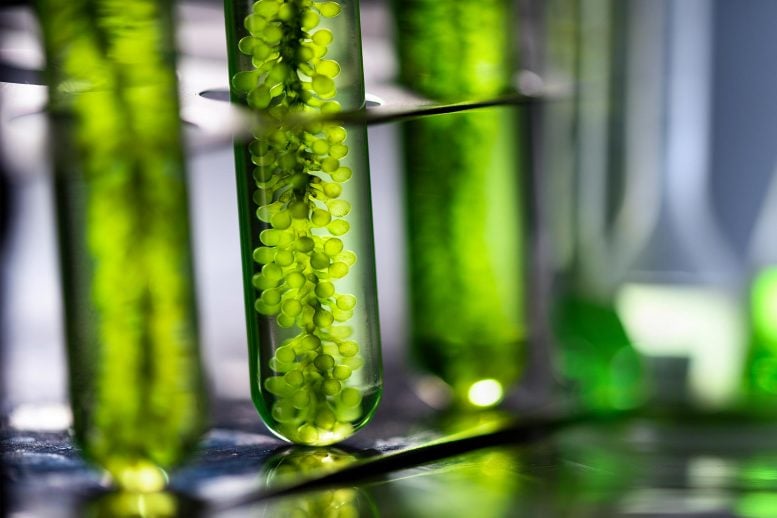
Hydrogen is an essential commodity with over 60 million tons produced globally every year. However over 95 percent of it is made by steam reformation of fossil fuels, a process that is energy intensive and produces carbon dioxide. If we could replace even a part of that with algal biohydrogen that is made via light and water, it would have a substantial impact.
This is essentially what has just been achieved in the lab of Kevin Redding, professor in the School of Molecular Sciences and director of the Center for Bioenergy and Photosynthesis. Their research, entitled Rewiring photosynthesis: a Photosystem I -hydrogenase chimera that makes hydrogen in vivo was published very recently in the high-impact journal Energy and Environmental Science.
“What we have done is to show that it is possible to intercept the high energy electrons from photosynthesis and use them to drive alternate chemistry, in a living cell” explained Redding. “We have used hydrogen production here as an example.”
“Kevin Redding and his group have made a true breakthrough in re-engineering the Photosystem I complex,” explained Ian Gould, interim director of the School of Molecular Sciences, which is part of The College of Liberal Arts and Sciences. “They didn’t just find a way to redirect a complex protein structure that nature designed for one purpose to perform a different, but equally critical process, but they found the best way to do it at the molecular level.”
It is common knowledge that plants and algae, as well as cyanobacteria, use photosynthesis to produce oxygen and “fuels,” the latter being oxidizable substances like carbohydrates and hydrogen. There are two pigment-protein complexes that orchestrate the primary reactions of light in oxygenic photosynthesis: Photosystem I (PSI) and Photosystem II (PSII).
Algae (in this work the single-celled green alga Chlamydomonas reinhardtii, or ‘Chlamy’ for short) possess an enzyme called hydrogenase that uses electrons it gets from the protein ferredoxin, which is normally used to ferry electrons from PSI to various destinations. A problem is that the algal hydrogenase is rapidly and irreversibly inactivated by oxygen that is constantly produced by PSII.
In this study, doctoral student and first author Andrey Kanygin has created a genetic chimera of PSI and the hydrogenase such that they co-assemble and are active in vivo. This new assembly redirects electrons away from carbon dioxide fixation to the production of biohydrogen.
“We thought that some radically different approaches needed to be taken — thus, our crazy idea of hooking up the hydrogenase enzyme directly to Photosystem I in order to divert a large fraction of the electrons from water splitting (by Photosystem II) to make molecular hydrogen,” explained Redding.
Cells expressing the new photosystem (PSI-hydrogenase) make hydrogen at high rates in a light-dependent fashion, for several days.
This important result will also be featured in an upcoming article in Chemistry World – a monthly chemistry news magazine published by the Royal Society of Chemistry. The magazine addresses current developments in the world of chemistry including research, international business news, and government policy as it affects the chemical science community.
The NSF grant funding for this research is part of the U.S.-Israel Binational Science Foundation (BSF). In this arrangement, a U.S. scientist and Israeli scientist join forces to form a joint project. The U.S. partner submits a grant on the joint project to the NSF, and the Israeli partner submits the same grant to the ISF (Israel Science Foundation). Both agencies must agree to fund the project in order to obtain the BSF funding. Professor Iftach Yacoby of Tel Aviv University, Redding’s partner on the BSF project, is a young scientist who first started at TAU about eight years ago and has focused on different ways to increase algal biohydrogen production.
In summary, re-engineering the fundamental processes of photosynthetic microorganisms offers a cheap and renewable platform for creating bio-factories capable of driving difficult electron reactions, powered only by the sun and using water as the electron source.
Reference: “Rewiring photosynthesis: a photosystem I-hydrogenase chimera that makes H2in vivo” by Andrey Kanygin, Yuval Milrad, Chandrasekhar Thummala, Kiera Reifschneider, Patricia Baker, Pini Marco, Iftach Yacoby and Kevin E. Redding, 17 April 2020, Energy and Environmental Science.
DOI; 10.1039/C9EE03859K
The team included Kevin E. Redding, Andrey Kanygin and Patricia Baker of ASU, Kiera Reifschneider (formerly Redding’s doctoral student), Iftach Yacoby and Yuval Milrad of Tel Aviv University and Chandrasekhar Thummala of Yogi Vemana University, India (formerly a visiting professor in Redding’s lab).This work was funded by the National Science Foundation, grant number CBET-1706960.
Never miss a breakthrough: Join the SciTechDaily newsletter.
Follow us on Google and Google News.