
Researchers found an early electron pathway in photosynthesis, unlocking potential for renewable energy and resilient crops.
Researchers have ‘hacked’ the earliest stages of photosynthesis, the natural machine that powers the vast majority of life on Earth, and discovered new ways to extract energy from the process, a finding that could lead to new ways of generating clean fuel and renewable energy.
“We didn’t know as much about photosynthesis as we thought we did, and the new electron transfer pathway we found here is completely surprising.” Dr. Jenny Zhang
An international team of physicists, chemists, and biologists, led by the University of Cambridge, was able to study photosynthesis – the process by which plants, algae, and some bacteria convert sunlight into energy – in live cells at an ultrafast timescale: a millionth of a millionth of a second.
Despite the fact that it is one of the most well-known and well-studied processes on Earth, the researchers found that photosynthesis still has secrets to tell. Using ultrafast spectroscopic techniques to study the movement of energy, the researchers found the chemicals that can extract electrons from the molecular structures responsible for photosynthesis do so at the initial stages, rather than much later, as was previously thought. This ‘rewiring’ of photosynthesis could improve how it deals with excess energy, and create new and more efficient ways of using its power. The results were reported on March 22 in the journal Nature.
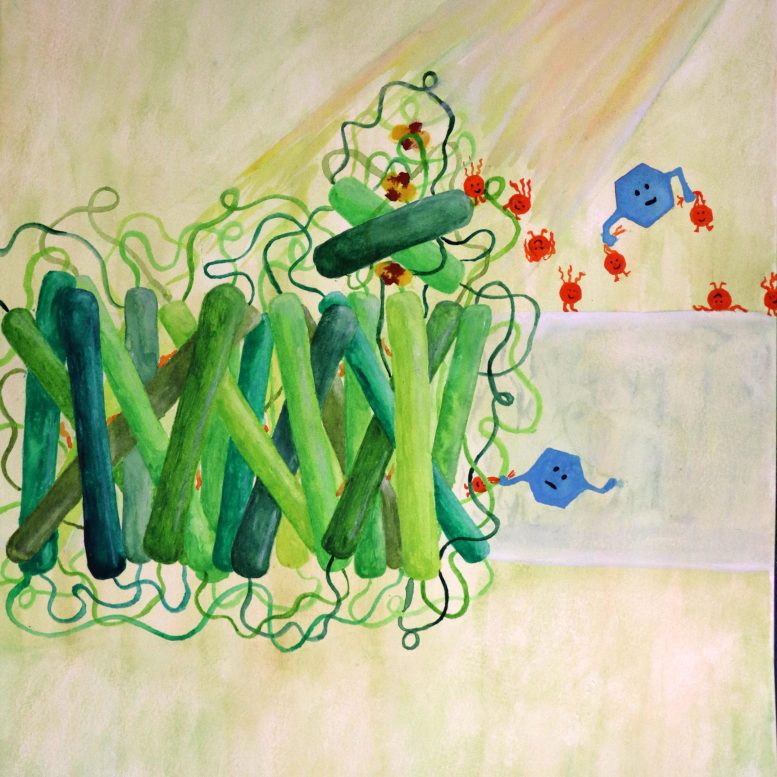
Although photosynthesis is a widely-known and extensively studied process, University of Cambridge researchers have discovered that it still holds hidden secrets. By employing ultrafast spectroscopic techniques, they found that electron extraction from the molecular structures responsible for photosynthesis occurs at earlier stages than previously assumed. This “rewiring” of photosynthesis could lead to better management of excess energy and the development of new, more efficient methods for harnessing its potential. Credit: Mairi Eyres
“We didn’t know as much about photosynthesis as we thought we did, and the new electron transfer pathway we found here is completely surprising,” said Dr. Jenny Zhang from Cambridge’s Yusuf Hamied Department of Chemistry, who coordinated the research.
While photosynthesis is a natural process, scientists have also been studying how it could be used as to help address the climate crisis, by mimicking photosynthetic processes to generate clean fuels from sunlight and water, for example.
The Role of Quinones in Photosynthesis
Zhang and her colleagues were originally trying to understand why a ring-shaped molecule called a quinone is able to ‘steal’ electrons from photosynthesis. Quinones are common in nature, and they can accept and give away electrons easily. The researchers used a technique called ultrafast transient absorption spectroscopy to study how the quinones behave in photosynthetic cyanobacteria.

“No one had properly studied how this molecule interplays with photosynthetic machineries at such an early point of photosynthesis: we thought we were just using a new technique to confirm what we already knew,” said Zhang. “Instead, we found a whole new pathway, and opened the black box of photosynthesis a bit further.”
Using ultrafast spectroscopy to watch the electrons, the researchers found that the protein scaffold where the initial chemical reactions of photosynthesis take place is ‘leaky’, allowing electrons to escape. This leakiness could help plants protect themselves from damage from bright or rapidly changing light.
“The physics of photosynthesis is seriously impressive,” said co-first author Tomi Baikie, from Cambridge’s Cavendish Laboratory “Normally, we work on highly ordered materials, but observing charge transport through cells opens up remarkable opportunities for new discoveries on how nature operates.”
Harnessing Photosynthesis for Renewable Energy
“Since the electrons from photosynthesis are dispersed through the whole system, that means we can access them,” said co-first author Dr Laura Wey, who did the work in the Department of Biochemistry, and is now based at the University of Turku, Finland. “The fact that we didn’t know this pathway existed is exciting, because we could be able to harness it to extract more energy for renewables.”
The researchers say that being able to extract charges at an earlier point in the process of photosynthesis, could make the process more efficient when manipulating photosynthetic pathways to generate clean fuels from the Sun. In addition, the ability to regulate photosynthesis could mean that crops could be made more able to tolerate intense sunlight.
“Many scientists have tried to extract electrons from an earlier point in photosynthesis, but said it wasn’t possible because the energy is so buried in the protein scaffold,” said Zhang. “The fact that we can steal them at an earlier process is mind-blowing. At first, we thought we’d made a mistake: it took a while for us to convince ourselves that we’d done it.”
Key to the discovery was the use of ultrafast spectroscopy, which allowed the researchers to follow the flow of energy in the living photosynthetic cells on a femtosecond scale – a thousandth of a trillionth of a second.
“The use of these ultrafast methods has allowed us to understand more about the early events in photosynthesis, on which life on Earth depends,” said co-author Professor Christopher Howe from the Department of Biochemistry.
Reference: “Photosynthesis re-wired on the pico-second timescale” by Tomi K. Baikie, Laura T. Wey, Joshua M. Lawrence, Hitesh Medipally, Erwin Reisner, Marc M. Nowaczyk, Richard H. Friend, Christopher J. Howe, Christoph Schnedermann, Akshay Rao and Jenny Z. Zhang, 22 March 2023, Nature.
DOI: 10.1038/s41586-023-05763-9
The research was supported in part by the Engineering and Physical Sciences Research Council (EPSRC), Biotechnology and Biological Sciences Research Council (BBSRC) part of UK Research and Innovation (UKRI), as well as the Winton Programme for the Physics of Sustainability at University of Cambridge, the Cambridge Commonwealth, European & International Trust, and the European Union’s Horizon 2020 research and innovation programme. Jenny Zhang is a David Phillips Fellow at the Yusuf Hamied Department of Chemistry, and a Fellow of Corpus Christi College, Cambridge. Tomi Baikie is a NanoFutures Fellow at the Cavendish Laboratory. Laura Wey is Novo Nordisk Foundation Postdoctoral Fellow at the University of Turku.
Never miss a breakthrough: Join the SciTechDaily newsletter.
Follow us on Google and Google News.
3 Comments
This analysis suggesting tapping the photosynthesis process to extract energy is the most exciting item of research I have come across. Thank you, and well done and doing researchers! James Peter, Multidiscipline Engineer (retired), Johannesburg, S.Africa.
“…and discovered new ways to extract energy from the process, a finding that could lead to new ways of generating clean fuel and renewable energy.”
Yes, but in the real world fossil fuels for the conventional vehicles that do the transportation involved in delivering and installing renewables in the transition to EV transportation will still be required.
This happens everytime energy is the issue. 10,000 “woulda, coulda, shoulda” ideas that have zero hope of happening are touted as the cure.