
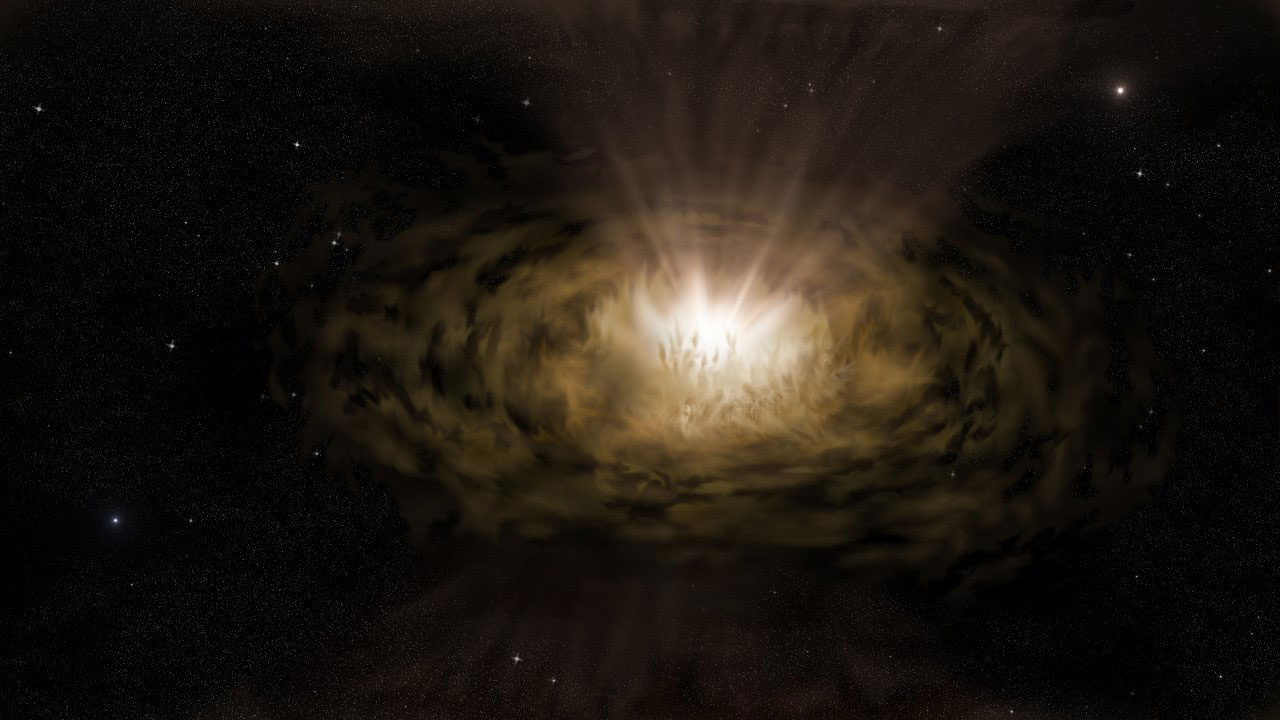
Mysterious features seen in light emitted from active galactic nuclei may be due to partial obscuration by dust clouds, according to new study.
Many large galaxies have a bright central region called an active galactic nucleus (AGN), powered by matter spiraling into a supermassive black hole. Gas clouds in an area around the AGN known as the “broad-line region” emit light at characteristic wavelengths, but the complexity and variability of these emissions have been a longstanding puzzle for astrophysicists.
A new analysis by researchers at UC Santa Cruz, published June 14 in Monthly Notices of the Royal Astronomical Society, explains these and other puzzling features of active galactic nuclei as the result of small clouds of dust that can partially obscure the innermost regions of AGNs.
“We’ve shown that a lot of mysterious properties of active galactic nuclei can be explained by these small dusty clouds causing changes in what we see,” said first author Martin Gaskell, a research associate in astronomy and astrophysics at UC Santa Cruz.
The findings have important implications because researchers use the optical emissions from the broad-line region to make inferences about the behavior of the gases in the inner regions around a supermassive black hole.
“The emission from this gas is one of the best sources of information about the mass of a black hole and how it is growing. However, the nature of this gas is poorly understood,” Gaskell said.
Coauthor Peter Harrington, a UCSC graduate student who began work on the project as an undergraduate, explained that gas spiraling toward a galaxy’s central black hole forms a flat accretion disk, and the superheated gas in the accretion disk emits intense thermal radiation. Some of that light is “reprocessed” (absorbed and re-emitted) by hydrogen and other gases swirling above and below the accretion disk in the broad-line region. Above and beyond this is a region of dust.
“Once the dust crosses a certain threshold it is subjected to the strong radiation from the accretion disk,” said Harrington. “This radiation is so intense that it blows the dust away from the disk, resulting in a clumpy outflow of dust clouds starting at the outer edge of the broad-line region.”
The effect of the dust clouds on the light emitted is to make the light coming from behind them look fainter and redder, just as Earth’s atmosphere makes the sun look fainter and redder at sunset. In their paper, Gaskell and Harrington present several lines of observational evidence supporting the existence of such dust clouds in the inner regions of active galactic nuclei. They developed a computer code to model the effects of dust clouds on observations of the broad-line region.
“We’ve written the code so we can adjust parameters like the distribution of gas in the broad-line region, how fast it’s moving, and the orientation of the system, and then we can introduce dust clouds and see how they affect the emission-line profiles,” Harrington said.
The results show that by including dust clouds in their model, it can replicate many features of emission from the broad-line region that have long puzzled astrophysicists. Rather than the gas having a changing, asymmetrical distribution that is hard to explain, the gas is simply in a uniform, symmetric, turbulent disk around the black hole. The apparent asymmetries and changes are due to dust clouds passing in front of the broad-line region and making the regions behind them look fainter and redder.
“We think it is a much more natural explanation of the asymmetries and changes than other more exotic theories, such as binary black holes, that have been invoked to explain them,” Gaskell said. “Our explanation lets us retain the simplicity of the standard AGN model of matter spiraling onto a single black hole.”
Reference: “Partial dust obscuration in active galactic nuclei as a cause of broad-line profile and lag variability, and apparent accretion disc inhomogeneities” by C Martin Gaskell and P Z Harrington, 4 April 2018, MNRAS.
DOI: 10.1093/mnras/sty848
Never miss a breakthrough: Join the SciTechDaily newsletter.
Follow us on Google and Google News.
1 Comment
good article