
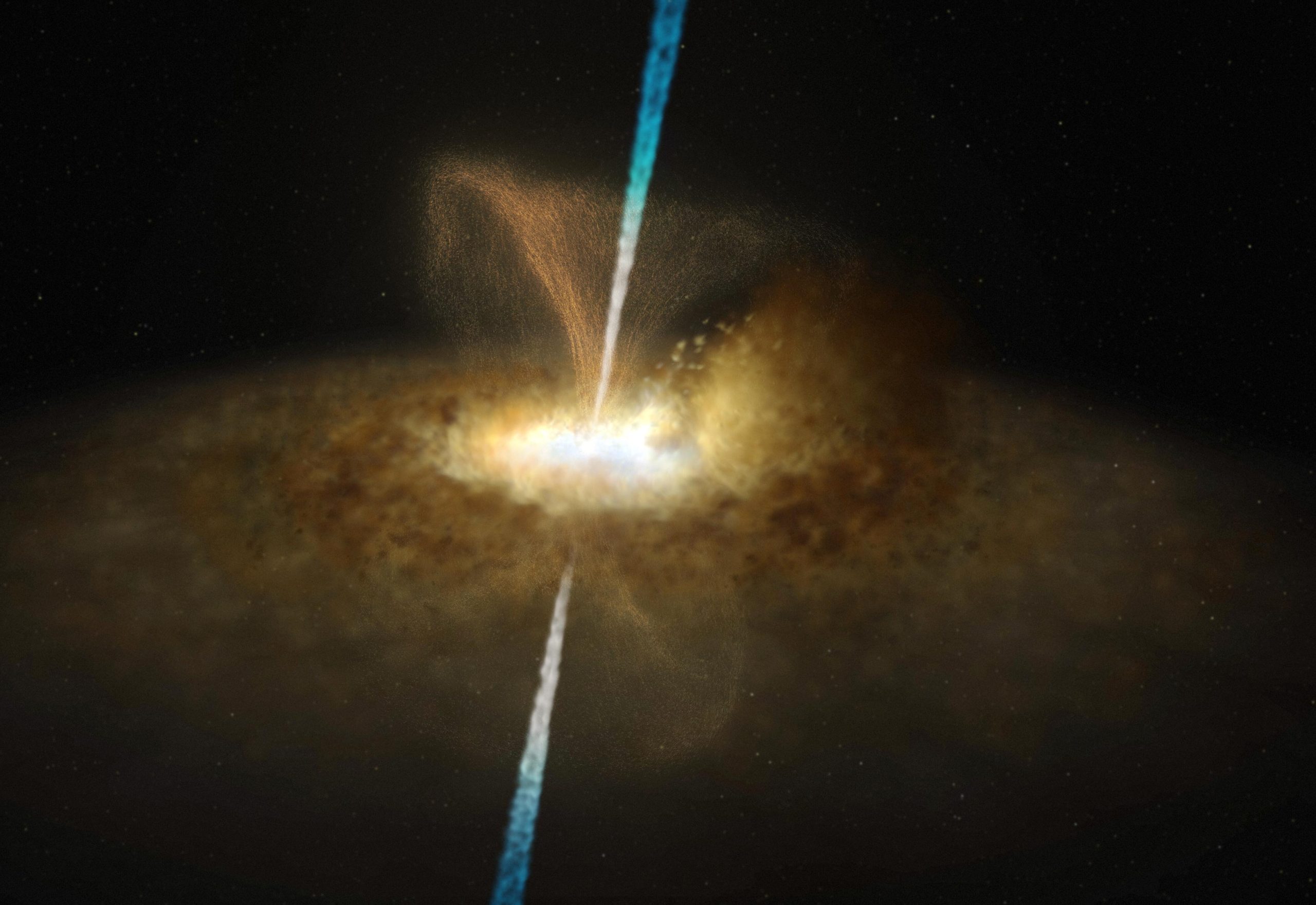
This active galactic nucleus is also believed to have jets, as well as dusty winds, that flow out of the region around the black hole perpendicularly to the accretion disc around it. Credit: ESO/M. Kornmesser and L. Calçada
The European Southern Observatory’s Very Large Telescope Interferometer (ESO’s VLTI) has observed a cloud of cosmic dust at the center of the galaxy Messier 77 that is hiding a supermassive black hole. The findings have confirmed predictions made around 30 years ago and are giving astronomers new insight into “active galactic nuclei,” some of the brightest and most enigmatic objects in the universe.
Active galactic nuclei (AGNs) are extremely energetic sources powered by supermassive black holes and found at the center of some galaxies. These black holes feed on large volumes of cosmic dust and gas. Before it is eaten up, this material spirals towards the black hole, and huge amounts of energy are released in the process, often outshining all the stars in the galaxy.
Astronomers have been curious about AGNs ever since they first spotted these bright objects in the 1950s. Now, thanks to ESO’s VLTI, a team of researchers, led by Violeta Gámez Rosas from Leiden University in the Netherlands, have taken a key step towards understanding how they work and what they look like up close. The results are published today (February 16, 2022)y in Nature.
Active galactic nuclei (AGNs) are extremely energetic sources powered by supermassive black holes. This short video provides insights into these peculiar objects by showcasing a new discovery on the AGN at the center of the Messier 77 galaxy. Credit: ESO
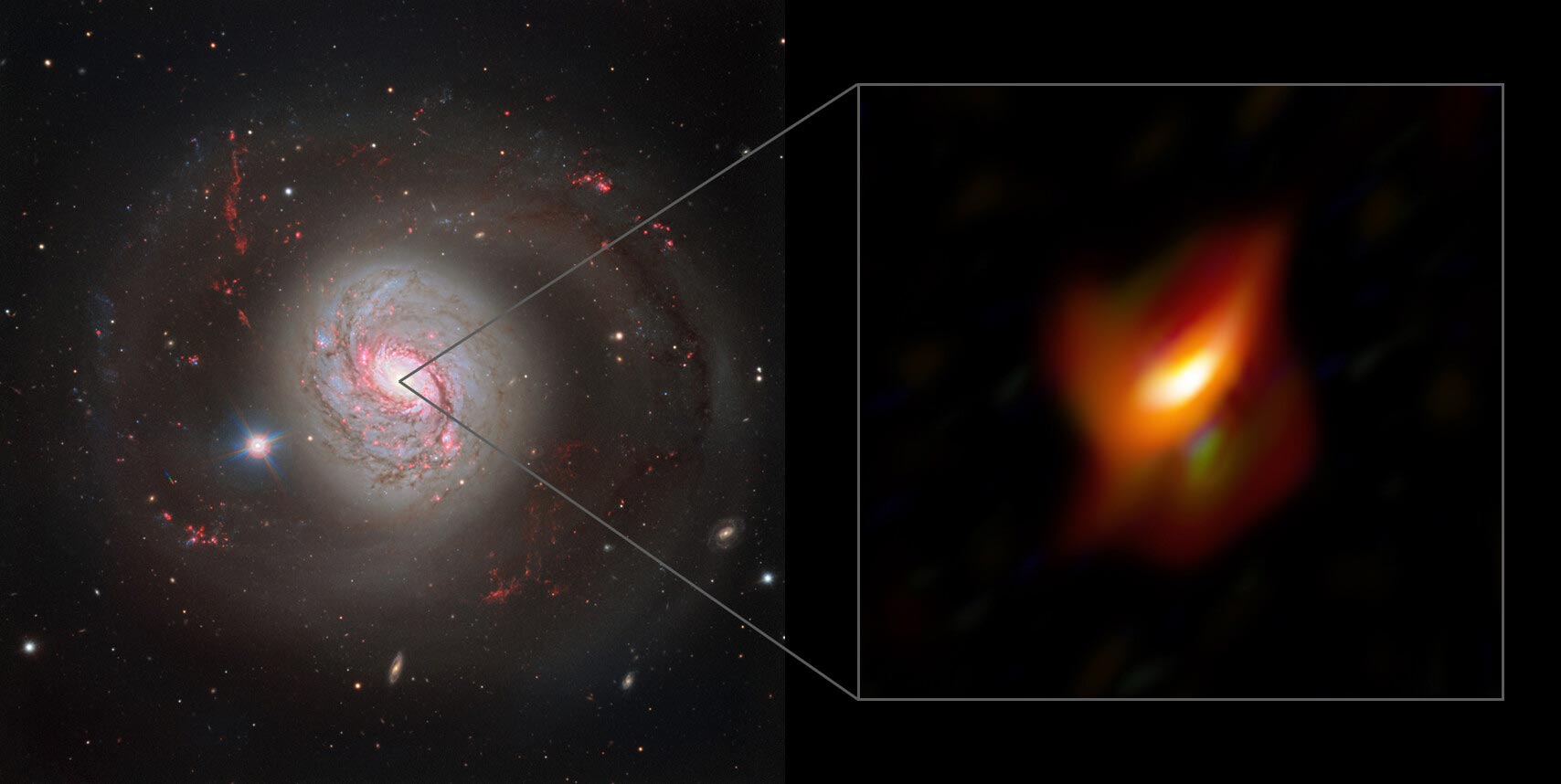
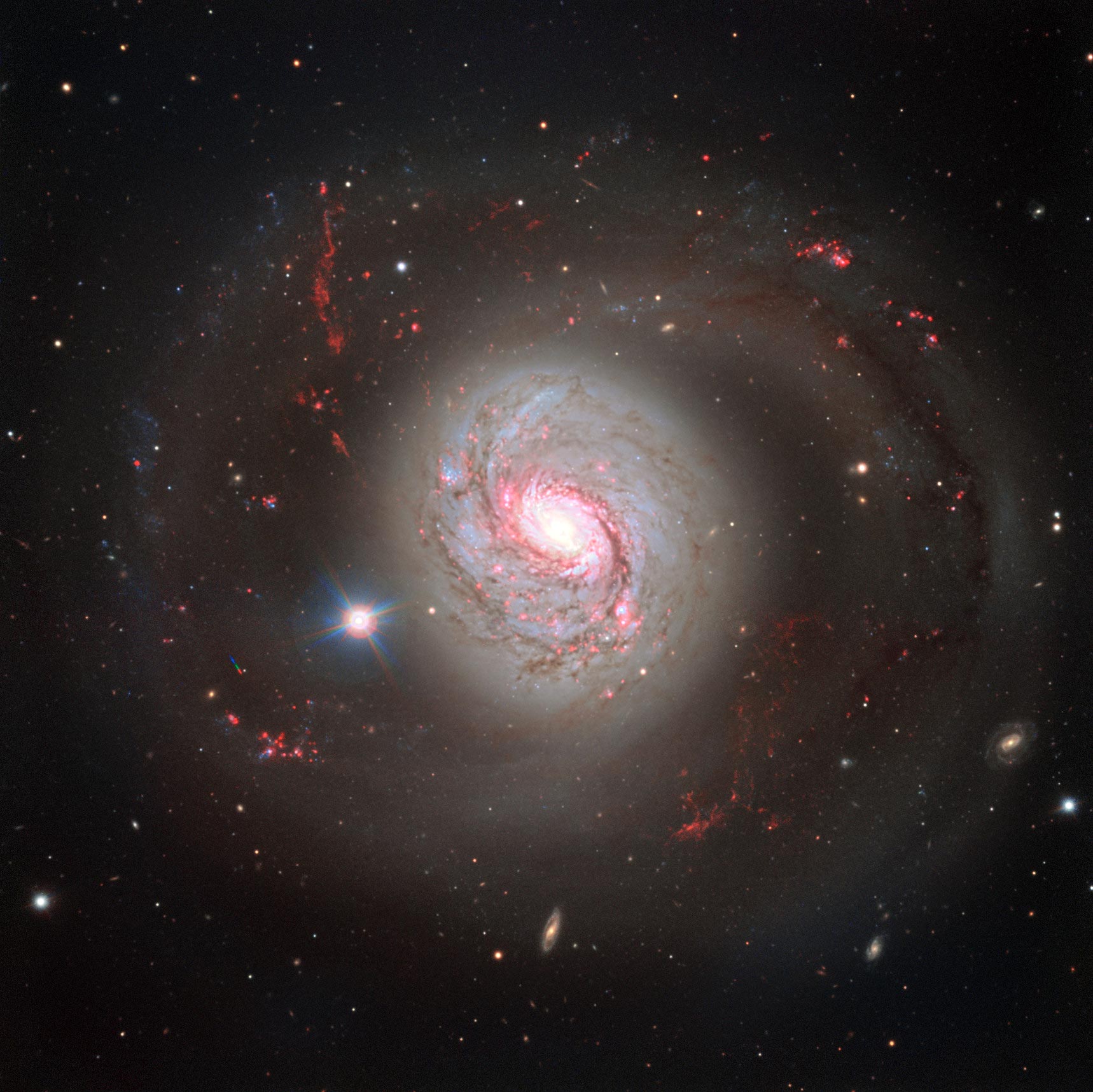
By making extraordinarily detailed observations of the center of the galaxy Messier 77, also known as NGC 1068, Gámez Rosas and her team detected a thick ring of cosmic dust and gas hiding a supermassive black hole. This discovery provides vital evidence to support a 30-year-old theory known as the Unified Model of AGNs.
Astronomers know there are different types of AGN. For example, some release bursts of radio waves while others don’t; certain AGNs shine brightly in visible light, while others, like Messier 77, are more subdued. The Unified Model states that despite their differences, all AGNs have the same basic structure: a supermassive black hole surrounded by a thick ring of dust.
According to this model, any difference in appearance between AGNs results from the orientation at which we view the black hole and its thick ring from Earth. The type of AGN we see depends on how much the ring obscures the black hole from our viewpoint, completely hiding it in some cases.
Astronomers had found some evidence to support the Unified Model before, including spotting warm dust at the center of Messier 77. However, doubts remained about whether this dust could completely hide a black hole and hence explain why this AGN shines less brightly in visible light than others.
“The real nature of the dust clouds and their role in both feeding the black hole and determining how it looks when viewed from Earth have been central questions in AGN studies over the last three decades,” explains Gámez Rosas. “Whilst no single result will settle all the questions we have, we have taken a major step in understanding how AGNs work.”
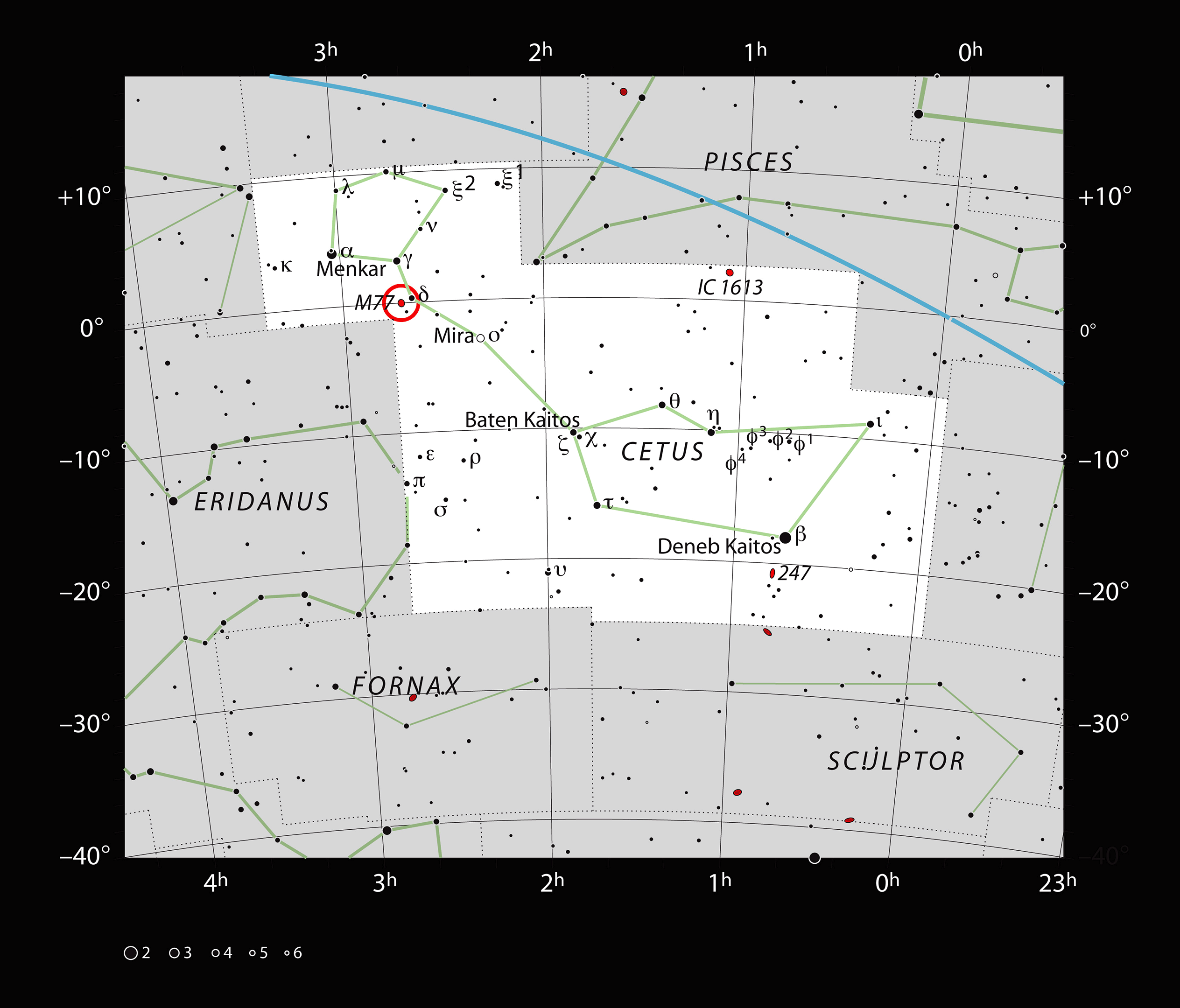
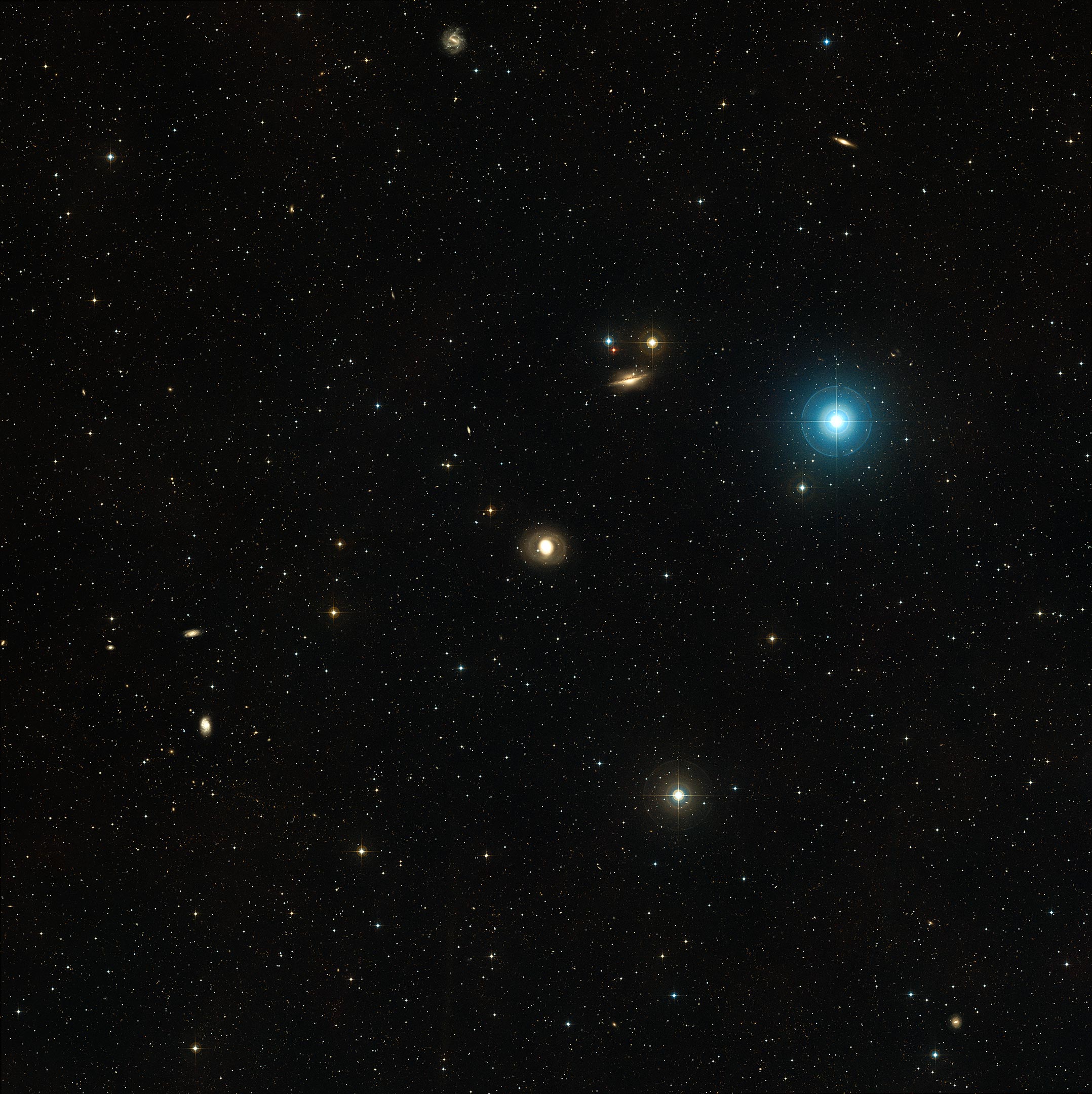
The observations were made possible thanks to the Multi AperTure mid-Infrared SpectroScopic Experiment (MATISSE) mounted on ESO’s VLTI, located in Chile’s Atacama Desert. MATISSE combined infrared light collected by all four 8.2-meter telescopes of ESO’s Very Large Telescope (VLT) using a technique called interferometry. The team used MATISSE to scan the center of Messier 77, located 47 million light-years away in the constellation Cetus.
This animation shows what the core of Messier 77 might look like. As other active galactic nuclei, the central region of Messier 77 is powered by a black hole that is surrounded by a thin accretion disc, which itself is surrounded by a thick ring or torus of gas and dust. In the case of Messier 77, this thick ring completely obscures our view of the supermassive black hole. This active galactic nucleus is also believed to have jets, as well as dusty winds, that flow out of the region around the black hole perpendicularly to the accretion disc around it. Credit: ESO/M. Kornmesser and L. Calçada
“MATISSE can see a broad range of infrared wavelengths, which lets us see through the dust and accurately measure temperatures. Because the VLTI is in fact a very large interferometer, we have the resolution to see what’s going on even in galaxies as far away as Messier 77. The images we obtained detail the changes in temperature and absorption of the dust clouds around the black hole,” says co-author Walter Jaffe, a professor at Leiden University.
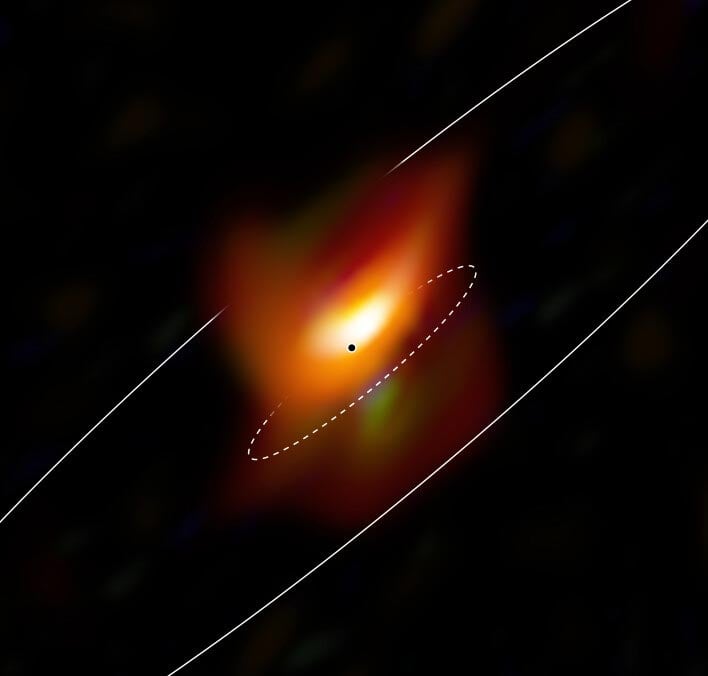
Combining the changes in dust temperature (from around room temperature to about 1200 °C) caused by the intense radiation from the black hole with the absorption maps, the team built up a detailed picture of the dust and pinpointed where the black hole must lie. The dust — in a thick inner ring and a more extended disc — with the black hole positioned at its center supports the Unified Model. The team also used data from the Atacama Large Millimeter/submillimeter Array, co-owned by ESO, and the National Radio Astronomy Observatory’s Very Long Baseline Array to construct their picture.
This animated infographic provides a simplified representation of the Unified Model of active galactic nuclei or AGNs, energetic sources powered by supermassive black holes that exist at the center of some galaxies.
Astronomers have observed different types of AGN. Some, called blazars, are exceedingly bright and can undergo changes in their brightness on timescales of only hours or days while another type, called quasars, are also very bright but tend to be less variable than blazars. Seyfert galaxies, which come in two flavors (1 and 2), are another type of AGN, which are surrounded by host galaxies that are clearly detectable. Seyfert 1 and Seyfert 2 galaxies both have bright cores, but Seyfert 2 tend to be more subdued.
The Unified Model of AGNs states that despite their differences, all AGNs have the same basic structure: a supermassive black hole surrounded by a thick ring or torus of dust. According to this model, any difference in appearance between AGNs results from the orientation at which we view the black hole and its thick ring from Earth. The type of AGN we see depends on how much the ring obscures the black hole from our view point, completely hiding it in some cases.
Credit: ESO/L. Calçada and M. Kornmesser
“Our results should lead to a better understanding of the inner workings of AGNs,” concludes Gámez Rosas. “They could also help us better understand the history of the Milky Way, which harbors a supermassive black hole at its center that may have been active in the past.”
The researchers are now looking to use ESO’s VLTI to find more supporting evidence of the Unified Model of AGNs by considering a larger sample of galaxies.
Team member Bruno Lopez, the MATISSE Principal Investigator at the Observatoire de la Côte d’Azur in Nice, France, says: “Messier 77 is an important prototype AGN and a wonderful motivation to expand our observing program and to optimize MATISSE to tackle a wider sample of AGNs.”
ESO’s Extremely Large Telescope (ELT), set to begin observing later this decade, will also aid the search, providing results that will complement the team’s findings and allow them to explore the interaction between AGNs and galaxies.
Reference: “Thermal imaging of dust hiding the black hole in the Active Galaxy NGC 1068”by Violeta Gámez Rosas, Jacob W. Isbell, Walter Jaffe, Romain G. Petrov, James H. Leftley, Karl-Heinz Hofmann, Florentin Millour, Leonard Burtscher, Klaus Meisenheimer, Anthony Meilland, Laurens B. F. M. Waters, Bruno Lopez, Stéphane Lagarde, Gerd Weigelt, Philippe Berio, Fatme Allouche, Sylvie Robbe-Dubois, Pierre Cruzalèbes, Felix Bettonvil, Thomas Henning, Jean-Charles Augereau, Pierre Antonelli, Udo Beckmann, Roy van Boekel, Philippe Bendjoya, William C. Danchi, Carsten Dominik, Julien Drevon, Jack F. Gallimore, Uwe Graser, Matthias Heininger, Vincent Hocdé, Michiel Hogerheijde, Josef Hron, Caterina M. V. Impellizzeri, Lucia Klarmann, Elena Kokoulina, Lucas Labadie, Michael Lehmitz, Alexis Matter, Claudia Paladini, Eric Pantin, Jörg-Uwe Pott, Dieter Schertl, Anthony Soulain, Philippe Stee, Konrad Tristram, Jozsef Varga, Julien Woillez, Sebastian Wolf, Gideon Yoffe and Gerard Zins, 16 February 2022, Nature.
DOI: 10.1038/s41586-021-04311-7
The team is composed of Violeta Gámez Rosas (Leiden Observatory, Leiden University, Netherlands [Leiden]), Jacob W. Isbell (Max Planck Institute for Astronomy, Heidelberg, Germany [MPIA]), Walter Jaffe (Leiden), Romain G. Petrov (Université Côte d’Azur, Observatoire de la Côte d’Azur, CNRS, Laboratoire Lagrange, France [OCA]), James H. Leftley (OCA), Karl-Heinz Hofmann (Max Planck Institute for Radio Astronomy, Bonn, Germany [MPIfR]), Florentin Millour (OCA), Leonard Burtscher (Leiden), Klaus Meisenheimer (MPIA), Anthony Meilland (OCA), Laurens B. F. M. Waters (Department of Astrophysics/IMAPP, Radboud University, the Netherlands; SRON, Netherlands Institute for Space Research, the Netherlands), Bruno Lopez (OCA), Stéphane Lagarde (OCA), Gerd Weigelt (MPIfR), Philippe Berio (OCA), Fatme Allouche (OCA), Sylvie Robbe-Dubois (OCA), Pierre Cruzalèbes (OCA), Felix Bettonvil (ASTRON, Dwingeloo, the Netherlands [ASTRON]), Thomas Henning (MPIA), Jean-Charles Augereau (Univ. Grenoble Alpes, CNRS, Institute for Planetary sciences and Astrophysics, France [IPAG]), Pierre Antonelli (OCA), Udo Beckmann (MPIfR), Roy van Boekel (MPIA), Philippe Bendjoya (OCA), William C. Danchi (NASA Goddard Space Flight Center, Greenbelt, USA), Carsten Dominik (Anton Pannekoek Institute for Astronomy, University of Amsterdam, The Netherlands [API]), Julien Drevon (OCA), Jack F. Gallimore (Department of Physics and Astronomy, Bucknell University, Lewisburg, Pennsylvania, USA), Uwe Graser (MPIA), Matthias Heininger (MPIfR), Vincent Hocdé (OCA), Michiel Hogerheijde (Leiden; API), Josef Hron (Department of Astrophysics, University of Vienna, Austria), Caterina M.V. Impellizzeri (Leiden), Lucia Klarmann (MPIA), Elena Kokoulina (OCA), Lucas Labadie (1st Institute of Physics, University of Cologne, Germany), Michael Lehmitz (MPIA), Alexis Matter (OCA), Claudia Paladini (European Southern Observatory, Santiago, Chile [ESO-Chile]), Eric Pantin (Centre d’Etudes de Saclay, Gif-sur-Yvette, France), Jörg-Uwe Pott (MPIA), Dieter Schertl (MPIfR), Anthony Soulain (Sydney Institute for Astronomy, University of Sydney, Australia [SIfA]), Philippe Stee (OCA), Konrad Tristram (ESO-Chile), Jozsef Varga (Leiden), Julien Woillez (European Southern Observatory, Garching bei München, Germany [ESO]), Sebastian Wolf (Institute for Theoretical Physics and Astrophysics, University of Kiel, Germany), Gideon Yoffe (MPIA), and Gerard Zins (ESO-Chile).
MATISSE was designed, funded and built in close collaboration with ESO, by a consortium composed of institutes in France (J.-L. Lagrange Laboratory — INSU-CNRS — Côte d’Azur Observatory — University of Nice Sophia-Antipolis), Germany (MPIA, MPIfR and University of Kiel), the Netherlands (NOVA and University of Leiden), and Austria (University of Vienna). The Konkoly Observatory and Cologne University have also provided some support in the manufacture of the instrument.
Never miss a breakthrough: Join the SciTechDaily newsletter.
Follow us on Google and Google News.
2 Comments
Very Interesting.
Some Thoughts.
1. Suppose we wanted to build a Nuclear Fusion Reactor? Can learnings from the above help?
2. Looks like Nature is producing a great deal of energy from AGNs and thermal energy can be used to drive steam turbines.
3. If only we could build a mini AGN based Nuclear Reactor , with appropriate application of known chemistry and physics of electrochemistry, and appropriate dust (Deutrium and Tritium) serving as the electrolyte with the Anode and Catode integrated (to serve as a black hole) in squeezed Space-Time, so that the fusion which must be occuring in the Stars , for relaese of such energy under the appropriate Temperatre and Pressure conditions to achieve ignition and control the fusion chain reaction, under risk-controlled conditions.
Views expressed are personal and not binding on anyone.
Does this mean I could find a black hole under my couch – a place never visited by a vacuum cleaner? Should I dare to look?