
A crab trapped by its own growth exposes an overlooked hazard of floating plastic waste.
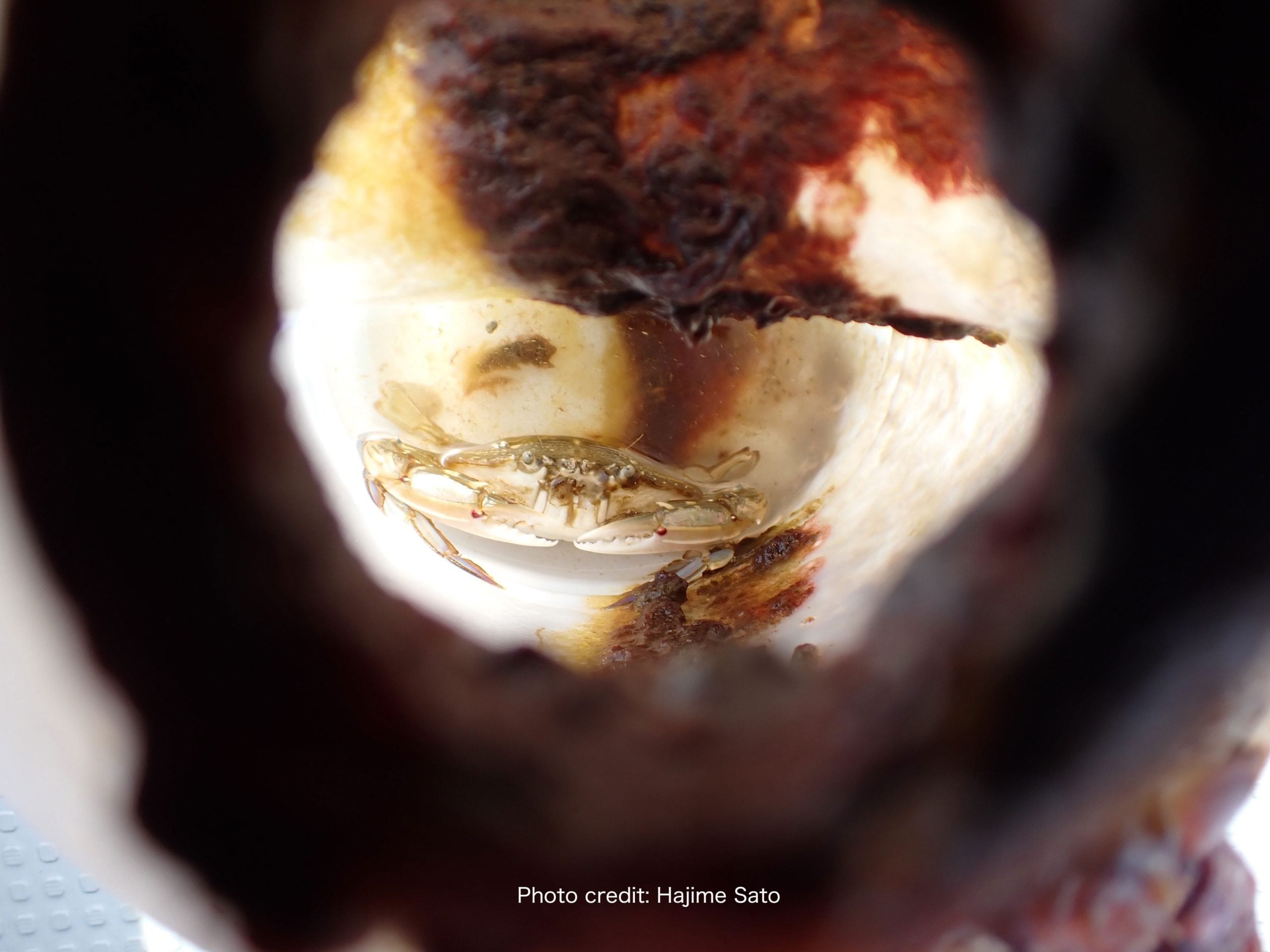
About 500 meters off Sesoko Island in Okinawa, Japan, a plastic bottle drifted at the sea surface with juvenile fish gathered around it. Inside was something harder to explain: a live swimming crab whose body had grown far wider than the bottle’s opening.
The crab was not simply sheltering inside the debris. It was trapped. That puzzle led Hiroshima University researchers to reconstruct how the animal entered the bottle, what it ate, and how it survived long enough to outgrow its only exit.
Plastic pollution is often illustrated through large animals in obvious distress, such as seals and seabirds caught in discarded fishing nets or sea turtles swallowing plastic bags. This case revealed a quieter danger. Floating waste can also become a confined habitat that threatens smaller marine animals, including crustaceans.
The researchers found the crab inside a high-density polyethylene (HDPE) bottle that had once contained Shaoxing wine. The container was floating in waters off Okinawa, Japan. By examining the bottle and the animal inside it, the researchers sought to understand how an ordinary piece of plastic waste had become an inescapable chamber.
The findings were published in the journal Ecosphere.
A bottle becomes a trap
“During juvenile fish surveys in offshore waters, we happened to encounter a floating plastic bottle approximately 500 m off Sesoko Island, Okinawa, Japan, with many juvenile fish associated with it,” say study authors Hajime Sato and Yoichi Sakai. Sato, first and corresponding author of the study, was a doctoral student under Sakai at the time of the study (now a postdoctoral research fellow at the Okinawa Institute of Science and Technology (OIST) in Okinawa). Sakai is a professor at Hiroshima University’s Graduate School of Integrated Sciences for Life. “[To our surprise], a large live swimming crab, Portunus sanguinolentus, was trapped inside the bottle. The crab was clearly larger than the opening of the bottle!”
The researchers collected the bottle on July 15, 2022. Manufacturing marks showed that it had been produced on November 17, 2021. Its cap was missing, so seawater could circulate freely through the container.
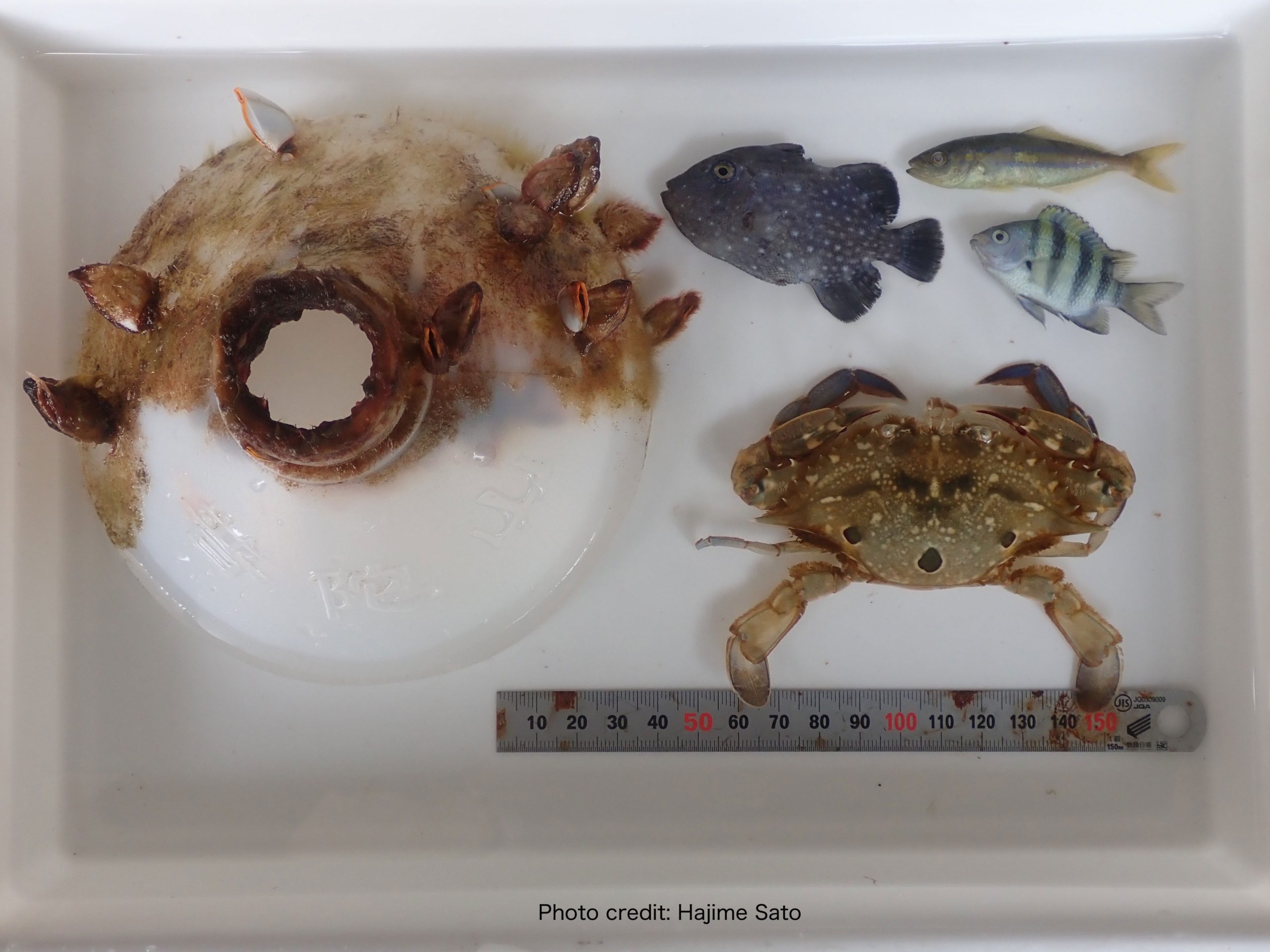
Measurements made the central mystery clear. The bottle’s mouth was only 24 mm across, but the crab measured 40.31 mm long and 88.23 mm wide and weighed 42.06 g. An animal of that size could not have passed through the opening. The researchers therefore needed to determine whether it had entered when it was smaller and how long it had remained inside.
Evidence reconstructs its survival
To retrace the crab’s history, the researchers examined biological evidence preserved both inside and outside the bottle. Each clue addressed a different part of the problem, from how the crab found food to how long the container had been drifting.
DNA recovered from the crab’s stomach contents identified juvenile fish that had gathered around the floating bottle. Its prey included the rough triggerfish Canthidermis maculata and the sergeant major Abudefduf vaigiensis. The crab had also eaten algae that probably developed on the bottle’s interior.
The researchers then turned to the goose barnacle Lepas anserifera attached to the bottle. Because barnacles grow at measurable rates, its size provided a biological clock that helped estimate how long the container had been drifting at sea.
Together, the evidence supported a consistent explanation. The crab had probably entered the bottle as a juvenile, when it was still small enough to pass through the opening. It then survived for about two months by feeding on young fish and algae before growing too large to leave.
“This crab reminds us of Salamander, a famous short story by Japanese novelist Masuji Ibuse,” the authors said. Salamander depicts the despair of a salamander who, after spending more than two years continuously eating in its burrow, becomes unable to leave because of its growth.
Plastic debris threatens small animals
The case suggests that discarded bottles can create hazards that are easy to overlook. A container may appear to provide shelter and food, yet an animal that enters while young can become permanently confined as its body grows.
“Plastic bottles discarded by humans can trap crabs and prevent their escape. Similar cases have already been reported from waters around Japan, suggesting that this was not an isolated accident. Through this striking example, we would like readers to recognize that objects that make our lives more convenient can sometimes have unexpected effects on small marine animals, while also appreciating the remarkable vitality of the swimming crab,” the authors conclude.
Reference: “Swimming crab in a bottle: A two-month drift on the ocean surface while entrapped” by Hajime Sato, Yoichi Sakai and Tetsuo Kuwamura, 3 April 2026, Ecosphere.
DOI: 10.1002/ecs2.70609
This study was supported by the Sasakawa Scientific Research Grant from the Japan Science Society and by the Japan Science and Technology Agency (JST) under the University Fellowships for the Creation of Science and Technology Innovation (grant number JPMJFS2129 to Hajime Sato).
Never miss a breakthrough: Join the SciTechDaily newsletter.
Follow us on Google and Google News.
3 Comments
Why couldn’t it use its pincher claw to poke through the bottle at a weak point and rip open an exit?
Please tells us just where that “weak point” is located. Crabs United would like to know.
Poor little crab. Gets stuck in a glass prison, then when he’s found, the humans decide to study his gastric contents (this kills the crab).