
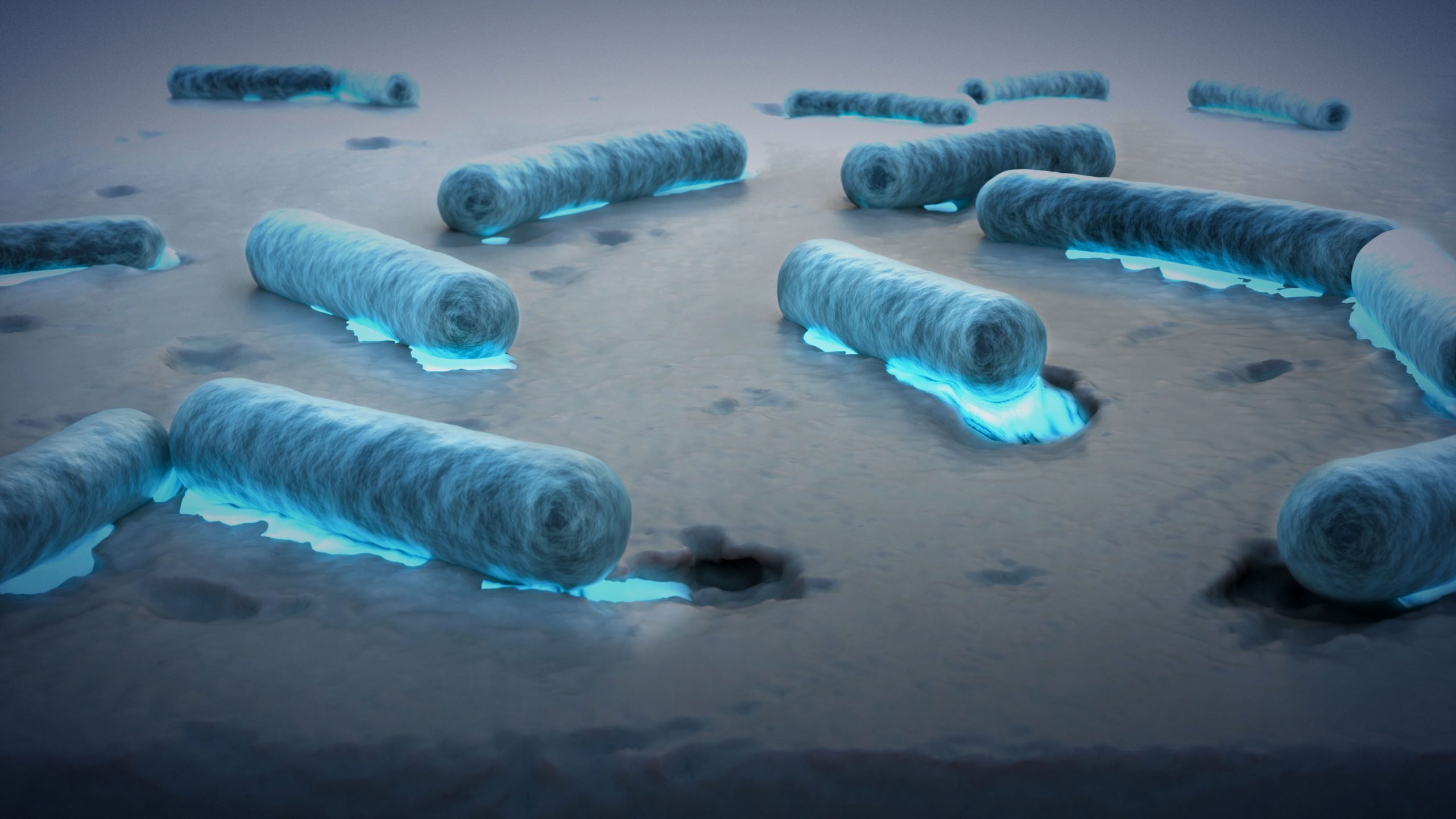
A newly discovered enzyme motif reveals how ocean microbes are evolving to digest plastic, potentially aiding future cleanup efforts.
Hidden in the depths of the ocean, scientists have discovered marine bacteria equipped with enzymes that can consume plastic, their evolution shaped by humanity’s discarded waste.
According to a global study by researchers at KAUST, these microscopic recyclers are not only abundant but also genetically adapted to break down polyethylene terephthalate (PET), the tough plastic used in products such as beverage bottles and fabrics.
The key to their ability lies in a distinctive structural feature of the PET-degrading enzyme, called PETase. This identifying mark, known as the M5 motif, serves as a molecular signature of the enzyme’s plastic-eating power.
“The M5 motif acts like a fingerprint that tells us when a PETase is likely to be functional, able to break down PET plastic,” explains Carlos Duarte, a marine ecologist and co-leader of the study. “Its discovery helps us understand how these enzymes evolved from other hydrocarbon-degrading enzymes,” he says. “In the ocean, where carbon is scarce, microbes seem to have fine-tuned these enzymes to make use of this new, human-made carbon source: plastic.”
From Indestructible Plastic to Microbial Feast
For years, scientists believed that PET could not be naturally broken down. That view began to change in 2016, when researchers identified a bacterium living in a Japanese recycling facility that was thriving on plastic waste. This organism had developed an enzyme, known as a PETase, that could dismantle PET into its basic building blocks.
However, scientists were still unsure whether ocean-dwelling microbes had evolved similar enzymes.
Through a combination of AI-driven structural modeling, extensive genetic analysis, and laboratory testing, Duarte and his team discovered that a specific feature called the M5 motif distinguishes genuine PET-degrading microbes from those that only resemble them. Marine bacteria possessing the complete motif were able to efficiently break down PET in the lab. Further gene expression studies showed that M5-PETase genes are highly active throughout the oceans, particularly in regions heavily polluted with plastic.
To chart the global spread of these enzymes, the team analyzed more than 400 ocean samples from across the seven seas, finding functional versions with the M5 motif in nearly 80 percent of the waters tested — from rubbish-rich surface gyres to nutrient-starved depths two kilometers down. In the latter, the ability to snack on synthetic carbon may confer a crucial survival advantage, according to Intikhab Alam, a senior bioinformatics researcher who co-led the study.
A Slow Natural Response to Human Pollution
Ecologically, the rise of these enzymes signals an early microbial response to humanity’s planetary littering.
Duarte warns that nature’s cleanup crew works far too slowly to rescue the seas. “By the time plastics reach the deep sea, the risks to marine life and human consumers have already been inflicted,” he says.
On land, however, the discovery could fast-track industrial enzyme design for closed-loop recycling. “The range of PET-degrading enzymes spontaneously evolved in the deep sea provides models to be optimized in the lab for use in efficiently degrading plastics in treatment plants and, eventually, at home,” Duarte notes.
To that end, the M5 motif now offers the blueprint, pinpointing the structural tweaks that matter in real-world conditions, not just in a test tube. If scientists can harness those tweaks, then — as the world gropes for ways to tidy its plastic mess — they may find unlikely allies in the abyss: bacteria that already turn waste into lunch.
Reference: “Widespread distribution of bacteria containing PETases with a functional motif across global oceans” by Intikhab Alam, Ramona Marasco, Afaque A Momin, Nojood Aalismail, Elisa Laiolo, Cecilia Martin, Isabel Sanz-Sáez, Begoña Baltá Foix, Elisabet L Sá, Allan Kamau, Francisco J Guzmán-Vega, Tahira Jamil, Silvia G Acinas, Josep M Gasol, Takashi Gojobori, Susana Agusti, Daniele Daffonchio, Stefan T Arold and Carlos M Duarte, 10 June 2025, The ISME Journal.
DOI: 10.1093/ismejo/wraf121
Never miss a breakthrough: Join the SciTechDaily newsletter.
Follow us on Google and Google News.
9 Comments
Bacteria eating plastic is not ‘evolution’. It is of gene expression modification. This is an inbuilt ability, as standard equipment in all life. This takes on an intelligent design signature, not the Godless evolution one. Evolution is NOT happening. Evolutionary theory is misspeaking on epigenetic’epigenome-derived adaptations and EFFECTS from mutations making new traits or new phenotypes. An slowly accumulating mutations load is normal but does not equal evolution. It is a non sequitur. Evolution is all smoke and mirrrors.
We are a creation by Jesus Christ. Also known as The Word in Genesis. He did not pop into existence 2025 years ago but is from the beginning. Get the free gift of eternal life before it is too late thru His substitutionary death for you by having faith in it and He resurrected. This is the simpler explanation for life. Evolution is absurd comic book science.
Just because an explanation is simple does not mean it is right. Simplicity is “Sweets for the sweet.”
If God made Man in the form of himself, why does God have reproductive organs? There is no reproductive capability inherent in God the Spirit, God the Father does not have a feminine counterpart to impregnate and had to send an angel to instill conception in the Virgin Mary. That did not require reproductive organs. Why did God, who is reputed to be all powerful, need the assistance of an angel when He could have simply willed Mary’s pregnancy into existence. For that matter, why not duplicate the cloning method He used to create Adam — a lump of clay — and avoid any possible dissension about the status of Mary’s virginity and the paternity of Jesus?
I find that evolution is a more acceptable explanation than the idea that a God created the universe and ‘designed’ life because if life required a God, where did God come from? Saying that God always existed is just a ‘kick the can down the road’ argument because the counter to it is, if insisting that the universe needs a creator, then why did God not need a creator. To paraphrase an old joke, “It is turtles all the way down.” It seems to me that there is no logical barrier to accepting the idea that the universe, or at least its fundamental constituent parts, have always existed if one is willing to accept the claim that God has always existed. It strikes me that the whole complex of bizarre events is a house of cards held together only by blind faith.
Thank you, Clyde, for a little of what should be common sense (e.g., that a “beginning” [& thus a pre-existing “creator”] of everything is impossible), but, what instead is very uncommon: using our 99-billion neuron brain to simply see what must be true .. and what must be false. \\
Thank you, Clyde, for a little of what should be common sense (e.g., that a “beginning” [& thus a pre-existing “creator”] of everything is impossible), but, what instead is very uncommon: using our 99-billion neuron brain to simply see what must be true .. and what must be false. \\
….if insisting that the universe needs a creator,……..
No, I agree, a daft idea; but it just needed a self-exploding singularity that appeared from nowhere, wherever nowhere was and whatever it was at the time, according to my simplistic understanding of Hubellian cosmological thought.
Maybe I’ll go for turtles………..
Reminds me of a number of SciFi movies where the bacteria evolve to eat stuff…and it doesn’t stop.
Oh, what could possibly go wrong???
I agree that the side effects are potentially catastrophic when — not if — the recycling bacteria escape confinement. We might have to go back to wearing furs instead of synthetic fibers and plastic objects would probably have shorter lifespans than currently.
As bacteria can eat us, I am sure they could cope with real furs made of protein………
I suspect that the problem with fur coats is largely one of losing the hairs and either losing the insulating value, or begins to look shabby, defeating the purpose of looking luxurious and fashionable. However, a heavy leather coat can last longer than a person’s lifetime. Usually, the stitching (which can be replaced) goes before the leather. The bacteria then handle the final job of disposing of what gets discarded. However, if a bacterium is designed expressly for the purpose of recycling plastics, it will almost certainly be much more effective than run-of-the-mill wild forms and be faster and more efficient. That is what worries me.