
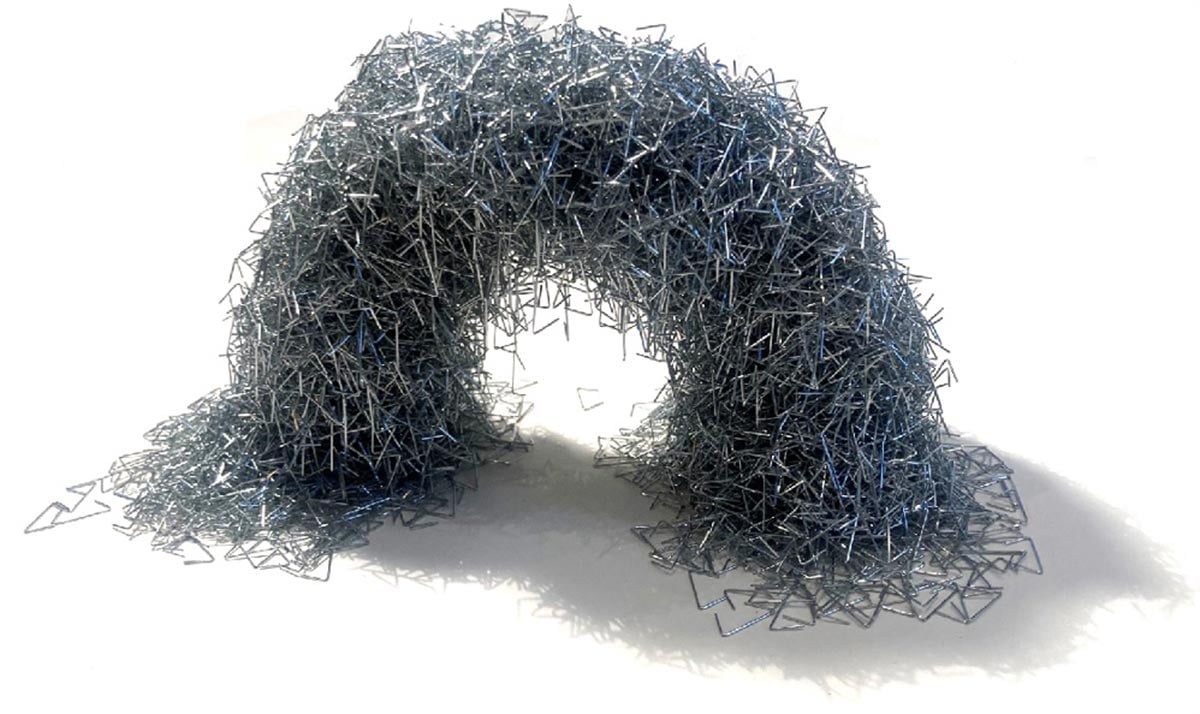
A simple bundle of staples reveals an unusual physical behavior, one that shifts between rigidity and fluidity depending on how it is handled.
A dense clump of office staples can act in an unexpected way. Pull on it, and the tangled metal resists like a rigid object.
Shake it the right way, and it suddenly loosens, collapsing into separate pieces.
This unusual behavior is now inspiring engineers at the University of Colorado Boulder to rethink how materials can be designed from the ground up. Instead of relying on traditional solid blocks or chemical bonding, they are exploring systems made of small, specially shaped particles that physically hook into one another and can also come apart on command.
“We’ve been playing around with the idea of building blocks and geometry for many years, but we started looking at interlocking, entangled particles only recently,” said Professor Francois Barthelat, the leader of the Laboratory for Advanced Materials & Bioinspiration. “We are excited about the combination of properties we can get out of these systems and we believe this technology has the potential to go in many directions.”
Learning From Entanglement in Nature
The study, published in the Journal of Applied Physics, centers on what the team calls “entanglement,” a process where particles become intertwined and form connections.
This idea is not new. Many natural structures rely on interlocking elements to gain strength. A bird’s nest, for example, is built from woven sticks and fibers, while bones depend on the interaction between rigid minerals and softer proteins.
The challenge is how to recreate this effect in engineered materials. According to Barthelat’s team, the answer largely depends on particle shape.
“Let’s take sand as an example. Sand is smooth and convex-shaped, meaning it cannot interlock from grain to grain,” PhD student Youhan Sohn said. “However, we found that if we change the shape of a grain of sand, we can drastically affect its behavior and mechanical properties, including the particle’s ability to link with other particles.”
After identifying this key factor, the researchers used Monte Carlo simulations, a computational method, to predict how different shapes would interact. Their goal was to determine which geometry would produce the highest level of entanglement.
They then carried out pickup tests to observe how these particles behaved in practice.
Discovering an Optimal Design
The experiments pointed to a simple but effective solution. A “two-legged” particle, shaped like a staple, showed the strongest tendency to interlock.
This design also revealed several unexpected benefits. One was a rare combination of tensile strength and toughness, a pairing that is difficult to achieve with conventional materials.
“Our entangled granular material using the staple-like particle demonstrates both high strength and toughness at the same time,” said PhD student Saeed Pezeshki.
Another advantage was how quickly the material could assemble and break apart. By applying different vibration patterns, the researchers could control how tightly the particles linked together. Gentle vibrations encouraged interlocking and increased strength, while stronger vibrations caused the structure to come apart.
“It’s a strange material because it’s obviously not a liquid. However, it’s also not quite solid. This opens new and intriguing engineering possibilities,” Barthelat said. “Handling a bundle of these entangled particles feels very remote and exotic.”
Future Applications and Possibilities
One promising area is sustainability. The team envisions buildings and bridges made from these materials that could be taken apart when no longer needed and reused or recycled.
There may also be applications in robotics.
“I was talking with other students who believe this technology can be used in swarm robotics— where small robots can entangle, do a task, and then disentangle when they are done,” said Pezeshki.
“Yes, kind of like that liquid metal T-1000 in Terminator 2 who can change shape to slide under a door and then transform back to a human’s size on the other side,” added Barthelat. “It’s expensive and scaling up is a challenge, but it’s something that’s on everybody’s mind.”
For now, the researchers are continuing to refine their approach. They are testing new particle designs with extra protruding “legs,” similar to the spiky burrs that cling to clothing, which may create even stronger entanglement effects.
Reference: “Combined effects of particle geometry and applied vibrations on the mechanics and strength of entangled materials” by Saeed Pezeshki and Francois Barthelat, 10 April 2026, Journal of Applied Physics.
DOI: 10.1063/5.0308921
Never miss a breakthrough: Join the SciTechDaily newsletter.
Follow us on Google and Google News.
1 Comment
thanks for this