

Close Menu
    Facebook X (Twitter) Instagram
    SciTechDaily
    • Biology
    • Chemistry
    • Earth
    • Health
    • Physics
    • Science
    • Space
    • Technology
    Facebook X (Twitter) Pinterest YouTube RSS
    SciTechDaily
    Home»Physics»Harnessing Energy Waves: Smart Material Prototype Challenges Newton’s Laws of Motion
    Physics

    Harnessing Energy Waves: Smart Material Prototype Challenges Newton’s Laws of Motion

    By University of Missouri-ColumbiaMay 19, 20231 Comment4 Mins Read
    Facebook Twitter Pinterest Telegram LinkedIn WhatsApp Email Reddit
    Share
    Facebook Twitter LinkedIn Pinterest Telegram Email Reddit
    Swirl Particle Physics Concept
    A prototype innovative metamaterial with unconventional properties employs electrical signals to control the direction and intensity of energy waves traversing a solid. This innovative metamaterial, characterized by odd mass density, presents a divergence from Newton’s second law, as force and acceleration do not go in the same direction. Huang envisions wide-ranging applications from military and commercial uses, such as controlling radar waves or managing vibration from air turbulence in aircraft, to civil uses like monitoring the health of structures like bridges and pipelines.

    University of Missouri researchers designed a prototype of a small, lightweight active ‘metamaterial’ that can control the direction and intensity of energy waves.

    Professor Guoliang Huang of the University of Missouri has developed a prototype metamaterial that can control the direction and intensity of energy waves using electrical signals. The innovative material has potential applications in the military and commercial sectors, and can also be used to monitor the structural health of bridges and pipelines.

    For more than 10 years, Guoliang Huang, the Huber and Helen Croft Chair in Engineering at the University of Missouri, has been investigating the unconventional properties of “metamaterials” — an artificial material that exhibits properties not commonly found in nature as defined by Newton’s laws of motion — in his long-term pursuit of designing an ideal metamaterial.

    Huang’s goal is to help control the “elastic” energy waves traveling through larger structures — such as an aircraft — without light and small “metastructures.”
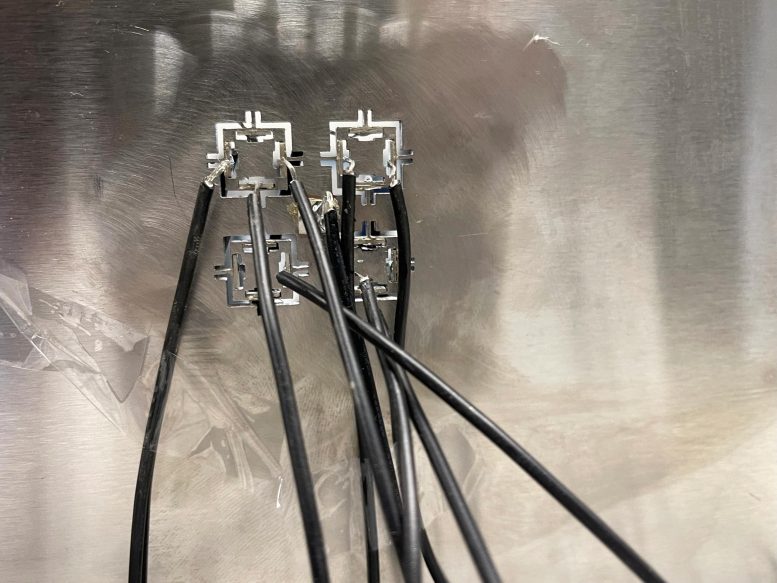
    Prototype Metamaterial Uses Electrical Signals To Control Energy Waves
    The prototype metamaterial uses electrical signals transported by these black wires to control both the direction and intensity of energy waves passing through a solid material. Credit: University of Missouri

    “For many years I’ve been working on the challenge of how to use mathematical mechanics to solve engineering problems,” Huang said. “Conventional methods have many limitations, including size and weight. So, I’ve been exploring how we can find an alternative solution using a lightweight material that’s small but can still control the low-frequency vibration coming from a larger structure, like an aircraft.”

    Guoliang Huang
    Guoliang Huang. Credit: University of Missouri

    Now, Huang’s one step closer to his goal. In a new study published in the Proceedings of the National Academy of Sciences (PNAS) on May 18, Huang and colleagues have developed a prototype metamaterial that uses electrical signals to control both the direction and intensity of energy waves passing through a solid material.

    Potential applications of his innovative design include military and commercial uses, such as controlling radar waves by directing them to scan a specific area for objects or managing vibration created by air turbulence from an aircraft in flight.

    Challenging Newton’s Laws with Odd Mass Density

    “This metamaterial has odd mass density,” Huang said. “So, the force and acceleration are not going in the same direction, thereby providing us with an unconventional way to customize the design of an object’s structural dynamics, or properties to challenge Newton’s second law.”

    This is the first physical realization of odd mass density, Huang said.

    “For instance, this metamaterial could be beneficial to monitor the health of civil structures such as bridges and pipelines as active transducers by helping identify any potential damage that might be hard to see with the human eye.”

    Reference: “Active metamaterials for realizing odd mass density” by Qian Wu, Xianchen Xu, Honghua Qian, Shaoyun Wang, Rui Zhu, Zheng Yan, Hongbin Ma, Yangyang Chen and Guoliang Huang, 18 May 2023, Proceedings of the National Academy of Sciences.
    DOI: 10.1073/pnas.2209829120

    Other MU contributors include Qian Wu, Xianchen Xu, Honghua Qian, Shaoyun Wang, Zheng Yan and Hongbin Ma. Grants from the Air Force Office of Scientific Research and the Army Research Office funded the research.

    Never miss a breakthrough: Join the SciTechDaily newsletter.
    Follow us on Google and Google News.

    Materials Science Mechanical Engineering Metamaterials Popular University of Missouri-Columbia
    Share. Facebook Twitter Pinterest LinkedIn Email Reddit

    Related Articles

    160x More Power From a Twist: The Metamaterial Breakthrough Redefining Energy Storage

    Not Science Fiction: Harvard Scientists Have Developed an “Intelligent” Liquid

    Breaking Physics: How Solitons Bend Time, Space, and Rules

    Engineering the Unbreakable: MIT’s Microscopic Metamaterials Defy Supersonic Impacts

    Collision Course: Electromagnetic Waves Interact in Groundbreaking Experiment

    Fourth Dimension Breakthrough: New Metamaterial Controls Energy Waves

    Light Control Breakthrough – Innovative Twist in Physics “A Blessing in Disguise!”

    Ancient Arts of Origami and Kirigami Inspire Mechanical Metamaterials

    3D Kirigami Building Blocks Designed To Make Dynamic Metamaterial Structures

    1 Comment

    1. BibhutibhusanPatel on June 3, 2023 1:56 am

      There is a near perfect solution within certain limits
      in designing of materials for such problematic situation with Newton’s laws can be possible.So,more works can only refine the model.

      Reply
    Leave A Reply Cancel Reply

    • Facebook
    • Twitter
    • Pinterest
    • YouTube

    Don't Miss a Discovery

    Subscribe for the Latest in Science & Tech!

    Trending News

    Scientists Warn That This Common Pet Fish Can Wreck Entire Ecosystems

    Scientists Make Breakthrough in Turning Plastic Trash Into Clean Fuel Using Sunlight

    This Popular Supplement May Interfere With Cancer Treatment, Scientists Warn

    Scientists Finally Solved One of Water’s Biggest Mysteries

    Could This New Weight-Loss Pill Disrupt the Entire Market? Here’s What You Should Know About Orforglipron

    Earth’s Crust Is Tearing Open in Africa, and It Could Form a New Ocean

    Breakthrough Bowel Cancer Trial Leaves Patients Cancer-Free for Nearly 3 Years

    Natural Compound Shows Powerful Potential Against Rheumatoid Arthritis

    Follow SciTechDaily
    • Facebook
    • Twitter
    • YouTube
    • Pinterest
    • Newsletter
    • RSS
    SciTech News
    • Biology News
    • Chemistry News
    • Earth News
    • Health News
    • Physics News
    • Science News
    • Space News
    • Technology News
    Recent Posts
    • Kratom Use Explodes in the US, With Life-Changing Consequences
    • Scientists Uncover Fatal Weakness in “Zombie Cells” Linked to Cancer
    • World-First Study Reveals Human Hearts Can Regenerate After a Heart Attack
    • Why Your Dreams Feel So Real Sometimes and So Strange Other Times
    • Scientists Debunk 100-Year-Old Belief About Brain Cells, Rewriting Textbooks
    Copyright © 1998 - 2026 SciTechDaily. All Rights Reserved.
    • Science News
    • About
    • Contact
    • Editorial Board
    • Privacy Policy
    • Terms of Use

    Type above and press Enter to search. Press Esc to cancel.