
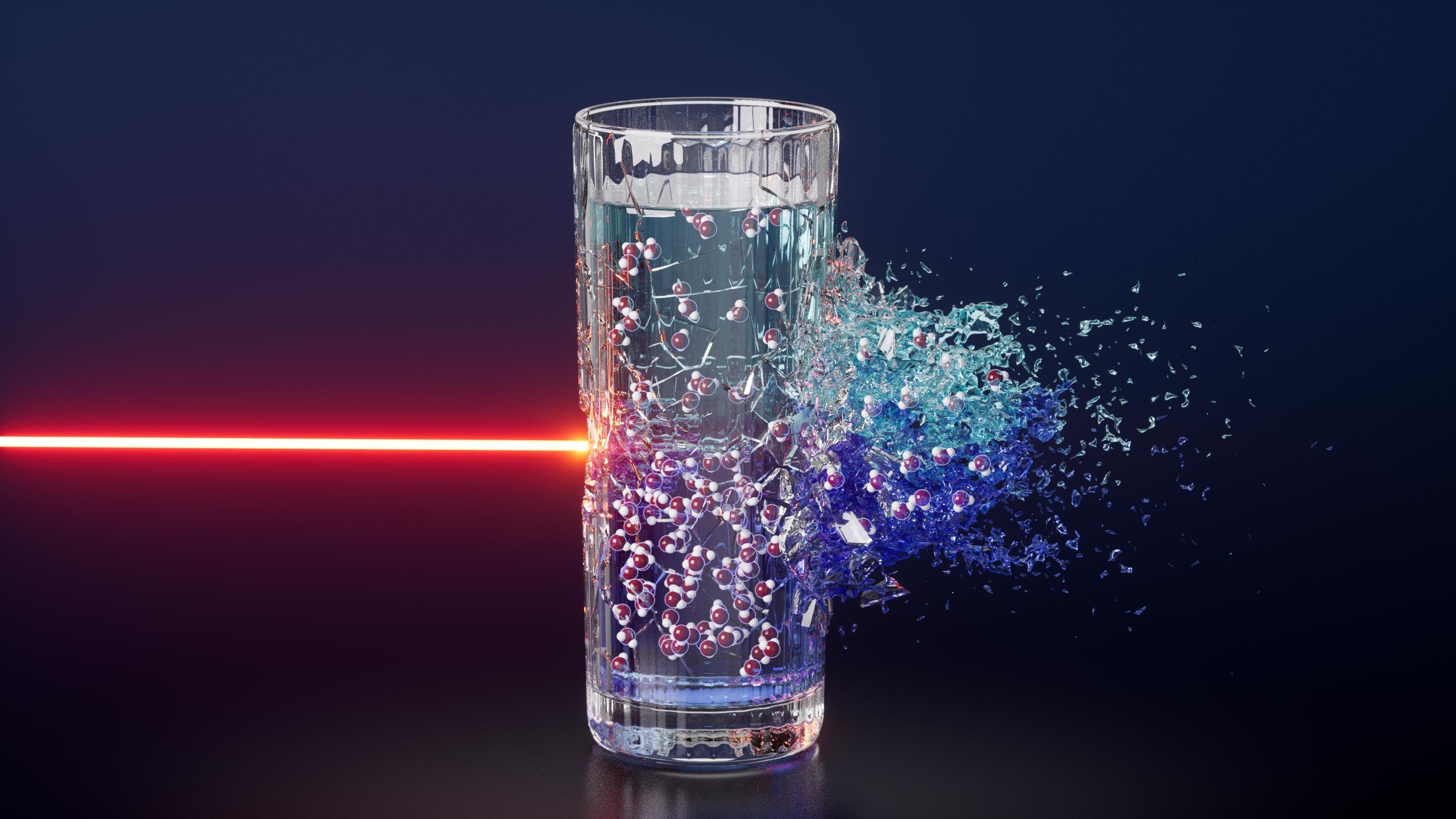
Scientists uncovered a hidden state in water that explains its bizarre behavior.
Researchers at Stockholm University have used advanced X-ray laser technology to uncover a long-suspected feature of water: a critical point that appears when water is deeply supercooled, around -63 °C and 1000 atmospheres. This hidden state helps explain why water behaves so unusually under normal conditions. The results have been published in the journal Science.
Water is everywhere and essential for life, yet it behaves very differently from most other liquids. Properties such as density, specific heat, viscosity, and compressibility respond to temperature and pressure in ways that run counter to what scientists see in other substances.
Why Water Defies Normal Physical Rules
Most materials become denser as they cool. Following that logic, water should be most dense at its freezing point. However, everyday observations show the opposite. Ice floats, meaning it is less dense than liquid water. In fact, water reaches its maximum density at 4 degrees C, which is why it sinks below ice in a glass or in natural bodies of water.
When cooled below 4 degrees, water begins expanding again. If pure water is cooled further below 0 degrees without freezing (a process possible when crystallization is slow), this expansion continues and even accelerates as the temperature drops. Other properties, including compressibility and heat capacity, also become increasingly unusual as the water cools.
X-Ray Lasers Reveal Water’s Hidden State
To investigate these mysteries, scientists used ultra-fast X-ray pulses at facilities in South Korea, allowing them to observe water before it could freeze. This made it possible to identify the critical point and confirm its role in shaping water’s unusual behavior.
“What was special was that we were able to X-ray unimaginably fast before the ice froze and could observe how the liquid-liquid transition vanishes and a new critical state emerges,” says Anders Nilsson, Professor of Chemical Physics at the Department of Physics at Stockholm University. “For decades, there have been speculations and different theories to explain these remarkable properties, and one theory has been the existence of a critical point. Now we have found that such a point exists.”
Two Liquid Forms of Water and a Critical Transition
Water is unusual because it can exist as two distinct liquid forms under low temperature and high pressure. These forms differ in how their molecules are arranged and bonded. As temperature rises and pressure drops, the distinction between these two liquid states disappears, merging into a single phase at the critical point.
This region is highly unstable, producing fluctuations across a wide range of temperatures and pressures, even reaching everyday conditions. In this state, water shifts between the two liquid structures, almost as if it cannot settle on one. These fluctuations are what give water its unusual properties. Beyond the critical point, water enters a supercritical state, which is the condition of water under normal ambient environments.
A Slowing System Near a “Black Hole” Like State
The researchers also observed that the system’s dynamics slow significantly as it approaches the critical point. “It looks almost as if you cannot escape the critical point if you entered it, almost like a Black Hole,” says Robin Tyburski, researcher in Chemical Physics at Stockholm University.
Breakthrough Built on Advanced Technology
“It’s amazing how amorphous ices, such an extensively studied state of water, happened to become our entrance to the critical region. It’s a great inspiration for my further studies and a reminder of the possibilities of making discoveries in much-studied topics such as water,” says Aigerim Karina, Postdoc in Chemical Physics at Stockholm University.
“It was a dream come true to be able to measure water under such low temperature condition without freezing,” says Iason Andronis, PhD student in Chemical Physics at Stockholm University. “Many have dreamt about finding this critical point, but the means have not been available before the development of the x-ray lasers.”
Implications for Science and Life
“I find it very exciting that water is the only supercritical liquid at ambient conditions where life exists and we also know there is no life without water. Is this a pure coincidence or is there some essential knowledge for us to gain in the future?” says Fivos Perakis, an associate professor in Chemical Physics at Stockholm University.
For more than a century, scientists have debated why water behaves so differently, dating back to the work of Wolfgang Röntgen. According to Anders Nilsson, this discovery may finally resolve that debate. “Researchers studying the physics of water can now settle on the model that water has a critical point in the supercooled regime. The next stage is to find the implications of these findings on waters importance in physical, chemical, biological, geological and climate related processes. A big challenge in the next few years.”
Reference: “Experimental evidence of a liquid-liquid critical point in supercooled water” by Seonju You, Marjorie Ladd-Parada, Kyeongmin Nam, Aigerim Karina, Seoyoung Lee, Myeongsik Shin, Cheolhee Yang, Yeseul Han, Sangmin Jeong, Kichan Park, Kyeongwon Kim, Minjeong Ki, Robin Tyburski, Iason Andronis, Keely Ralf, Jae Hyuk Lee, Intae Eom, Minseok Kim, Rory Ma, Dogeun Jang, Fivos Perakis, Peter H. Poole, Katrin Amann-Winkel, Kyung Hwan Kim and Anders Nilsson, 26 March 2026, Science.
DOI: 10.1126/science.aec0018
The research involved collaboration between institutions including POSTECH University and PAL-XFEL in South Korea, the Max Planck Society and Johannes Gutenberg University in Germany, and St. Francis Xavier University in Canada. Contributors from Stockholm University included Aigerim Karina, Robin Tyburski, Iason Andronis, and Fivos Perakis, along with former group members Kyung Hwan Kim, Marjorie Ladd-Parada, and Katrin Amann-Winkel.
Never miss a breakthrough: Join the SciTechDaily newsletter.
Follow us on Google and Google News.
6 Comments
Your article: “St. Francis Xavier University in Candada” (sic). Where is Candada?
I was imagining that maybe the unusual states water transitions into could be associated with higher dimensions revealing themselves, then BAM, you mentioned like it’s entering a black hole. Crazy universe.
Most will immediately understand what country that is, others, like you, have problems with that, or you’re just an annoying person that needs to always point out every typo.
water, amongst other “crazy” truths regarding “reality” (as we perceive/conceive) including the horrendously, almost ridiculously extreme probabilities for not just life to randomly occur, but also the equally extreme probabilities for matter and the laws of physics to be so almost impossibly exact in the “finely-tuned” balance of parameters, just makes accepting randomness as becoming the single most ludicrously unlikely explanation the more is discovered, that the only sensible stance is agnostic, simply because random materialism is just so impossibly untenable from a purely probabilistic pov. probably.
The level of understanding we have of water is almost zero. That is about to change thank god. Some people are melding science art and consciousness to bring forward the wonders of water.
I can’t understand how supposedly intelligent scientist and certain astronomers and others actually still are so narrow minded that they don’t understand that there are many other bases for life other than water.
Mankind is definitely not intelligent.