

Close Menu
    Facebook X (Twitter) Instagram
    SciTechDaily
    • Biology
    • Chemistry
    • Earth
    • Health
    • Physics
    • Science
    • Space
    • Technology
    Facebook X (Twitter) Pinterest YouTube RSS
    SciTechDaily
    Home»Physics»Ancient Arts of Origami and Kirigami Inspire Mechanical Metamaterials
    Physics

    Ancient Arts of Origami and Kirigami Inspire Mechanical Metamaterials

    By American Institute of PhysicsDecember 4, 20211 Comment3 Mins Read
    Facebook Twitter Pinterest Telegram LinkedIn WhatsApp Email Reddit
    Share
    Facebook Twitter LinkedIn Pinterest Telegram Email Reddit
    Abstract Fractal Mechanical Material Concept
    Origami and kirigami, ancient paper-folding and cutting arts, are increasingly popular among researchers crafting mechanical metamaterials.

    Origami- and kirigami-based metamaterials have applications from robotics to medical devices.

    The ancient arts of origami, the art of paper-folding, and kirigami, the art of paper-cutting, have gained popularity in recent years among researchers building mechanical metamaterials. Folding and cutting 2D thin-film materials transforms them into complex 3D structures and shapes with unique and programmable mechanical properties.

    In Applied Physics Reviews, by AIP Publishing, researchers in the United States and China categorize origami- and kirigami-based mechanical metamaterials, artificially engineered materials with unusual mechanical properties, into six groups based on two different criteria.

    “Origami and kirigami are, by nature, mechanical metamaterials, because their properties are mainly determined by how the crease patterns and/or cuts are made and just slightly depend on the material that folds the origami or kiragami,” said author Hanqing Jiang.
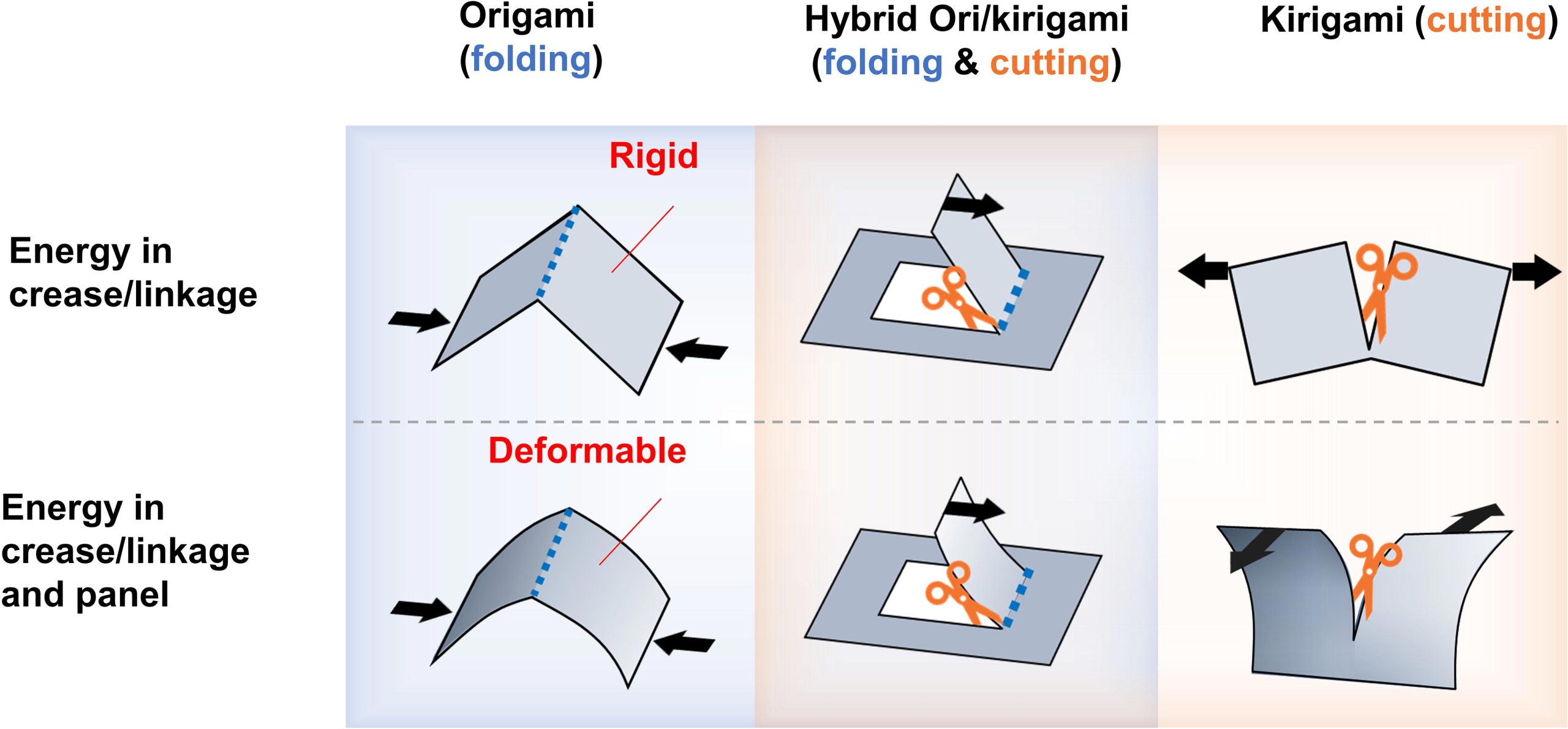
    Origami and Kirigami Based Mechanical Metamaterials
    Categories of origami- and kirigami-based mechanical metamaterials. Credit: Zirui Zhai and Hanqing Jiang

    Origami, Kirigami, and Hybrid Categories

    The researchers divided the mechanical metamaterials into three categories that include origami-based metamaterials (folding only), kirigami-based metamaterials (cutting only), and hybrid origami-kirigami metamaterials (both folding and cutting). The hybrid origami-kirigami metamaterials, in particular, offer great potential in shape morphing.

    Each group was subdivided into a rigid or deformable category based on the elastic energy landscape. Metamaterials were classified as rigid if energy was stored in the creases or linkages only. Metamaterials were put in the deformable category if energy was stored in both creases or linkages and panels.

    The researchers want to discover new origami and kirigami designs, especially curved origami designs, hybrid origami-kirigami designs, modular designs, and hierarchical designs.

    They plan to focus on the selection of new materials for origami- and kirigami-based mechanical metamaterials. Traditionally paper is used to prototype metamaterials but there are limits based on the fragility and plasticity of paper. To design for real-world applications, it will be helpful to explore materials with different properties such as thin or thick, soft or hard, and elastic or plastic.

    Analyzing Performance Through Energy Distribution

    They want to use the energy landscape and energy distribution as two powerful tools to analyze the mechanical performances of origami and kirigami and will seek to carefully design the actuation method of origami- and kirigami-based mechanical metamaterials.

    “Origami- and kiragami-based mechanical metamaterials can be applied in many fields, including flexible electronics, medical devices, robotics, civil engineering and aerospace engineering,” said Jiang.

    Reference: “Mechanical metamaterials based on origami and kirigami” by Zirui Zhai, Lingling Wu and Hanqing Jiang, 23 November 2021, Applied Physics Reviews.
    DOI: 10.1063/5.0051088

    Never miss a breakthrough: Join the SciTechDaily newsletter.
    Follow us on Google and Google News.

    American Institute of Physics Materials Science Mechanical Engineering Metamaterials Robotics
    Share. Facebook Twitter Pinterest LinkedIn Email Reddit

    Related Articles

    Breaking Physics: How Solitons Bend Time, Space, and Rules

    Harnessing Energy Waves: Smart Material Prototype Challenges Newton’s Laws of Motion

    Spider-Man-Style Robotic Graspers Defy Gravity – Secret Is High-Speed Rotating Water Rings

    ‘Robotic Skins’ Turn Inanimate Objects Into Multifunctional Robots

    Nanoscientists Develop Blueprint for Next-Generation Computing

    Metamaterials Amplify the Photonic Spin Hall Effect

    Cathodoluminescence Used to Probe Metamaterials

    Electron-Cloaking Material May Enable More Efficient Transfer of Electrons

    Light Activated Muscle Cells May Advance Biorobotics

    1 Comment

    1. Larry on December 5, 2021 4:26 pm

      Good

      Reply
    Leave A Reply Cancel Reply

    • Facebook
    • Twitter
    • Pinterest
    • YouTube

    Don't Miss a Discovery

    Subscribe for the Latest in Science & Tech!

    Trending News

    Scientists Discover 132-Million-Year-Old Dinosaur Tracks on South Africa’s Coast

    Scientists Uncover the Secret Ingredient Behind the Spark That May Have Started Life on Earth

    Physicists Observe Matter in Two Places at Once in Mind-Bending Quantum Experiment

    Stanford Scientists Discover Hidden Brain Circuit That Fuels Chronic Pain

    New Study Reveals Why Ozempic Works Better for Some People Than Others

    Climate Change Is Altering a Key Greenhouse Gas in a Way Scientists Didn’t Expect

    New Study Suggests Gravitational Waves May Have Created Dark Matter

    Scientists Discover Why the Brain Gets Stuck in Schizophrenia

    Follow SciTechDaily
    • Facebook
    • Twitter
    • YouTube
    • Pinterest
    • Newsletter
    • RSS
    SciTech News
    • Biology News
    • Chemistry News
    • Earth News
    • Health News
    • Physics News
    • Science News
    • Space News
    • Technology News
    Recent Posts
    • The Ideal Temperature for Storing Mangoes Isn’t What You Think
    • Groundbreaking Enzyme Atlas Rewrites Decades of Biology Research
    • New “Nanozyme Hypothesis” Could Rewrite the Story of Life’s Origins
    • Anatomy Isn’t Finished: The Human Body Still Holds Secrets
    • Researchers Discover Long-Lost Words of Ancient Greek Philosopher After 2,000 Years
    Copyright © 1998 - 2026 SciTechDaily. All Rights Reserved.
    • Science News
    • About
    • Contact
    • Editorial Board
    • Privacy Policy
    • Terms of Use

    Type above and press Enter to search. Press Esc to cancel.