
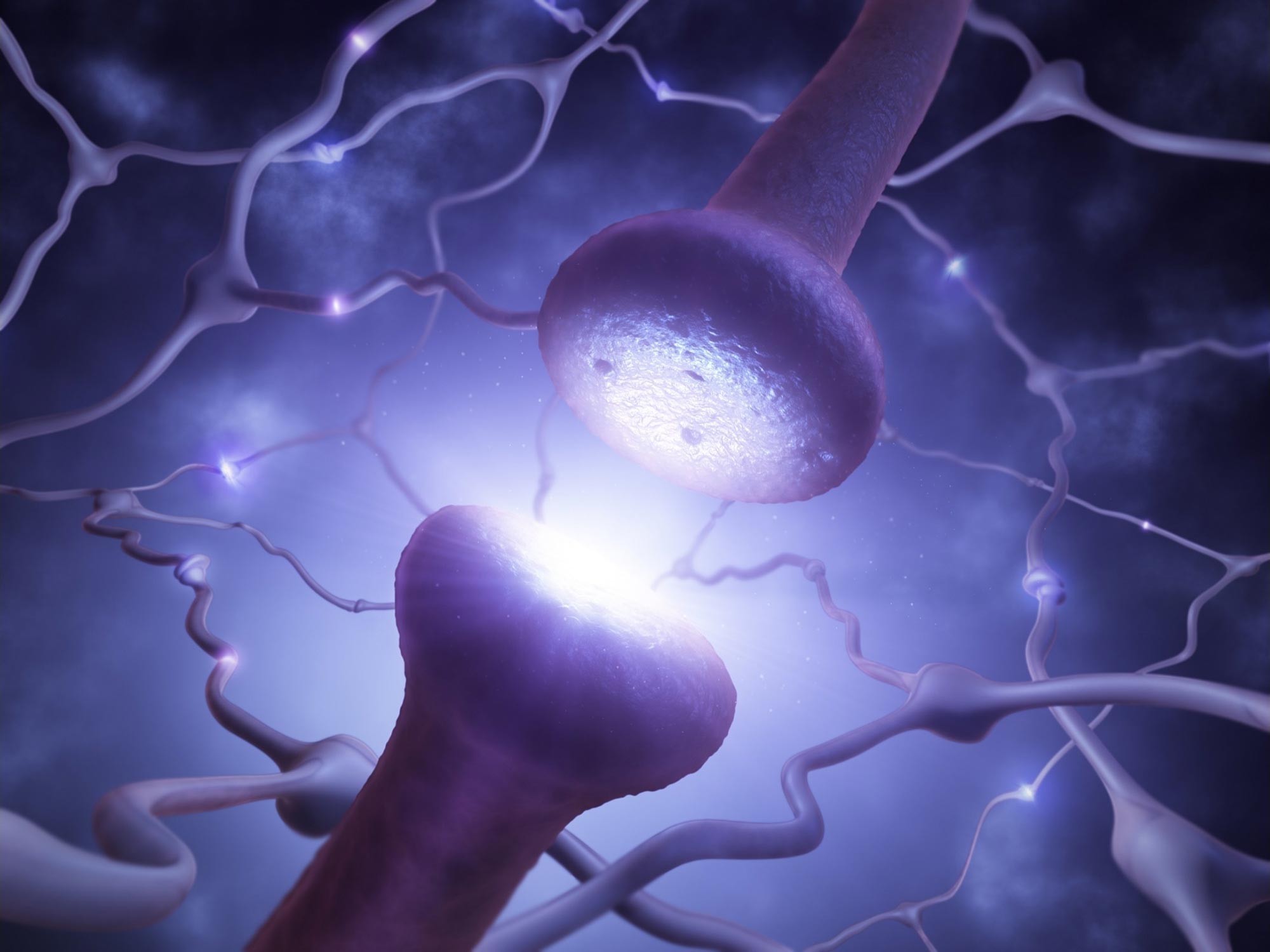
New evidence suggests axons may not be uniform tubes but dynamic, pearl-like structures.
Johns Hopkins Medicine researchers say one of biology’s most familiar textbook images may be wrong, challenging a view of neuron structure that has persisted for more than a century.
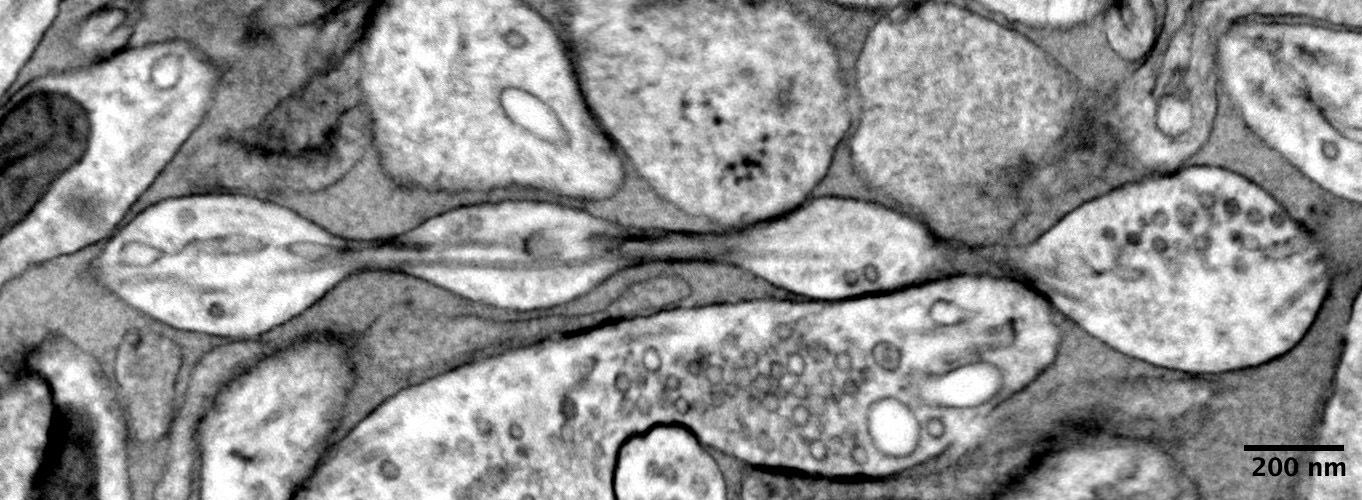
Axons, the long extensions neurons use to send signals, may not be smooth, tube-like wires after all. In mouse brain cells, and in follow-up work involving worms and human cortical neurons, the team found that many axons resemble strings of pearls.
The original discovery was published in Nature Neuroscience in 2024, with additional findings reported in Biophysical Journal in 2025 showing similar pearls-on-a-string structures in Caenorhabditis elegans motor neurons, mouse hippocampal neurons, and human cortical neurons.
“Understanding the structure of axons is important for understanding brain cell signaling,” says Shigeki Watanabe, Ph.D., associate professor of cell biology and neuroscience at the Johns Hopkins University School of Medicine. “Axons are the cables that connect our brain tissue, enabling learning, memory, and other functions.”
Bead-like swelling in axons has long been associated with injury or disease, including Parkinson’s and other neurodegenerative conditions. However, these studies show that repeating swellings can also appear in otherwise normal axons, at least in the types of neurons examined.
Traditionally, axons are described as narrow cylinders with a fairly uniform diameter, interrupted only by occasional bulges called synaptic varicosities that store neurotransmitters. In contrast, the newly identified pattern consists of regularly spaced swellings that are not tied to synapses, which the researchers call “non-synaptic varicosities.”
Nanoscale Details and Imaging Techniques
These structures exist at an extremely small scale. The pearl-like regions measure about 250 nanometers across, while the thinner connecting segments are about 70 nanometers wide. By comparison, axons can extend from 100 mm to 1,000 mm (about 4 inches to 3.3 feet) in length while remaining only about 100 nanometers thick.
To capture these details, the team used high-pressure freezing electron microscopy, a technique that preserves cellular structures more accurately than standard preparation methods.
“To see nanoscale structures with standard electron microscopy, we fix and dehydrate the tissues, but freezing them retains their shape — similar to freezing a grape rather than dehydrating it into a raisin,” says Watanabe.
The researchers analyzed mouse neurons grown in the lab, as well as neurons taken from adult mice and mouse embryos. All lacked myelin, the insulating layer that surrounds many axons. Across tens of thousands of images, the same repeating, bead-like pattern appeared.
“These findings challenge a century of understanding about axon structure,” Watanabe says.
Initial explanations focused on the axon’s internal skeleton, but experiments led by Jacqueline Griswold showed that disrupting this framework did not eliminate the pearled appearance. Further analysis, including mathematical modeling with Padmini Rangamani, Ph.D., pointed instead to the physical properties of the cell membrane.
Membrane Physics and Signal Transmission
Changes in the surrounding environment supported this idea. Increasing sugar concentration around axons caused the swellings to shrink, while more diluted conditions made them expand. Reducing membrane stiffness by removing cholesterol also decreased pearling and, at the same time, slowed the transmission of electrical signals.
“A wider space in the axons allows ions [chemical particles] to pass through more quickly and avoid traffic jams,” says Watanabe.
Electrical stimulation produced similar effects, with high-frequency activity causing the swellings to expand by an average of 8% in length and 17% in width for at least 30 min, alongside faster signal transmission; when cholesterol was removed, these structural changes and the increase in signal speed no longer occurred.
Evidence From Living Brain Tissue
A related 2025 Neuron study extended these observations to living brain tissue from epilepsy surgeries. Using zap-and-freeze electron microscopy, researchers stimulated mouse and human brain slices and preserved them within milliseconds, allowing synaptic activity to be captured at nanometer resolution. The results showed that both mouse and human cortical synapses recycle synaptic vesicles through ultrafast endocytosis, a rapid membrane retrieval process, and confirmed the same pearled axon structure in human tissue.
The study also identified clustering of the protein dynamin 1xA near active zones in both species, supporting a shared mechanism for rapid synaptic function.
References:
“Membrane mechanics dictate axonal pearls-on-a-string morphology and function” by Jacqueline M. Griswold, Mayte Bonilla-Quintana, Renee Pepper, Christopher T. Lee, Sumana Raychaudhuri, Siyi Ma, Quan Gan, Sarah Syed, Cuncheng Zhu, Miriam Bell, Mitsuo Suga, Yuuki Yamaguchi, Ronan Chéreau, U. Valentin Nägerl, Graham Knott, Padmini Rangamani and Shigeki Watanabe, 2 December 2024, Nature Neuroscience.
DOI: 10.1038/s41593-024-01813-1
“BPS2025 – Biophysical regulation of axon morphology and plasticity” by Shigeki Watanabe, Jacqueline Griswold, Mayte Bonilla Quintana, Renee Pepper, Christopher T. Lee, Sumana Raychaudhuri, Sumana Raychaudhuri and Padmini Rangamani, 13 February 2025, Biophysical Journal.
DOI: 10.1016/j.bpj.2024.11.2324
“Ultrastructural membrane dynamics of mouse and human cortical synapses” by Chelsy R. Eddings, Minghua Fan, Yuuta Imoto, Kie Itoh, Xiomara McDonald, Jens Eilers, William S. Anderson, Paul F. Worley, Kristina Lippmann, David W. Nauen and Shigeki Watanabe, 24 November 2025, Neuron.
DOI: 10.1016/j.neuron.2025.10.030
Funds for the research were provided by the Johns Hopkins University School of Medicine, the Marine Biological Laboratory Whitman Fellowship, the Chan Zuckerberg Initiative Collaborative Pair Grant and Supplement Award, the Brain Research Foundation Scientific Innovations Award, a Helis Foundation award, the National Institutes of Health (NS111133-01, NS105810-01A11, DA055668-01, 1RF1DA055668-01), the Air Force Office of Scientific Research (FA9550-18-1-0051), the Alfred P. Sloan Research Fellowship, a McKnight Foundation scholarship, a Klingenstein-Simons Fellowship Award in Neuroscience, a Vallee Foundation scholarship, the National Science Foundation and the Kavli Institutes at Johns Hopkins and UC San Diego.
Never miss a breakthrough: Join the SciTechDaily newsletter.
Follow us on Google and Google News.
5 Comments
I have enjoyed my perusal of alldata offered regarding structure and function of the axonal varicosities! Ty! Live long and prosper!
John Hopkin’s…. Prior to the Edit. After all… Have You ever met someone named Johns? Exactly… Trust your self above all else.
Hello. My Name is Sarah thiess I’m 55. I have chairi malformation… A idiopathic tumor on my right thailimus nucluis,,, and other health issues. I have tried 16 different medications and the rebound headaches n other side effects. So I don’t take meds. Neurosurgeons neurologist say there isn’t anything they can do because of the location. So I sit with severe pain anger and depression that isn’t getting better. I don’t know what to do. …..shotgun or wait for aneurysm. Lil by lil I’m losing my mind my cognitive issues are becoming more obvious unable to hide so people ,family just ignore me I live alone off the grid. I would appreciate any advice. Thank you
Hi Sarah,
I’m so sorry you are going through this. I just came across your comment. Please consider reaching out to 988 Suicide and Crisis Lifeline or finding another resource that is available in your area.
https://www.cdc.gov/suicide/resources/general-resources.html
You can call or text 988, or chat at 988lifeline.org
Dear Sarah,
When people mistreat you, just remember: YOU MATTER! So please, take Elizabeth’s advice.