
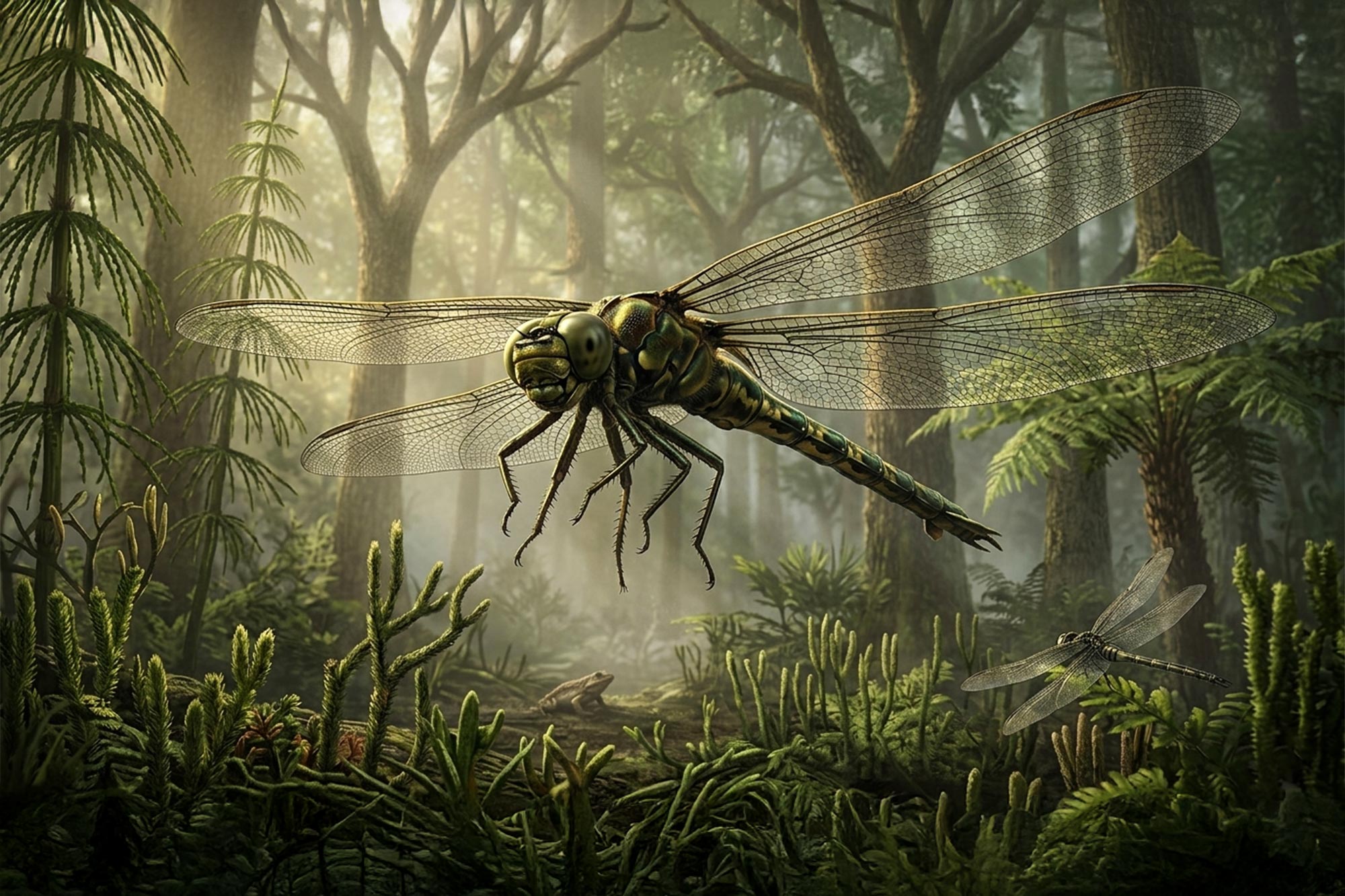
The true reason ancient insects grew so huge just got a lot more mysterious.
Three hundred million years ago, Earth looked nothing like it does today. The continents were joined into a single landmass called Pangaea. Around the equator, vast coal-swamp forests dominated the landscape. Oxygen levels in the atmosphere were much higher than they are now, and wildfires occurred frequently.
Life was thriving in every environment. Oceans were filled with fish, while land was home to amphibians, early reptiles, crawling arthropods, and even giant cockroaches. Above it all, insects ruled the skies, and some reached extraordinary sizes.
Giant Dragonflies and Griffinflies
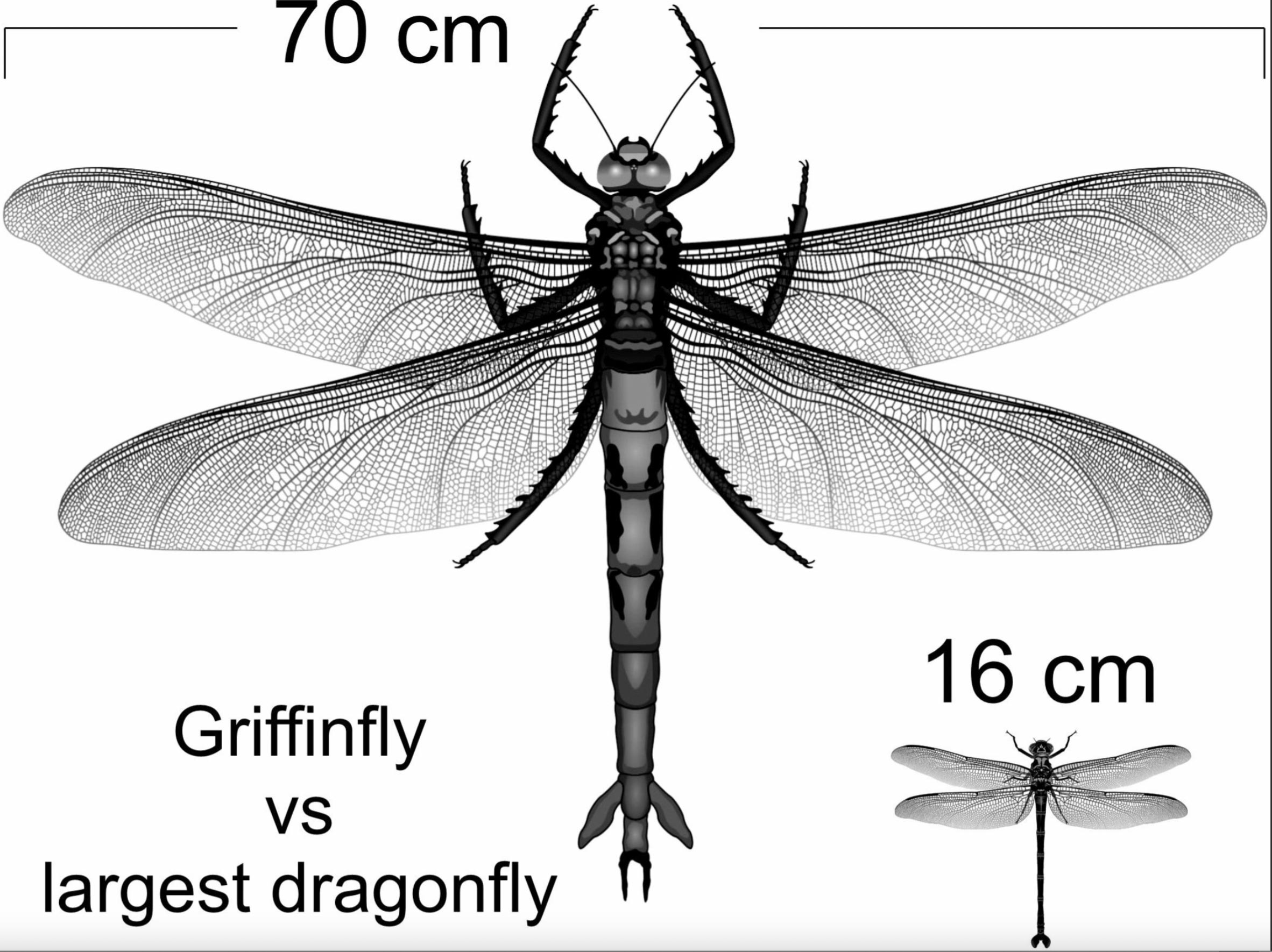
Among these flying insects were mayfly-like species with wingspans of 17 inches (45 cm) and dragonfly-like giants stretching up to 27 inches (70 cm). These massive insects, often referred to as “griffinflies,” were first identified from fossil impressions preserved in fine-grained sedimentary rock in Kansas nearly a century ago.
For many years, scientists believed these enormous insects could only exist because atmospheric oxygen levels were about 45% higher than today. That long-standing explanation is now being challenged by new research.
The Oxygen Theory of Insect Size
In the 1980s, scientists developed methods to reconstruct the composition of ancient atmospheres. These techniques revealed a period of elevated oxygen levels around 300 million years ago.
A 1995 study published in Nature connected this oxygen-rich period to the presence of giant insects. Researchers proposed that larger insects required more oxygen, and that higher oxygen concentrations in the atmosphere made their size possible.
This idea was based on how insects breathe. Instead of lungs, insects rely on a tracheal system, a network of branching air tubes that extend throughout the body and end in tiny structures called tracheoles. Oxygen moves through these tracheoles by diffusion, traveling down concentration gradients to reach the flight muscles.
Because diffusion becomes less efficient over longer distances, scientists reasoned that today’s lower oxygen levels would not support insects of such massive size. In other words, giant flying insects were thought to be impossible under modern atmospheric conditions.
New Study Challenges the Long-Held Explanation
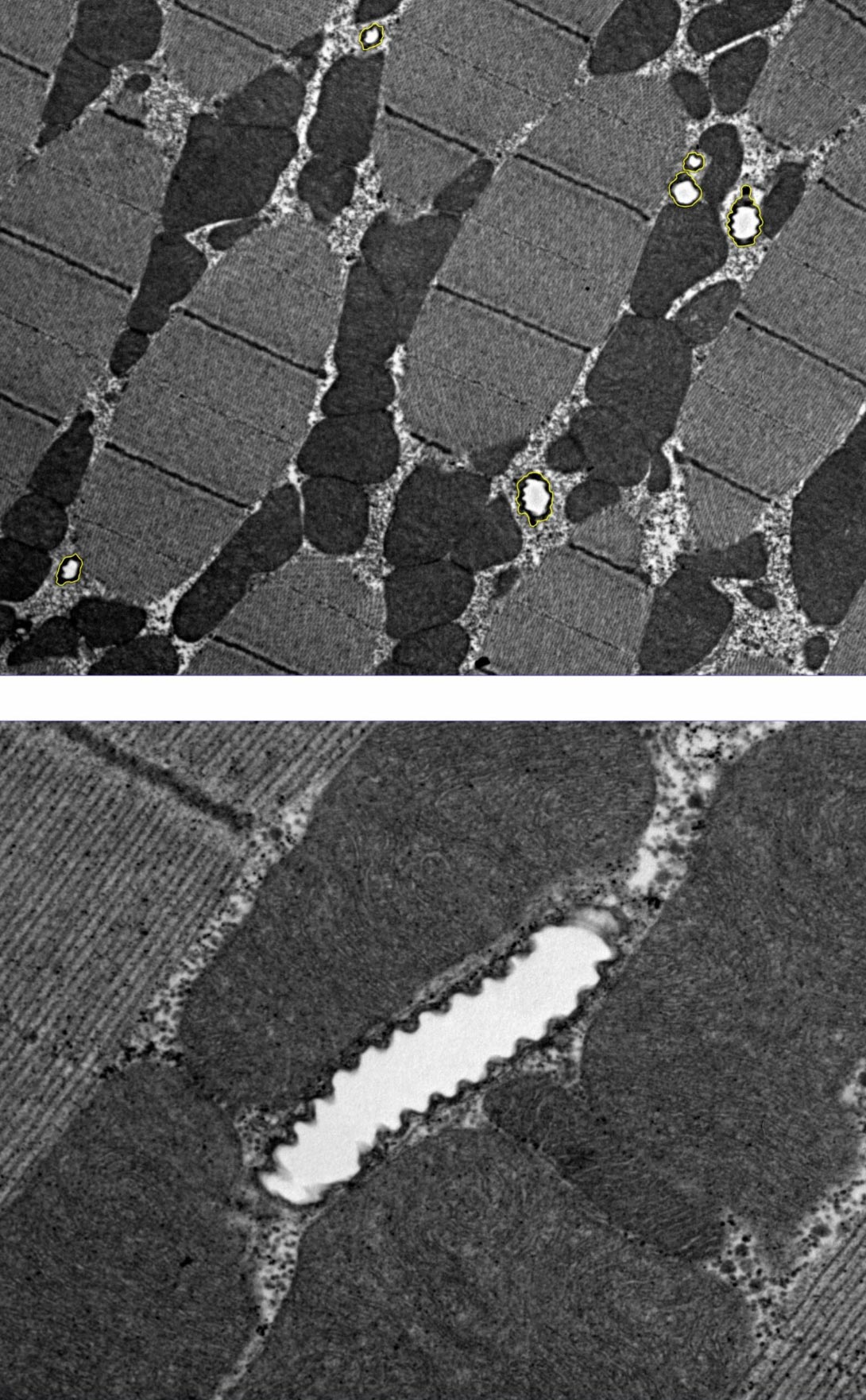
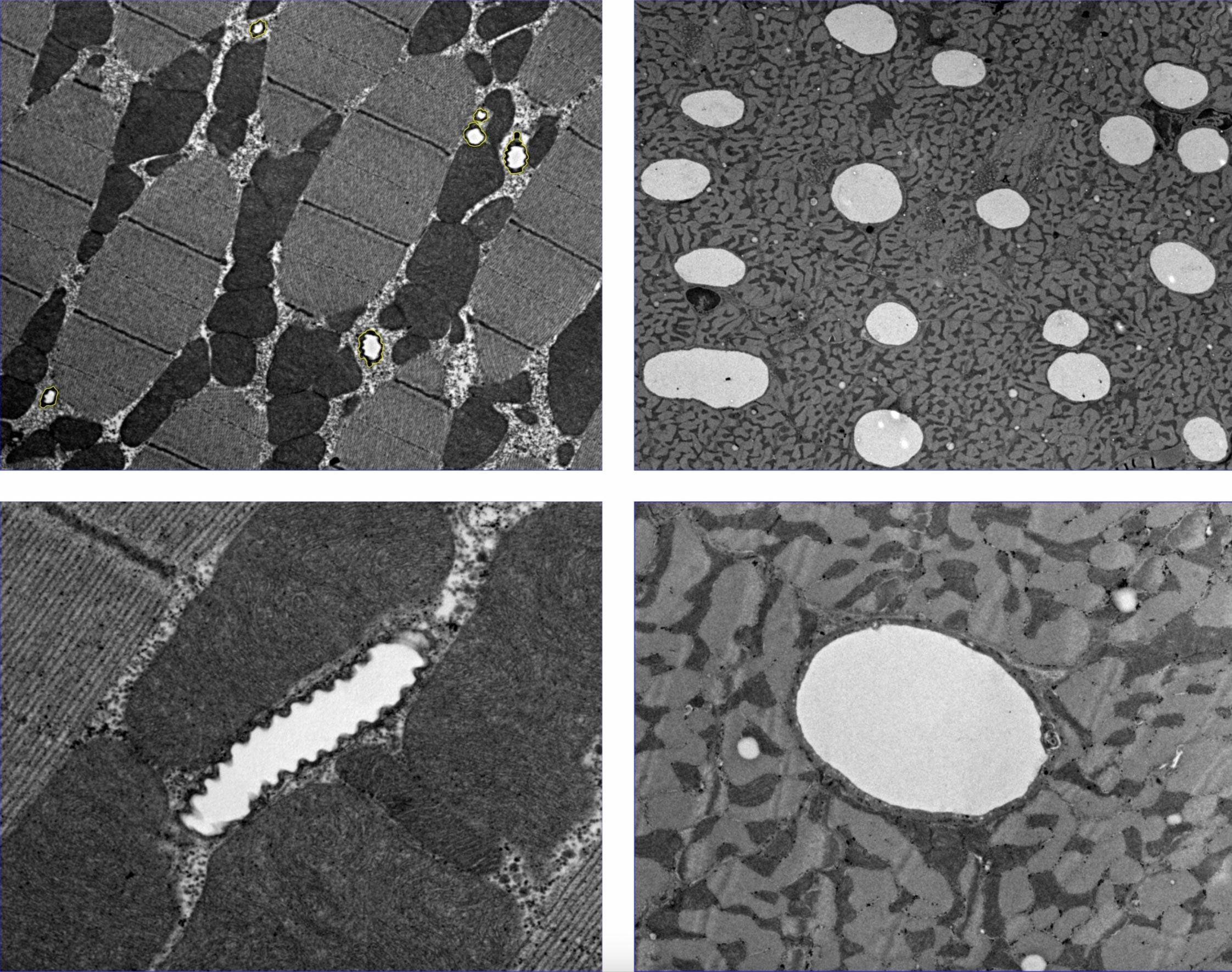
A new study published in the latest issue of Nature offers a different perspective. Led by Edward (Ned) Snelling of the University of Pretoria, the research team used high-power electron microscopy to examine how body size relates to the number of tracheoles in insect flight muscles.
The researchers found that tracheoles occupy only about 1% or less of the flight muscle in most insect species. This pattern also appears to hold when applied to the massive griffinflies that lived 300 million years ago, including those measuring 2 feet and larger.
These findings suggest that insect flight muscles are not limited by atmospheric oxygen levels. Because tracheoles take up so little space, insects could potentially increase their number without major structural constraints.
Evidence From Modern Animals
“If atmospheric oxygen really sets a limit on the maximum body size of insects, then there ought to be evidence of compensation at the level of the tracheoles,” said lead author Edward (Ned) Snelling, associate professor, and Faculty of Veterinary Science at the University of Pretoria. “There is some compensation occurring in larger insects, but it is trivial in the grand scheme of things.”
Researchers also compared insects to vertebrates. In birds and mammals, capillaries in heart muscle occupy about ten times more space than tracheoles do in insect flight muscle.
“By comparison, capillaries in the cardiac muscle of birds and mammals occupy about ten times the relative space than tracheoles occupy in the flight muscle of insects, so there must be great evolutionary potential to ramp up investment of tracheoles if oxygen transport were really limiting body size,” said Professor Roger Seymour of Adelaide University.
A Mystery Still Unresolved
Some scientists argue that oxygen might still limit insect size in other parts of the body or earlier stages of oxygen transport. Because of this, the idea that oxygen constrains maximum insect size has not been completely dismissed.
However, the new findings clearly show that oxygen diffusion within flight muscle tracheoles is not the limiting factor. Researchers will need to investigate other explanations for why insects once grew so large.
Possible factors include increased predation by vertebrates or physical limits related to the strength of the insect exoskeleton. For now, the reason behind the rise and disappearance of giant insects remains an open and intriguing question.
Reference: “Oxygen supply through the tracheolar–muscle system does not constrain insect gigantism” by Edward P. Snelling, Antonia V. Lensink, Susana Clusella-Trullas, Chris Weldon, Philipp Lehmann, John S. Terblanche, Nicholas L. Payne, Jon F. Harrison, Anthony J. R. Hickey, Ashleigh Donaldson, Christian M. Deschodt and Roger S. Seymour, 25 March 2026, Nature.
DOI: 10.1038/s41586-026-10291-3
Never miss a breakthrough: Join the SciTechDaily newsletter.
Follow us on Google and Google News.
7 Comments
Read the bible. It explains the difference between pre-flood and post-flood. The vapor canopy over the earth before the flood filtered out the harmful U.V. light. After the vapor canopy collapsed there was a reduced protection from U.V. light, which is why life spans are not as great today.
One could just as easily explain the absence of griffin flies because they were playing with the unicorns and they both missed the boat. However, that doesn’t explain why we don’t have giant dinosaurs today. (Or why marine animals known from their fossils don’t exist today.) I suppose there just wasn’t room on The Ark, and they had to stay behind. As it is, there are problems with fitting all life known today on a floating boat of the dimensions given in the bible.
The Ark was plenty big enough to serve the purpose. You just need to learn which animals were actually on it. Hint……think species. Not hard to research.
BTW, I HAVE read the bible and I don’t recollect anything in it about a “vapor canopy.” You wouldn’t be making that up, would you? Are you suggesting that people and animals who live in very foggy areas live much longer than those who live in sunny deserts?
Actually it was a water canopy.
Thank you. Truth.
Slightly more oxygen. There was much more CO2 and water vapor. Warm and humid like a greenhouse.