
Vitamin B12 may shape metabolism and aging more than previously understood.
Vitamin B12 is typically associated with red blood cells and nerve health, but new research from Cornell University suggests its influence reaches much deeper into how the body produces energy and maintains muscle.
The study, published in the Journal of Nutrition, reveals previously unrecognized ways that B12 supports cellular metabolism. It also identifies early warning signals in the body that may detect nutritional strain long before classic deficiency symptoms appear.
Vitamin B12 reshapes metabolic understanding
“This is the first study that shows B12 deficiency affects skeletal muscle mitochondrial energy production,” said corresponding author Martha Field, Ph.D. ’07, associate professor in the Division of Nutritional Sciences and in the College of Human Ecology. “It’s highly relevant because muscles have high energy demands. More importantly, my co-author, Anna Thalacker-Mercer from the University of Alabama at Birmingham, wondered if B12 supplementation in aged mice would improve muscle mitochondrial function – and it did.”
Previous research has largely concentrated on the visible consequences of B12 deficiency, such as megaloblastic anemia, neuropathy, and cognitive decline, rather than examining the underlying biological mechanisms.
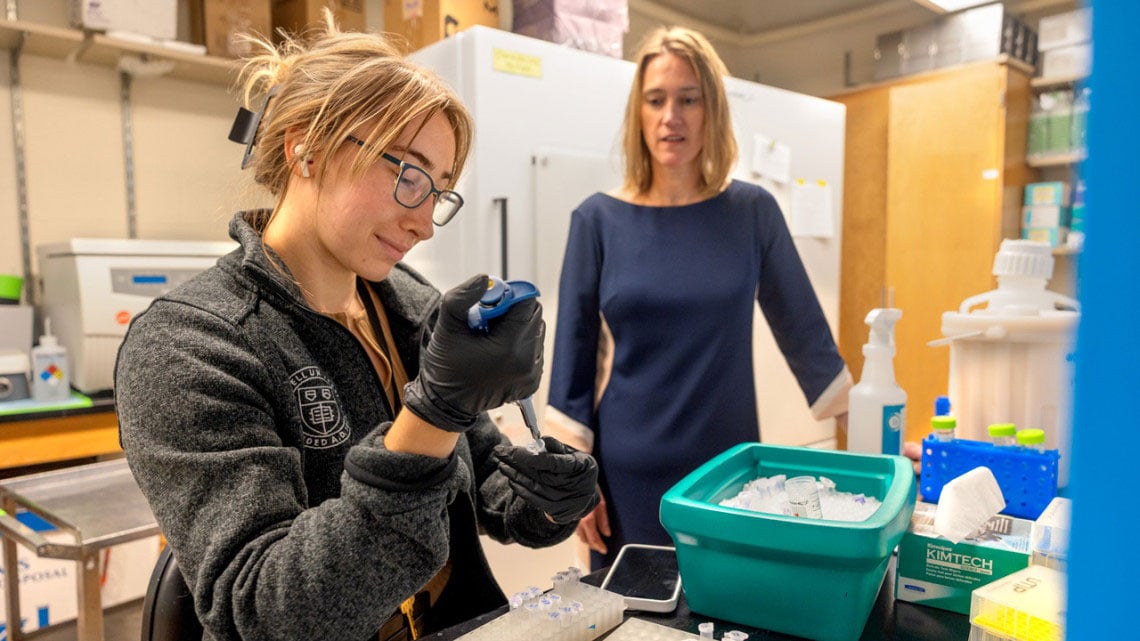
At Cornell, a research group led by Field, along with first authors Luisa Castillo, Ph.D. ’25, and Katarina Heyden, B.S. ’18, Ph.D. ’24, investigated these deeper processes. Their work mapped how B12 interacts with lipid metabolism, organelle stress pathways, and epigenetic regulation. The results indicate that B12 plays a central regulatory role across multiple interconnected biological systems, suggesting that even modest deficiencies could have widespread effects.
“Another thing we observed in mice is that B12 deficiency seemed to inhibit growth or maintenance of muscle mass,” Field said. “It seems that low B12 status is associated with lower muscle mass and maybe muscle strength.”
Subtle deficiency may carry broad risk
B12 deficiency remains widespread across the globe, particularly among older adults and in populations with limited access to animal-based foods, which are primary sources of the vitamin. Estimates suggest that about one in four older adults in developed countries may have suboptimal B12 levels, highlighting the need for improved detection and intervention.
The findings also align with a growing body of research showing that insufficient intake of micronutrients, even without full deficiency, can contribute to chronic disease.
While severe B12 deficiency is relatively uncommon in many developed regions, marginal levels are still frequently observed in older adults, as well as in vegans, vegetarians, and individuals with absorption disorders. The study indicates that even these lower levels may reduce the body’s ability to cope with metabolic stress, immune challenges, and the effects of aging.
Toward precision nutrition strategies
From a clinical perspective, the researchers suggest that B12-related biomarkers could support more personalized approaches to nutrition. Rather than relying on uniform supplement recommendations, future guidelines may be tailored to individual metabolic needs and lifestyles, reflecting a broader move toward precision nutrition. This approach fits within a larger effort to integrate nutrition science with systems-level biology.
The current findings are based on cell models and will need to be validated in human studies, Field said.
“We want to understand the whole causal pathway – understanding the molecules and mechanisms,” Field said. “This sets the stage for a future controlled human trial.”
Reference: “Vitamin B12 Supports Skeletal Muscle Oxidative Phosphorylation Capacity in Male Mice” by Luisa F Castillo, Katarina E Heyden, Abigail R Williamson, Wenxia Ma, Olga V Malysheva, Nathaniel M Vacanti, Anna E Thalacker-Mercer and Martha S Field, 20 January 2026, The Journal of Nutrition.
DOI: 10.1016/j.tjnut.2026.101367
Never miss a breakthrough: Join the SciTechDaily newsletter.
Follow us on Google and Google News.
60 Comments
So, probably a good idea to eat a lot of organ meats or take a supplement.
Please know that vegan is healthiest, slaughtered animals products only contain B12 because animal feed is supplemented. Throats slit, skin removed, bodies cut up, it is not healthy food and women in canada have been murdered by slaughterhouse workers 🧡🙏🌱 @beeasyvegan
I totally agree with you, but with all meats and poartry in these days are being injected with steriods. Also fish/seafood are showing up with microplastic. Our lifespan is getting cut shorter.
I have absorbtion problems and 2 years back I was suffering from dementia, I joined a clinical study for alzheimers and they found that I actually had megaloblastic anaemia, from non absorbtion of folic acid and B12 which had robbed me of my memory, made me clumsy, falling and dropping things, my hair and nails were not growing, I was permanently exhausted. My GP had, a few years before when I went with tingling, eyesight and memory problems, told me I was only borderline low. He didnt understand that the amount circulating in the blood had no relevance to how much was actually working at cellular level. My dna synthesis within the bone marrow just couldnt happen. A bit like trying to make a cake without eggs! Now I have my memory back, my eyesight improved, I rarely fall now but there is permanent damage. I still dont absorb via my gut, but daily sprays into my mouth have got me my life back
I had stage 4 colon cancer 10 years ago. I had a mass removed from my colon, a part of my small intestine and bladder removed and endured therapy for a while. I now have b12 injected every 3 months as I’m told my colon is too short to absorb b12 through diet. I KNOW when I’m due and feel better instantly when I’ve had it!
Wow, if your condition is true…I wonder..what vitamin B12 defeciency.
I know, tge have an injection of B12.
I just take B12 , 500mg.ta let daily. Feel good. Age 90.
You are very lucky. I have pernicious anemia and can’t absorb oral b12 from food am now on b12 inter muscular injections for life, they really hurt. I. 60.
I was getting those from Kaiser P
They must have used a tiny needle bc I could barely feel it!
Ask for better equipment.
How old are you?
Thank you for this insightful post. It will help several in our family.
Thank you for this insightful post. It will help several in our family. I would like to have any additional information you are willing to share. Bless you for sharing your recovery experience.
My replies and gratitude are directed to Christine Chant.
So you are using a vitamin B-12. Supplement in spray (oral) form?
How much? How often? I feel I have some of the same issues, with memory, vision & nerve tingling. I’d try it if it would improve these for me.
I have pernicious anemia my body can’t absorb b12 through diet or pills I have to be injected every 2 months
Hold sublingual B12 (methylcobalamin) pill under your tongue daily. No need for injections.
Every one each to their own of how vitamin B12 to take see when blood test are taken the blood test does not tell you how much vitamin B12 people have used to for a long life the only way Vitamin B12 if someone was lacking shows the person signs of lack VB12 always yawning all the time etc hair starts falling out and it takes time for the human body to repair itself from lacking vitamin Vitamin B12 and every one is different and to the people out their who has VB12 who is not lacking it do not understand what it’s like to have VB12 deficiency do you understand if you do great if you don’t then it’s your problem not mine
I am taking bit B complex and no complexity on my body and also with Centrum
What is the logical necessity for Vitamin B12 supplement be placed under tongue, and not taken direct with water..
I have an overabundance of b12, high number, yet I’m tired most days. Crash too early. Sleep is inconsistent. 🤷
Who is making this Your problem?
@ Rebecca Kennedy
Your advice on vit B 12 was ok
Until your Quote “do great if you don’t then it’s your problem not mine” ! You’re Rude
Why so nasty to other people?
Some people need injections because of absorption issues. To absorb B12 you need intrinsic factor which is in your stomach/gut. Many people have insufficient intrinsic factor due to aging, lifestyle choices like alcohol consumption which interferes with the making of intrinsic factor. Injections bypass the need of intrinsic factor. Also, people should take methylcobalamin not cyanocobalamin because it is more absorbable, especially for people that have the genetic mutation MTHFR, which affects your body’s ability to methylate Folate and B12.
Been taking pictures for years . Now have changed how long before my body start to absorb vitamins an dose that include medication as well
Some people need injections because of absorption issues. To absorb B12 you need intrinsic factor which is in your stomach/gut. Many people have insufficient intrinsic factor due to aging, lifestyle choices like alcohol consumption which interferes with the making of intrinsic factor. Injections bypass the need of intrinsic factor. Also, people should take methylcobalamin not cyanocobalamin because it is more absorbable, especially for people that have the genetic mutation MTHFR, which affects your body’s ability to methylate Folate and B12.
I understand that so many suffer from the B12 deficiency because of the regular practice of taking proton pump inhibitors.
Not true for everyone. If you have PA, pernicious anemia, you lack Intrinsic Factor. Your body cannot absorb B12 from any food source, sublingual drop, or pill. The ONLY way you can get B12 is via muscular injections. Impossible to overdose. Your body will urinate out what is not needed. I’m 65 and have been on injections every other week for 45 years.
She can’t absorb it. Sticking it under the tongue won’t make any difference.
Yes, have to specifically take Sublingual form of B12. It’s absorbed directly into bloodstream in a couple of minutes.
Great study! Thank you. My brother was a physician and gave the whole family B12/BComplex injections once a month. I have to start again. I wonder if I can buy the injectble online to give myself. I am a retired advance practice nurse and could use the boost in all directions.
The root cause of all these side effects is food what we are choosing to eat 🙂
I wouldn’t worry too much about meat injections since they are long gone by the time your fork dogs in. Beef liver is also delicious. Eat 2-3 eggs per day day, the cholesterol was a bad scare hype. Also eat dark leafy greens daily, spinach 2x a week, as much cottage cheese, Greek yogurt, salmon, sardines for muscle build and repair, kiwi and walnuts for brain health, yams, tart cherry juice for anti inflammatory benefits like joint pain.
Everyone needs to know that vegan is the right choice. Slaughtered animals are NOT healthier just because they contain vitamin B12 because animal feed is supplemented 🙏🌱 slaughterhouse worker has murdered over 50 women in Canada know it’s TRUE 🧡 @beeasyvegan
Please know vegan is healthier. Slaughtered animals products only contain vitamin b12 because animals feed is supplemented. Throats slit, skin removed, bodies cut up. It is not healthier to slaughter alive animals @beeasyvegan
I have a Doctorate Of Science Degree MSc. D. I have ahealing website. Recently I met a man who did a tiny prick of my finger and told me all of my blood cells are infected. I knew that was not true as I am healthy. i drink Vitamin B12 10,000
Units at least 3 times a week for energy. Your study is impressive .I always feel better when I take B12. I
Please help keep B12 available without a prescription as for all people most importantly the ordinary man who can’t afford many of the remedy’s available. I.e. Ivermectin. As soon as pharmaceutical company learned that Ivermectin kills COVID in 2 doses it was taken off shelves
And costs over $500. It’s shameful.
Keep up the great work. Thank you.
The ivermectin BS is another MAGAt myth perpetrated by the Liar in Chief.
Muy interesante el artículo sobre la vit B12 y como interviene en nuestra inmunidad y la formación de nuevas células gracias por la publicación .
Should an 83 year old male take a B12 supplement? If yes how much daily
Please advise. Thank you
Consult your medical provider.
New Research. SMH LOL
Once a day !
It should be taken into account that all synthetic versions of vitamin B12 are not absorbed by the body, and the only benefit from such supplements is for pharmaceutical companies in the form of their profits…
So then, 1. What you’re saying is we need to get B12 through the food we ingest? 2. Vitamin “B12” taken in the form of an over- the-counter vitamin or gummy has no benefit in raising our B-12 levels to a healthy value?
That B12 you’re taking is synthetic
There’s another that is better starts
That is simply not true. I had a deficiency that caused severe neuropathy, turned my occasional migraines chronic, caused severe exhaustion, and led to multiple other problems. Sublingual pills eventually brought my levels back to normal. I still have damage, but I am 10 years out now and doing soooo much better.
That B12 you’re taking is synthetic
There’s another that is better starts Hy
I am just 17 year old girl I have low B12 and half of my hairs become white there are so many wrinkle on my face I have low. Collegen and my energy is as low as people in 70s
Collagen deficiency is systemic. Do your joints bend too far? Easy dislocation?Trouble with gums and teeth? Have you been diagnosed with Ehlers Danloss syndrome?
Your problem is not only b12 def.
You need more detailed examination, like hormonal tests eg
I’m going on 80 years old. I believe in a year blood test to control vitamins supplements are needed to control my quality of life. The ones that I currently take is B, D, and folic acid.
In I got to that I had vit B12 difficience when it was too late I think I was anemic ,had beefy paining tongue that could hardly eat ,drink or brush.now on vit B supplement and trying to focus on animal products and have got some relief and some kg though the healing process séems to b slow. I lost my self confidence in pu be lic due to losss of weight almost a half of my normal weght
When my levels are low, my first symptom is a painful, burning tongue.
Been having b12 injections 20 years.They tried to stop them and gave me a supplements then had blood test I was so loow the doctor said I need injection of b12 for the rest of my life.
Consult your medical provider.
Hi l have been talking VB12 for a while now so I’d it going to be good for me and is there anything else to take with it as l have ostathrites,Polymalgor fibromyalgia, rhymatoide ,l lam on methotrexate, Abataset, injection aid spread pain, tied all the time is there anything else l should take to help my self
Lol 😂 you’ve got to be kidding me wow yal are a bunch of non to poor typing Mama Jamas here. Are y’all even reading what you’re typing before posting it? Can’t nobody here read most of yal’s typing lol 🤣 what’s up with this. Everybody please retype what you put here only correctly this time 😳😱 so we can all read each other; good grief.
You might want to learn English instead of Southern MAGAtese. Can’t understand most of the jargon you wrote. Oh, and try using punctuation too.
Sometimes what we eat is not necessarily by “choice”. It’s based on what’s available, and what you can afford and still keep a roof over your head, keep the lights on, and afford your medications.
Muy interesante el artículo sobre la vit B12 y como interviene en nuestra inmunidad y la formación de nuevas células gracias por la publicación .
Hey, I was curious because no one has been able to find the reason behind my stroke. According to some research, is there any possibility that my stroke could have been caused by my very low B12 levels at that time? Before the stroke, I often experienced tingling sensations in my body. After the stroke, I started taking weekly B12 injections, but my B12 levels only increased slightly above the normal range. My doctors performed many tests to identify the cause of the stroke, but nothing was found. Could low B12 still be a possible reason?
Been taking ppi
for years . Now have changed how long before my body start to absorb vitamins an dose that include medication as well