

Many of us wish for a fountain of youth, filled with magical water that could restore our youth and vitality. It is so simple and easy but unfortunately doesn’t exist.
A real key to longevity that is simple, but not easy for most of us, is to eat less. Numerous studies on various animals have shown that a restricted-calorie diet can lead to a longer and healthier lifespan.
In new research on mice, scientists found that a reduced-calorie diet led to a 10% longer life. However, their big discovery was that by combining the reduced-calorie diet with a time-restricted diet (only feeding during their most active time of day, which for mice is at night), the animals lived 35% longer.
One recipe for longevity is simple, if not easy to follow: eat less. Restricting calories can lead to a longer, healthier life, as studies have shown in a variety of animals.
Now, new research suggests that the body’s daily rhythms play a significant role in this longevity effect. Eating only during their most active time of day substantially extended the lifespan of mice on a reduced-calorie diet, Howard Hughes Medical Institute (HHMI) Investigator Joseph Takahashi and colleagues reported in the journal Science on May 5, 2022.
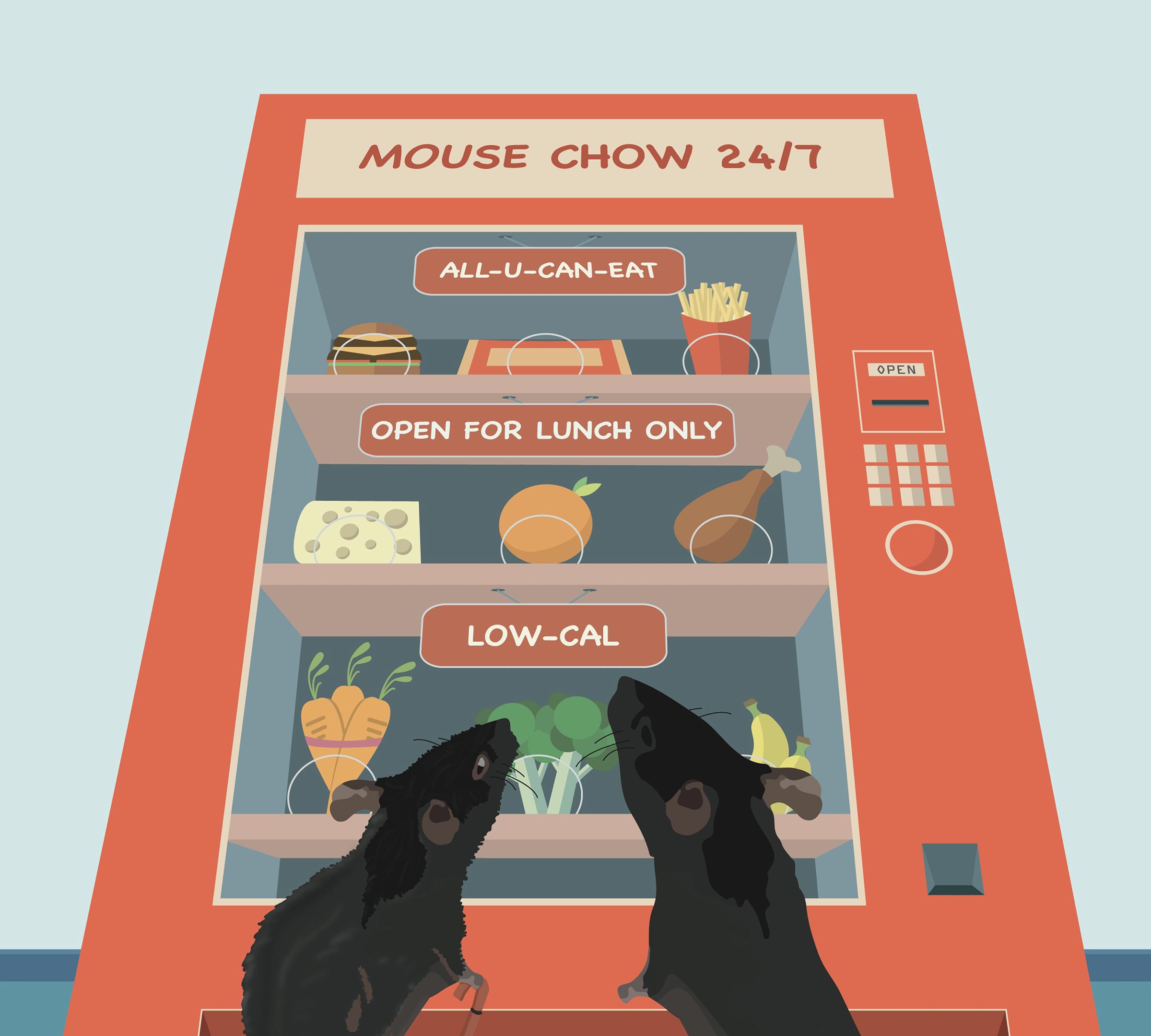
In his team’s study of hundreds of mice over four years, a reduced-calorie diet alone extended the animals’ lives by 10 percent. But feeding mice the diet only at nighttime, when mice are most active, extended life by 35 percent. That combo – a reduced-calorie diet plus a nighttime eating schedule – tacked on an extra nine months to the animals’ typical two-year median lifespan. For people, an equivalent plan would limit eating to daytime hours.
The research helps disentangle the controversy around diet plans that emphasize eating only at certain times of day, says Takahashi, a molecular biologist at the University of Texas Southwestern Medical Center. Such plans may not speed weight loss in humans, as a recent study in the New England Journal of Medicine reported, but they could prompt health benefits that add up to a longer lifespan.
Takahashi’s team’s findings highlight the crucial role of metabolism in aging, says Sai Krupa Das, a nutrition scientist at the Jean Mayer USDA Human Nutrition Research Center on Aging who was not involved with the work. “This is a very promising and landmark study,” she says.
Fountain of Youth
Decades of research has found that calorie restriction extends the lifespan of animals ranging from worms and flies to mice, rats, and primates. Those experiments report weight loss, improved glucose regulation, lower blood pressure, and reduced inflammation.
But it has been difficult to systematically study calorie restriction in people, who can’t live in a laboratory and eat measured food portions for their entire lives, Das says. She was part of the research team that conducted the first controlled study of calorie restriction in humans, called the Comprehensive Assessment of Long-term Effects of Reducing Intake of Energy, or CALERIE. In that study, even a modest reduction in calories “was remarkably beneficial” for reducing signs of aging, Das says.

Scientists are just beginning to understand how calorie restriction slows aging at the cellular and genetic level. As an animal ages, genes linked to inflammation tend to become more active, while genes that help regulate metabolism become less active. Takahashi’s new study found that calorie restriction, especially when timed to the mice’s active period at night, helped offset these genetic changes as mice aged.
Question of Time
Recent years have seen the rise of many popular diet plans that focus on what’s known as intermittent fasting, such as fasting on alternate days or eating only during a period of six to eight hours per day. To unravel the effects of calories, fasting, and daily, or circadian, rhythms on longevity, Takahashi’s team undertook an extensive four-year experiment. The team housed hundreds of mice with automated feeders to control when and how much each mouse ate for its entire lifespan.
Some of the mice could eat as much as they wanted, while others had their calories restricted by 30 to 40 percent. And those on calorie-restricted diets ate on different schedules. Mice fed the low-calorie diet at night, over either a two-hour or 12-hour period, lived the longest, the team discovered.
The results suggest that time-restricted eating has positive effects on the body, even if it doesn’t promote weight loss, as the New England Journal of Medicine study suggested. Takahashi points out that his study likewise found no differences in body weight among mice on different eating schedules — “however, we found profound differences in lifespan,” he says.
Rafael de Cabo, a gerontology researcher at the National Institute on Aging in Baltimore says that the Science paper “is a very elegant demonstration that even if you are restricting your calories but you are not [eating at the right times], you do not get the full benefits of caloric restriction.”
Takahashi hopes that learning how calorie restriction affects the body’s internal clocks as we age will help scientists find new ways to extend the healthy lifespan of humans. That could come through calorie-restricted diets, or through drugs that mimic those diets’ effects.
In the meantime, Takahashi is taking a lesson from his mice – he restricts his own eating to a 12-hour period. But, he says, “if we find a drug that can boost your clock, we can then test that in the laboratory and see if that extends lifespan.”
Reference: “Circadian alignment of early onset caloric restriction promotes longevity in male C57BL/6J mice” by Victoria Acosta-Rodríguez, Filipa Rijo-Ferreira, Mariko Izumo, Pin Xu, Mary Wight-Carter, Carla B. Green and Joseph S. Takahashi, 5 May 2022, Science.
DOI: 10.1126/science.abk0297
Never miss a breakthrough: Join the SciTechDaily newsletter.
Follow us on Google and Google News.
16 Comments
Actually I’m doing that now: Regularly consuming all my food within 12 hours despite never having set out to. I may not be doing anything else right, but this at least is easily achievable.
If this study is harmless, why not use humans for an accurate result?
I have been practicing intermittent fasting 21/3 for 2 years now – 21 hrs fasting – 3 hrs eating window – it has brought me physical changes and others that I still can’t explain –
The online doctors already told us that, thanks❣
This is stupid, mice studies are not human… The last line sums the point….”if we find a drug”
I lost 181bs on this method. Infact totally illiminated breakfast. First meal@12 when hungry. Drinking water 2nd meal if hungry before 7pm.
I did same and lost 50lbs
Why not create new, enjoyable, low impact sports for uninterrupted play during pandemics like Covid-19 to help with emotional and physical well-being? Moving along with less calories, can help with weight loss. See the sport entry at National Museum of American History New Sport That Keeps Players Separate.
Same here. Reduced calories, and eat within 8 hr window, don’t go beyond 9pm , and fast occasionally. Lost 60 lbs, reversed high blood pressure, blood sugar and triglycerides went back to normal after being declared diabetic 3 months previous, and kidney issues were fixed returning me to an eGRF of 99% from 43% in a 4 month period. There’s a reason why many of the ancient religions had fasting as part of religious observance – it recreated the variability found when people hunted and grazed before farming. Walking 10K steps a day helps too.
I eat breakfast, skip lunch and eat dinner at 5:00pm. All calories for the day consumed in 9 hours. Keeps my weight stable and it sounds like it’s the healthiest option.
Why not fast two days a week and see the difference, it is funny all such things exists for centuries but these so called scientists uncovering by wasting money in the name of research.
Have noticed some people who did low calorie and healthy food wind up with alhizmers and a healthy body
I thought I had discovered the secret to happiness years ago through exercise and diet. I was a long distance runner and I controlled my food intake to the extreme and only consumed healthy foods/vegetarian. Unfortunately, I discovered later that what I thought was true happiness was actually anorexia nervosa and I nearly died from it. This happened to me before this condition became a household word or the name Karen Carpenter became connected to the problem. Still, at the time I thought I had discovered happiness… I just was obsessed with losing weight and running. Today, at age 70, I still run long distance but eat more wisely.
What is you weight now?
What I wonder is, when it says ‘most active time’, does it mean daylight hours even if you’re a night worker? What about people who are night owls working a day schedule? Do they mean most active physically, or when chronologically gically most awake and alert?
@Observer, you posed a very relevant and important question. Would be good to get a scientific answer but I assume it’s eating when the person is up and about, actively moving, not close to bedtime or sitting around. For a night worker, it would be around that active work shift and a couple of hours before/after the shift. Be well.