
UNC School of Medicine’s Maya Styner, MD, led research showing that the combination of cutting calories and exercising can make bones smaller and more fragile in animals, whereas exercise on a full-calorie diet has a positive impact on bone health.
A new study published today in the Journal of Bone and Mineral Research shows how bones in mammals are negatively impacted by calorie restriction, particularly by the combination of exercise and calorie restriction. Maya Styner, MD, associate professor of medicine at the UNC School of Medicine, is the senior author on the study.

“These findings were somewhat of a surprise for us,” Styner said. “Past studies in mice have shown us that exercise paired with a normal calorie diet, and even a high-calorie diet, is good for bone health. Now we’re learning this isn’t true for exercise along with a calorie-restricted diet.”
Styner’s research focuses on the fat in bone marrow of mice. Although fat in the bone is poorly understood, to date it is thought to be harmful to the bones of mammals, including humans, because it makes bone weaker. Less fat is usually an indication of better bone health. Styner’s past studies have looked at the effects of calorie consumption on bone marrow fat, along with the role exercise plays. She’s found that in obesity caused by excess calories, the amount of bone marrow fat is increased. Exercise in both obese and normal weight mice decreased bone marrow fat and improved the density of bones.
The latest study looked at what happens to bone marrow fat and overall bone health when restricting calories. There were four groups of mice in all – a group on a regular diet (RD), a group on a calorie-restricted (CR) diet, a RD group that exercised (RD-E), and a CR group that exercised (CR-E). Mice in the CR group ate 30 percent less than what RD mice ate.
For context in humans, according to the United States Department of Agriculture (USDA), a ‘moderately active’ woman around the age of 30 should consume 2,000 calories per day. A 30 percent reduction would equal a diet of 1,400 calories per day, which is around the amount suggested to most women trying to lose weight at a rate of one pound a week.
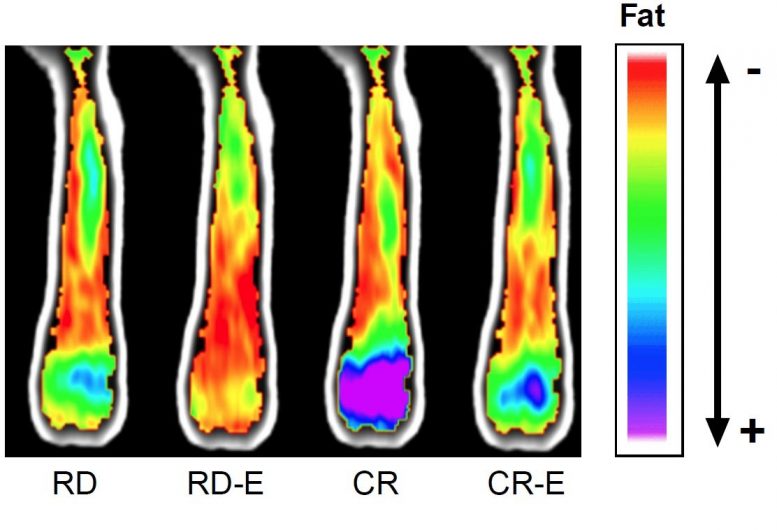
Styner found that mice in the CR group lost weight, but also had an increase in bone marrow fat.
“This was a mild caloric restriction, and we found a significant increase of fat in the bone marrow,” Styner said. “This group also had a decrease in bone quantity – they had less bone overall due to the cut in calories.”
Both CR groups of mice were given supplements of vitamins and minerals to match the amount the RD group received from the extra food they ate. This, Styner says, is an indication that the effect on bone health was from calorie restriction, and not a lack of nutrients.
When exercise was introduced to the CR group, bone marrow fat decreased as it had in previous studies, but the overall quantity and quality of bone decreased as well. Instead of making bones more robust, exercise made bones more fragile when paired with calorie restriction.
“Looking at this from a human perspective, even a lower calorie diet that is very nutritionally sound can have negative effects on bone health, especially paired with exercise,” said Styner. “This is important for women to consider because as we age our bone health starts to naturally decline. Your calorie intake and exercise routine can have a great impact on the strength of your bones and your risk for break or fracture.”
Styner says her team is now planning to conduct more research to understand the purpose of bone marrow fat and why it is affected by diet and exercise. This study was funded by grants from the National Institutes of Health (NIH) and National Institute of Arthritis and Musculoskeletal and Skin Diseases (NIAMS).
Reference: “Exercise degrades Bone in Caloric Restriction, despite Suppression of Marrow Adipose Tissue (MAT)” by Cody McGrath, Jeyantt Srinivas Sankaran, Negin Misaghian‐Xanthos, Buer Sen, Zhihui Xie, Martin A. Styner, Xiaopeng Zong, Janet Rubin and Maya Styner, 11 September 2019, Journal of Bone and Mineral Research.
DOI: 10.1002/jbmr.3872
Never miss a breakthrough: Join the SciTechDaily newsletter.
Follow us on Google and Google News.