
Close Menu
    Facebook X (Twitter) Instagram
    SciTechDaily
    • Biology
    • Chemistry
    • Earth
    • Health
    • Physics
    • Science
    • Space
    • Technology
    Facebook X (Twitter) Pinterest YouTube RSS
    SciTechDaily
    Home»Biology»Neuroscientists Show How Interactions Between Neuronal Migration and Outgrowth Shape Network Architecture
    Biology

    Neuroscientists Show How Interactions Between Neuronal Migration and Outgrowth Shape Network Architecture

    By University of FreiburgOctober 12, 2019No Comments3 Mins Read
    Facebook Twitter Pinterest Telegram LinkedIn WhatsApp Email Reddit
    Share
    Facebook Twitter LinkedIn Pinterest Telegram Email Reddit
    Neuronal Outgrowth and Migration Interact
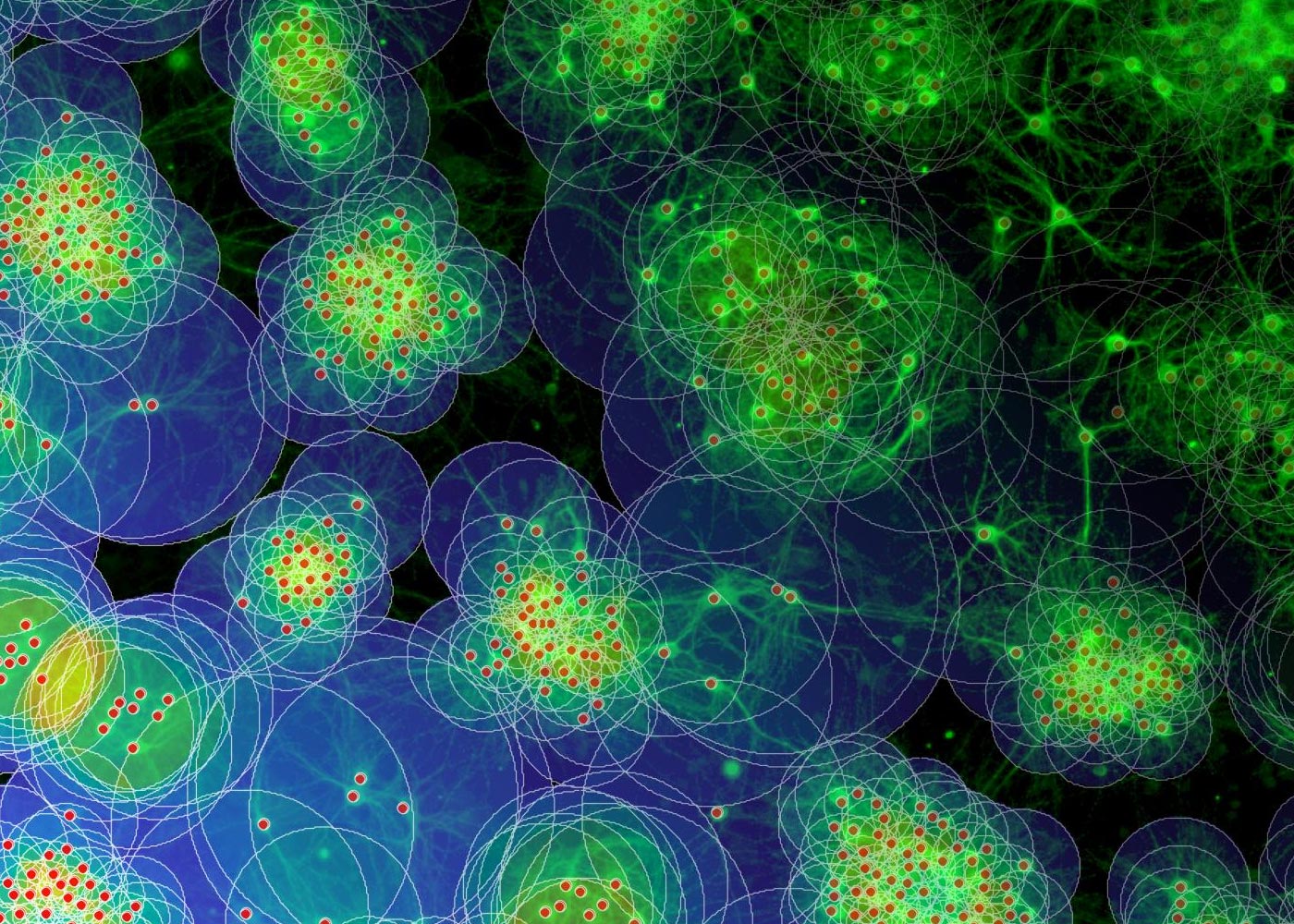
    Based on in vitro studies and computational modeling, neuroscientists show how neuronal outgrowth and migration interact in shaping network architecture and the degree of modularity in mature networks. Credit: Bernstein Center Freiburg

    Neurons are not randomly arranged in the human brain. In the cortex, they are organized in interconnected clusters with high intrinsic connectivity. This modular connectivity structure, in which clusters eventually serve as functional units, is formed in the early phases of development. The underlying self-organization process is regulated by neuronal activity but the detailed mechanisms are still poorly understood. Based on in vitro studies and computational modeling, neuroscientists Dr. Samora Okujeni and Prof. Dr. Ulrich Egert from the Bernstein Center Freiburg and IMTEK, Faculty of Engineering now made an important contribution to the understanding of brain networks and their development: in their current study, they show how neuronal outgrowth and migration interact in shaping network architecture and the degree of modularity in mature networks. Their findings have now been published in the open-access online journal eLife.

    Neurons are sociable cells that, in the long run, die in isolation. During development, they, therefore, grow out cellular processes, termed neurites, to establish synaptic connections with other neurons. Once they receive sufficient or too much synaptic input, however, they stop growing or shrink. By this, neurons avoid long-term over-excitation. It is widely assumed among researchers that neuronal growth is hereby controlled to stabilize neuronal activity at a specific target level.

    Yet, to increase the probability of connections, neurons cannot only grow out of their neurites but are also able to migrate toward other neurons. “In computer simulations, we show that migration and neurite outgrowth may interact to shape specific mesoscale network architectures,” says Samora Okujeni. The interaction regulates the relation between local connectivity within clusters and long-range inter-cluster connectivity and thereby the degree of network modularity. “This, in turn, influences the generation and spatiotemporal patterns of spontaneous activity.” Such interdependencies may be crucial for the proper development of the cortex.

    The scientists tested the model predictions experimentally by investigating how cell migration, neurite outgrowth, and activity interact in developing networks of cultured rat cortical neurons. To modulate cell migration in these networks they manipulated an enzyme that is centrally involved in the regulation of the neuronal cytoskeleton. As in their simulations, cell migration and clustering likewise promoted modular connectivity in vitro.

    Yet, in addition, clustering promoted activity generation and led to higher activity levels. This was inconsistent with the assumed regulation of growth to establish a common target activity level. The scientists could resolve this discrepancy: “Cytoskeletal dynamics are not directly controlled by action potential activity but indirectly through an associated calcium influx that influences the balance between growth and degradation.” Okujeni explains. “Modularity increased the overall rate of action potentials but decreased their synchronization across the network that effectively determines the calcium influx per action potential. Given this dependence, we estimated that all network structures attain a similar target level of calcium influx during development.”

    Reference: “Self-organization of modular network architecture by activity-dependent neuronal migration and outgrowth” by  Samora Okujeni and Ulrich Egert, 17 September 2019, eLife.
    DOI: 10.7554/eLife.47996

    Never miss a breakthrough: Join the SciTechDaily newsletter.
    Follow us on Google and Google News.

    Biochemistry Brain Cell Biology Neuroscience University of Freiburg
    Share. Facebook Twitter Pinterest LinkedIn Email Reddit

    Related Articles

    Researchers Discover a Molecule Critical to Functional Brain Rejuvenation

    Evidence of Sleep-Dependent Brain Activity in Clearing Toxic Proteins and Preventing Alzheimer’s Disease

    Scientists Discover How Humans Develop Much Larger Brains Than Other Apes

    Neuroscientists Transplant Human Neurons Into a Mouse Brain

    New Theory Says Only Brain Activity Involving ‘L5p Neurons’ Enters Conscious Awareness

    The Space-Time Fabric of Brain Networks – Neuroscientists Decode Neuronal Activity

    Deep Inside the Brain: Unraveling Dense Networks in the Cerebral Cortex [Video]

    Laminin Alpha 5 is Crucial to Adolescent Brain Maturation

    Scientists Create Brain Cells from Skin Cells

    Leave A Reply Cancel Reply

    • Facebook
    • Twitter
    • Pinterest
    • YouTube

    Don't Miss a Discovery

    Subscribe for the Latest in Science & Tech!

    Trending News

    Just a Few Breathless Minutes a Day Could Slash Your Risk of 8 Major Diseases

    This Simple Habit Could Cut Your Risk of Dementia by 30%

    Scientists Debunk Rattlesnake Myth That Fooled Hikers and Doctors for Decades

    Scientists Discover Plants Can “Count” – and May Be Smarter Than We Thought

    New Research Reveals Ancient Mars May Have Been Warm, Wet – and Possibly Alive

    This Surprising Daily Habit Could Cut Dementia Risk by 35%

    Just 10 Minutes a Day: Scientists Say This Ancient Chinese Practice Shows Powerful Blood Pressure Benefits

    Scientists Say This Popular Food Could Help Your Body Get Rid of Microplastics

    Follow SciTechDaily
    • Facebook
    • Twitter
    • YouTube
    • Pinterest
    • Newsletter
    • RSS
    SciTech News
    • Biology News
    • Chemistry News
    • Earth News
    • Health News
    • Physics News
    • Science News
    • Space News
    • Technology News
    Recent Posts
    • Scientists Uncover Massive Climate Secret Beneath Sweden’s Forests
    • Scientists Unlock 3 Million Years of Climate Secrets Hidden in Antarctic Ice
    • “We Were Truly Astonished”: New Discovery Rewrites Earth’s Origin Story
    • A Simple Nose Swab Could Detect Alzheimer’s Years Before Symptoms Appear
    • Scientists Warn: Vaping Likely Causes Cancer
    Copyright © 1998 - 2026 SciTechDaily. All Rights Reserved.
    • Science News
    • About
    • Contact
    • Editorial Board
    • Privacy Policy
    • Terms of Use

    Type above and press Enter to search. Press Esc to cancel.