
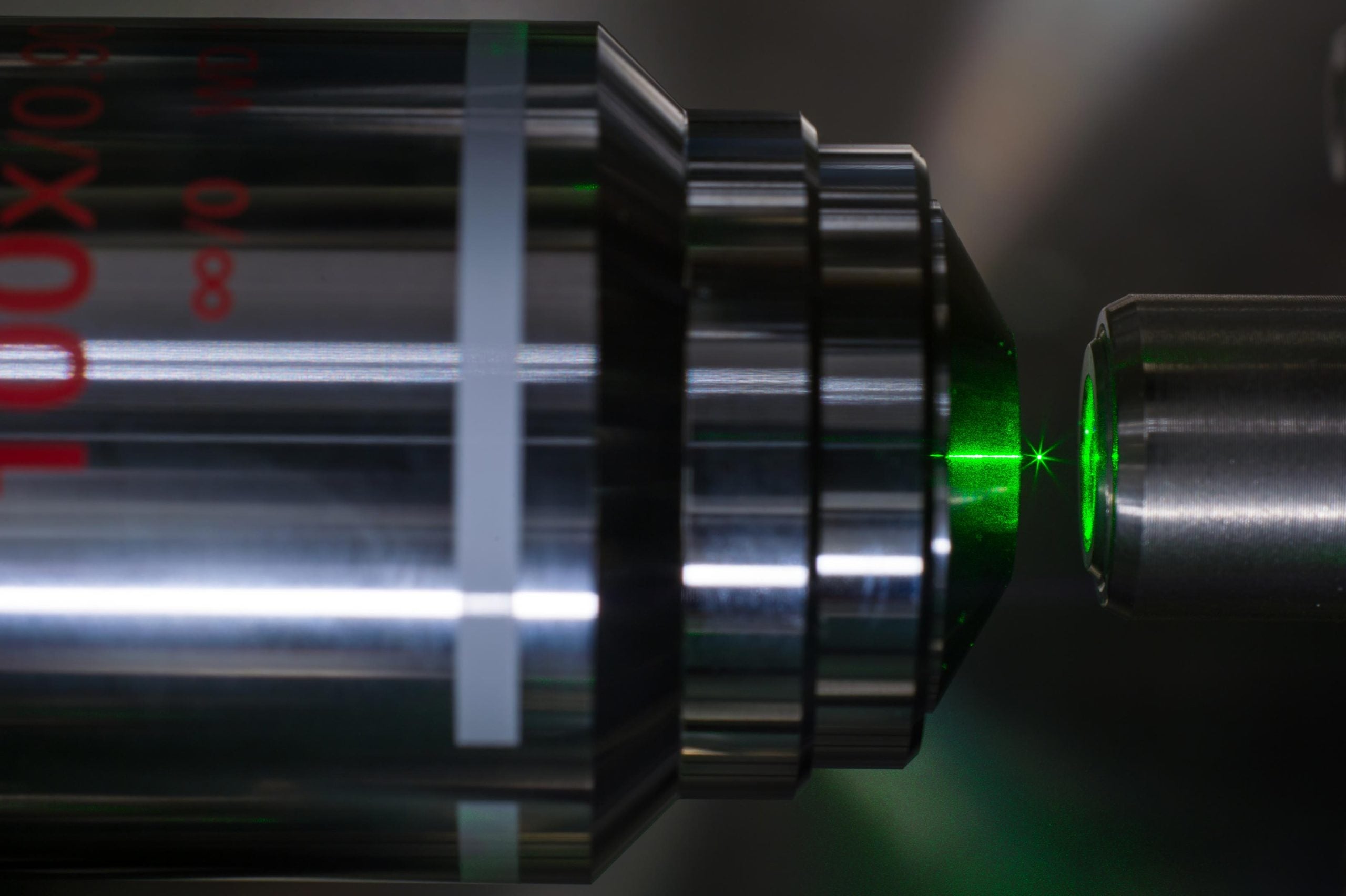
A new sound-based laser could measure gravity with unprecedented precision and reshape navigation technology.
Since their introduction in the 1960s, lasers have fueled major advances in science and everyday technology, from supermarket scanners to eye surgery. Traditional lasers operate by controlling photons, which are particles of light. Over the past two decades, researchers have expanded this concept to other particles, including phonons, which represent tiny units of vibration or sound. Learning to control phonons could unlock new capabilities, including access to unusual quantum effects such as entanglement.
Squeezed Phonon Laser Advances Precision
A team from the University of Rochester and Rochester Institute of Technology has developed a new squeezed phonon laser that can precisely control vibrations at the nanoscale. This level of control may help scientists better understand gravity, particle acceleration, and the principles of quantum physics. In their study published in Nature Communications, the researchers explain how they guided these small units of mechanical motion to behave in a coordinated, laser-like manner.
Overcoming Noise in Laser Systems
Nick Vamivakas, the Marie C. Wilson and Joseph C. Wilson Professor of Optical Physics with the URochester Institute of Optics, previously demonstrated a phonon laser in 2019. In that work, phonons were trapped and levitated using an optical tweezer inside a vacuum. However, turning this concept into a practical tool for precise measurement required addressing a major limitation shared by both photon and phonon lasers: noise. These unwanted fluctuations can interfere with signals and reduce measurement accuracy.
“While a laser looks to the naked eye like a steady beam, there’s actually a lot of fluctuation, which causes noise when you’re using lasers for measurement,” says Vamivakas. “By pushing and pulling on a phonon laser with light in the right way, we can reduce that phonon laser fluctuation significantly.”
Reducing Thermal Noise for Better Measurements
The researchers tackled this challenge by using a method known as squeezing to lower the thermal noise within the phonon laser. Reducing this background disturbance makes it possible to take more precise measurements. According to Vamivakas, this improvement allows acceleration to be measured more accurately than with approaches that rely on photon lasers or radio frequency waves.
Potential Uses in Navigation and Fundamental Physics
With its enhanced sensitivity, the phonon laser could become a valuable tool for measuring gravity and other forces with high precision. This capability may support new navigation technologies. Scientists have proposed quantum compasses as highly accurate, “unjammable” alternatives to GPS navigation that do not depend on satellites. Vamivakas is interested in exploring whether phonon lasers could contribute to the development of such systems.
Reference: “A two-mode thermomechanically squeezed phonon laser” by K. Zhang, K. Xiao, M. Bhattacharya and A. N. Vamivakas, 30 March 2026, Nature Communications.
DOI: 10.1038/s41467-026-70564-3
The research was supported by the National Science Foundation.
Never miss a breakthrough: Join the SciTechDaily newsletter.
Follow us on Google and Google News.
4 Comments
thanks
no
cool
cool Lazer