
Close Menu
    Facebook X (Twitter) Instagram
    SciTechDaily
    • Biology
    • Chemistry
    • Earth
    • Health
    • Physics
    • Science
    • Space
    • Technology
    Facebook X (Twitter) Pinterest YouTube RSS
    SciTechDaily
    Home»Technology»Development of Inkjet-Printable LC Lasers
    Technology

    Development of Inkjet-Printable LC Lasers

    By SciTechDailySeptember 24, 2012No Comments2 Mins Read
    Facebook Twitter Pinterest Telegram LinkedIn WhatsApp Email Reddit
    Share
    Facebook Twitter LinkedIn Pinterest Telegram Email Reddit
    printable-inkjet-lc-laser
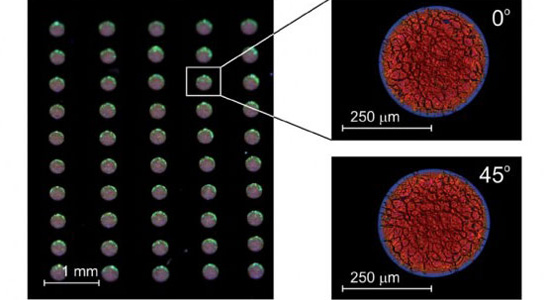
    Active laser arrays, of arbitrary pattern, were created by inkjet deposition of self-assembled photonic structures in the form of dye-doped chiral nematic liquid crystals.

    Most lasers are made up of silicon wafers using expensive processes, similar to the ones used to make microprocessors. Scientists have designed a new way to print a type of organic laser onto any surface, using technology similar to the one found in many homes.

    The scientists published their findings in the journal Soft Matter. The process involved developing lasers based on chiral nematic liquid crystals (LCs), similar to the ones used in flat-panel HDTVs. They are part of a unique class of photonic materials that can be stimulated to produce laser emissions under the right conditions.

    If the helix-shaped structure of the LC molecules is properly aligned, it can act as an optically resonant cavity, which is an essential component of any laser. After adding fluorescent dye, the cavity can be optically excited to produce laser light.

    Creating LC lasers is a complicated process that needs a cleanroom and involves multiple, intricate production steps. The range of substrates available is limited as well, typically restricted to silicon or glass.

    The new process involves printing the LC molecules using a custom inkjet printing system. By printing hundreds of small dots of LC material on a substrate covered with a wet polymer layer, the chemical interaction and mechanical stress causes the LC molecules to align and turns the printed dots into individual lasers as the polymer solution dries.

    It’s believed that this process can be adapted for use with existing printing equipment. The process can also be used to print fluorescence tag-based laser arrays, used extensively in biology and medicine.

    Reference: “Printed photonic arrays from self-organized chiral nematic liquid crystals” by D. J. Gardiner, W.-K. Hsiao, S. M. Morris, P. J. W. Hands, T. D. Wilkinson, I. M. Hutchings and H. J. Coles, 24 August 2012, Soft Matter.
    DOI: 10.1039/C2SM26479J

    Never miss a breakthrough: Join the SciTechDaily newsletter.
    Follow us on Google and Google News.

    Lasers Medicine Optics
    Share. Facebook Twitter Pinterest LinkedIn Email Reddit

    Related Articles

    World’s First Super-Chiral Light Produced by New Metasurface Laser

    Scientists Tame Electron Bunches to Generate Brighter X-Ray Beam With “Donut Laser”

    More Powerful and Smaller Particle Accelerators Possible With “Game Changer” Laser

    High-Performance Laser Fabrication Breakthrough Promises Low Cost Lasers

    Tiny Micromotor Is Powered Directly With Light

    Terahertz Laser Paves the Way for Better Sensing, Imaging and Communications

    New Printer Creates Extremely Realistic Colorful Holograms Using Lasers

    Tiny, Biocompatible Laser Could Function Inside Living Tissues for Imaging or Treatment

    Physicists Generate Laser-Like Beams of X-Rays From a Tabletop Device

    Leave A Reply Cancel Reply

    • Facebook
    • Twitter
    • Pinterest
    • YouTube

    Don't Miss a Discovery

    Subscribe for the Latest in Science & Tech!

    Trending News

    Scientists Call for a Complete Rethink of Alzheimer’s Treatment

    Scientists Identify Molecular Switch That Lets Exercise Reverse Muscle Aging

    Why Your Most Vivid Dreams Might Be the Key to Deep, Restful Sleep

    A Bright Star Hid a Massive Secret for 50 Years: Mystery of Gamma Cassiopeiae Finally Solved

    Scientists Identify Protein That Slows Key Effects of Aging

    Revolutionary Submarine Mysteriously Disappears Without a Trace – Scientists Are Now Preparing for a Bold Return

    Why Drinking More Water Isn’t Enough To Stop Kidney Stones

    New Study Reveals Surprising Effect of Drinking Coffee at Night

    Follow SciTechDaily
    • Facebook
    • Twitter
    • YouTube
    • Pinterest
    • Newsletter
    • RSS
    SciTech News
    • Biology News
    • Chemistry News
    • Earth News
    • Health News
    • Physics News
    • Science News
    • Space News
    • Technology News
    Recent Posts
    • Scientists Create Tiny “Nanolaser” That Could Revolutionize Future Computers
    • Mystery Deepens: Astrophysicists Say Dark Matter May Not Be One Thing
    • Life Without a Sun? Scientists Say It May Thrive on Rogue Planet Moons
    • Your BMI Might Be Wrong: Study Finds Millions Are Misclassified
    • More Than Half of U.S. College Students Are Lonely, Major Study Reveals
    Copyright © 1998 - 2026 SciTechDaily. All Rights Reserved.
    • Science News
    • About
    • Contact
    • Editorial Board
    • Privacy Policy
    • Terms of Use

    Type above and press Enter to search. Press Esc to cancel.