
By observing electrons that have been accelerated to extremely high energies, scientists are able to unlock clues about the particles that make up our universe.
Accelerating electrons to such high energies in a laboratory setting, however, is challenging: typically, the more energetic the electrons, the bigger the particle accelerator. For instance, to discover the Higgs boson — the recently observed “God particle,” responsible for mass in the universe — scientists at the CERN laboratory in Switzerland used a particle accelerator nearly 17 miles long.
But what if there was a way to scale down particle accelerators, producing high-energy electrons in a fraction of the distance?
In a paper published in Physical Review Letters, scientists at the University of Rochester’s Laboratory for Laser Energetics (LLE) outlined a method to shape intense laser light in a way that accelerates electrons to record energies in very short distances: the researchers estimate the accelerator would be 10,000 times smaller than a proposed setup recording similar energy, reducing the accelerator from nearly the length of Rhode Island to the length of a dining room table. With such a technology, scientists could perform tabletop experiments to probe the Higgs boson or explore the existence of extra dimensions and new particles that could lead to Albert Einstein’s dream of a grand unified theory of the universe.
“The higher energy electrons are required to study fundamental particle physics,” says John Palastro, a scientist at the LLE and the paper’s lead author. “Electron accelerators provide a looking glass into a sub-atomic world inhabited by the fundamental building blocks of the universe.”
While this research is currently theoretical, the LLE is working to make it a reality through plans to construct the highest-powered laser in the world at the LLE. The laser, to be named EP-OPAL, will allow the researchers to create the extremely powerful sculpted light pulses and technology described in this paper.
The electron accelerator outlined by the researchers relies on a revolutionary technique for sculpting the shape of laser pulses so that their peaks can travel faster than the speed of light.
“This technology could allow electrons to be accelerated beyond what is possible with current technologies,” says Dustin Froula, a senior scientist at the LLE and one of the paper’s authors.
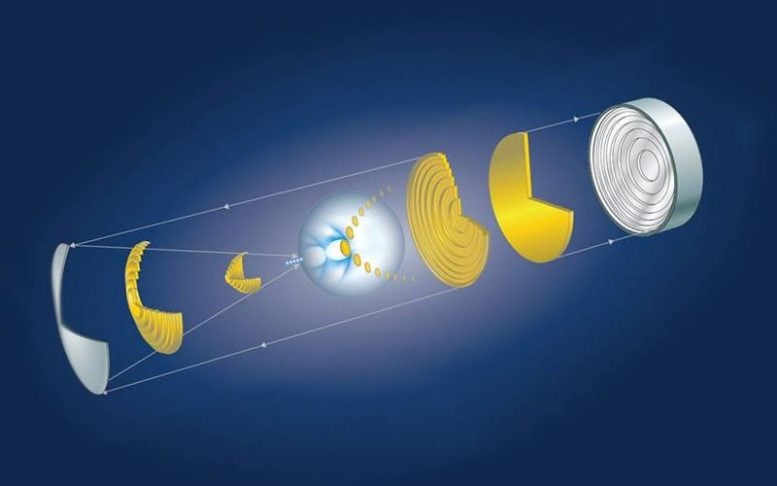
In order to sculpt the laser pulses, the researchers developed a novel optic setup resembling a circular amphitheater with wavelength-sized “steps” used to create a time delay between concentric rings of light delivered from a high-power laser.
A typical lens focuses each ring of light from a laser to a single distance from the lens, forming a single spot of high-intensity light. Instead of using a typical lens, however, the researchers use an exotically shaped lens, which allows them to focus each ring of light to a different distance from the lens, creating a line of high intensity rather than a single spot.
When this sculpted light pulse enters a plasma — a hot soup of freely moving electrons and ions — it creates a wake, similar to the wake behind a motorboat. This wake propagates at the speed of light. Much like a water skier riding in a boat’s wake, the electrons then accelerate as they ride the wake of the sculpted laser light pulses.
These “laser wakefield accelerators” (LWFA) were first theorized nearly 40 years ago, and were advanced by the invention of chirped-pulse amplification (CPA), a technique developed at the LLE by 2018 Nobel Prize recipients Donna Strickland and Gerard Mourou.
Previous versions of LWFA, however, used traditional, unstructured light pulses that propagated more slowly than the speed of light, which meant the electrons would outrun the wake, limiting their acceleration. The new sculpted light pulses enable faster-than-light speeds so electrons can ride the wake indefinitely and be continually accelerated.
“This work is extremely innovative and would be a game changer for laser accelerators,” says Michael Campbell, director of the LLE. “This research shows the value of theoretical and experimental plasma physics working closely together with outstanding laser scientists and engineers — it represents the best of the culture of LLE.”
Reference: “Dephasingless Laser Wakefield Acceleration” by J. P. Palastro, J. L. Shaw, P. Franke, D. Ramsey, T. T. Simpson and D. H. Froula, 31 March 2020, Physical Review Letters.
DOI: 10.1103/PhysRevLett.124.134802
The research is supported by the US Department of Energy (DOE) Office of Fusion Energy Sciences and the New York State Energy Research and Development Authority.
The LLE was established at the University in 1970 and is the largest US DOE university-based research program in the nation. As a nationally funded facility, supported by the National Nuclear Security Administration as part of its Stockpile Stewardship Program, the LLE conducts implosion and other experiments to explore fusion as a future source of energy, to develop new laser and materials technologies, and to conduct research and develop technology related to high-energy-density phenomena.
Never miss a breakthrough: Join the SciTechDaily newsletter.
Follow us on Google and Google News.
4 Comments
Cedric Thaury presented this idea in May 2019
https://doi.org/10.1117/12.2522126
I’m by no means a scientist, but this makes me wonder if it has potential to power an engine. Imagine an ftl drive …
Innovative &valuable information, (lenses)
Innovative & valuable information, (lenses)