
A decades-long experiment in a Massachusetts forest is uncovering unexpected behavior in soil carbon.
After nearly 40 years, the longest-running soil warming experiment in the world is producing an unexpected finding. What was once considered long-term, “stable” carbon in forest soils is proving far less permanent. As temperatures rise, even these stubborn carbon reserves can break down and release CO2 into the air.
“Microbes are critical components of soil ecosystems because they break down organic matter and recycle elements essential for plant growth,” explains Jerry Melillo, a Distinguished Scientist at the Marine Biological Laboratory, who has moved the needle on the world’s understanding of climate change over the course of his career. “As warming reshapes these microbial communities, it can speed the loss of carbon from soils.”
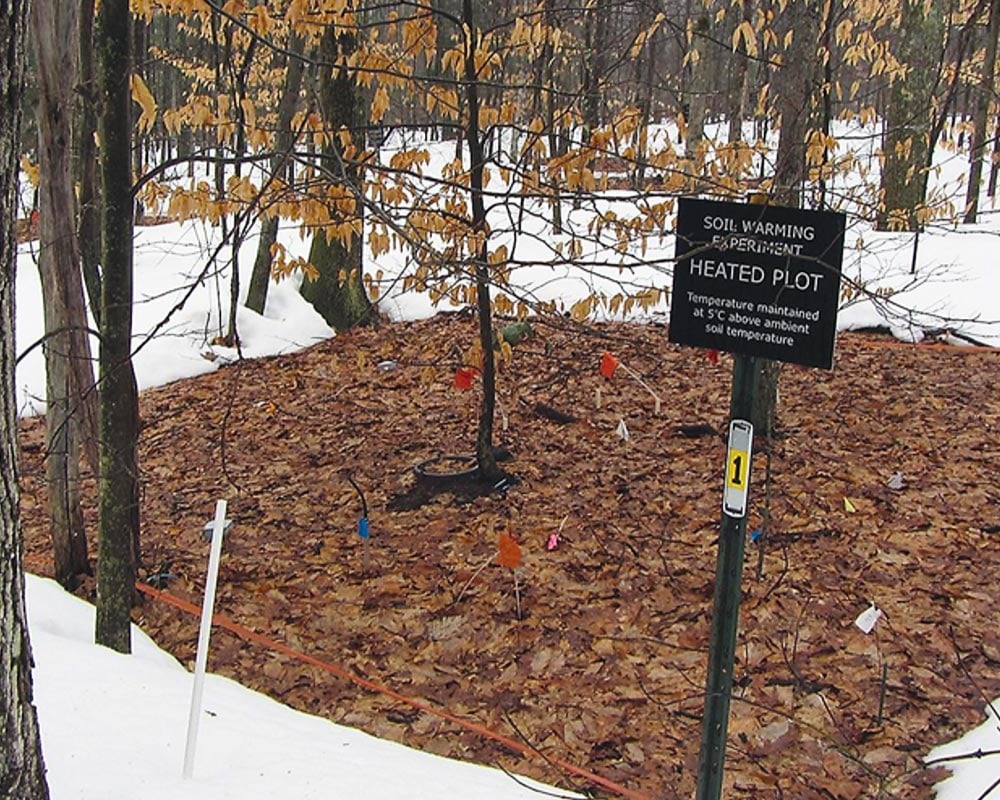
A Long-Term Experiment in Harvard Forest
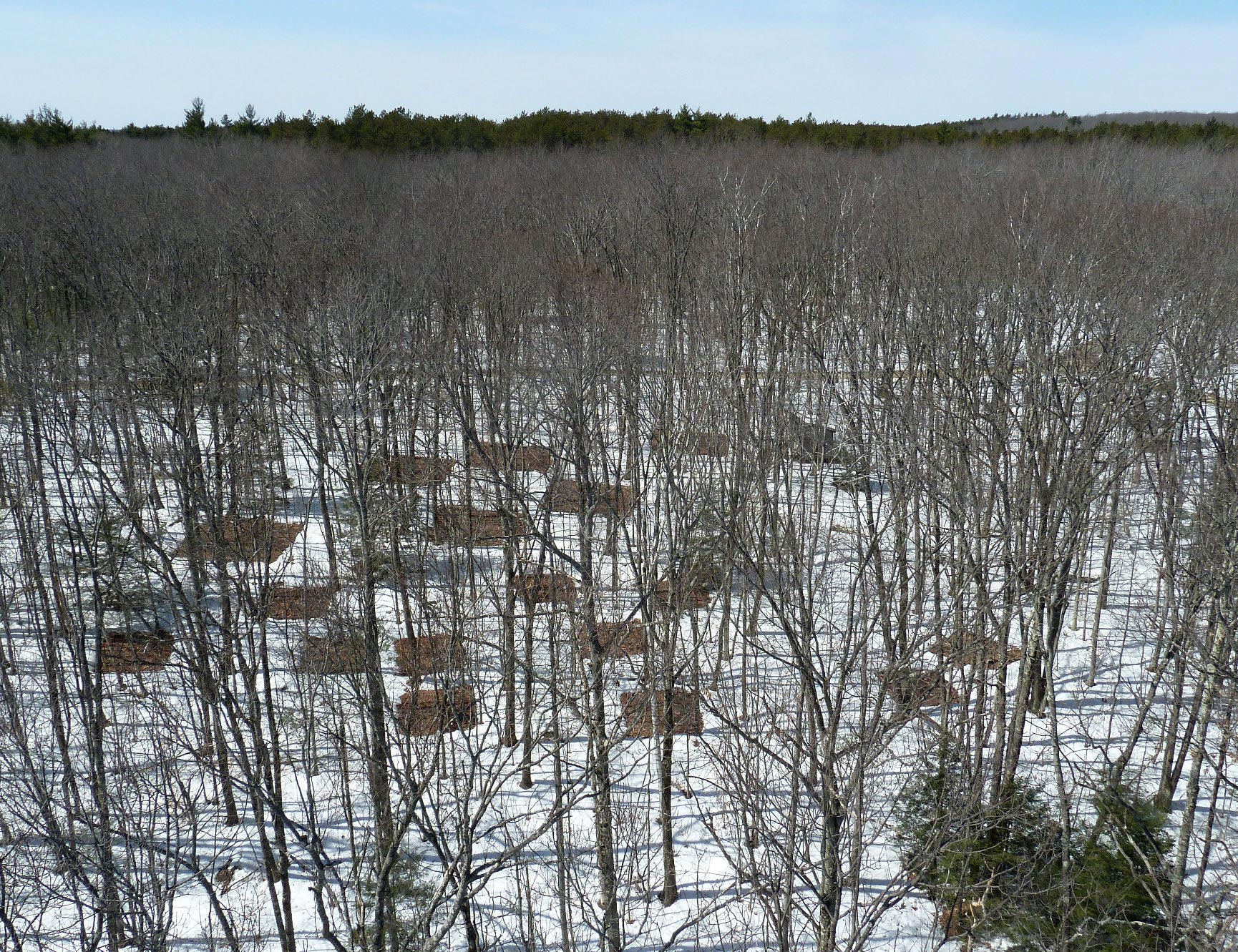
Deep in Harvard Forest in central Massachusetts, researchers have been running a controlled warming experiment for 37 years. Electric cables buried underground keep sections of soil at a steady 5 °C (9 °F) above natural conditions through every season, from frozen winters to humid summers.
When the study began in the late 1980s, that temperature increase reflected the upper range of climate projections at the time. Today, it no longer seems extreme. Global temperatures have already climbed by about 1.1 to 1.4 °C since the Industrial Revolution, and future warming will depend heavily on how quickly greenhouse gas emissions are reduced.
“If we dramatically cut CO2 emissions from fossil fuel burning, or reduce deforestation, the projected increase would be lower,” Melillo says.
A Hidden Shift Underground
Soil holds more carbon globally than the atmosphere and all plant life combined, making it a critical piece of the climate system. Scientists have long assumed that a portion of this carbon is effectively locked away for centuries. The new findings challenge that assumption.
After decades of warming, researchers observed that these supposedly resistant forms of soil organic matter are beginning to decompose. This shift did not appear immediately. Instead, it emerged slowly, underscoring the importance of long-term experiments that capture changes unfolding over decades rather than years.
A Feedback Loop With Global Stakes
As these materials decompose, they release additional CO2 into the atmosphere.
This process could strengthen a feedback loop in Earth’s climate system: rising temperatures lead to more carbon release from soils, which in turn drives further warming. Including these results in climate models may improve predictions of future climate change.
Reference: “Three decades of continuous warming in temperate forests destabilizes persistent forms of soil organic matter” by Atzín X. San Román, Serita D. Frey, Melissa A. Knorr, Huan Tong, Jerry M. Melillo and Myrna J. Simpson, 7 April 2026, Science of The Total Environment.
DOI: 10.1016/j.scitotenv.2026.181777
Never miss a breakthrough: Join the SciTechDaily newsletter.
Follow us on Google and Google News.
10 Comments
Testing at 5 degrees C above ambient would certainly support particular agendas!
Heating the roots of plants, where Winter respiration occurs, is NOT the same as heating the much colder air brought down from the Arctic!
This experiment has so many questionable assumptions.
It’s our government investment in fossil fuel. As long as their pockets are filled of profits and the oil companies our world will slowly die along with humans.
Almost poetic. However, without facts to support the assertion, it is little better than biogeopoetry.
8 billion people and growing. Either cut the population or stop crying about climate change. There is no slowing it down, there is just accepting and dealing with it. Unless you’re a megolmanic and want to cut population by 70%
The vast majority of Earth’s 8.3 billion humans continue to assume that we still have at least 20 years left to turn this ‘Titanic’ around using their favorite technologies They have become masterful in excluding the following warning from their consciousness.
UN chief: World has less than 2 years to avoid ‘runaway climate change’ (TheHill)
* This statement was made 7.6 years ago.
Predictions based on weakly-supported speculations, in turn based on cherry-picked facts, are invariably wrong. That is why numeric predictions have such a poor track record. To wit, there is no agreement on the climate sensitivity (warming resulting from a doubling of CO2). That may be because at this point in time, only a correlation between CO2 and temperature is firmly established. Additionally, there are unstated assumptions that the climate sensitivity is an unvarying constant, when it may well change with temperature.
Causation is probably obscured because of the complexity of the interrelated feedback loops and the necessity to ‘tune’ the models to history to predict future warming, instead of deriving the predictions from First Principles. We don’t have computers powerful enough to estimate the solutions to the differential equations describing energy exchanges in the clouds; therefore, we have to rely on what is called “parameterization.” That is not unlike stating that E = mC^2 +/- Fudge Factor, which is the potential error introduced by the inaccuracies of the parameterizations.
The poor predictions are likely to be the result of having causation backwards. That is, there are good reasons to believe that warming causes a net increase in CO2, rather than the consensus position of CO2 being the primary driver of warming.
One of the best arguments for fossil fuels driving an increase in CO2 is the increased relative abundance of 12C in the atmosphere. Unfortunately, being lighter, one can expect 12C to be more mobile than 13C. However, we don’t have good data on isotopic fractionation for all the phase changes and chemical reactions involving carbon in the environment. The (bi)carbonate buffering that stabilizes the ocean pH probably contributes to increasing the 12C fraction. That means we can’t eliminate isotopic fractionation from being the cause of an increasing percentage of 12C in the atmosphere as the oceans warm. Additionally, while it is well-known that photosynthetic organisms prefer 12C, what happens when trees respire CO2 at night and in the Winter? Do bacteria and fungi emit CO2 with the same isotopic ratios as the current atmosphere, or do they contribute to an unknown shift in the isotopic ratio?
It’s the trees that are taking the co2 from the soil. It’s not escaping to the atmosphere, Jock Mathie
thanks for this