
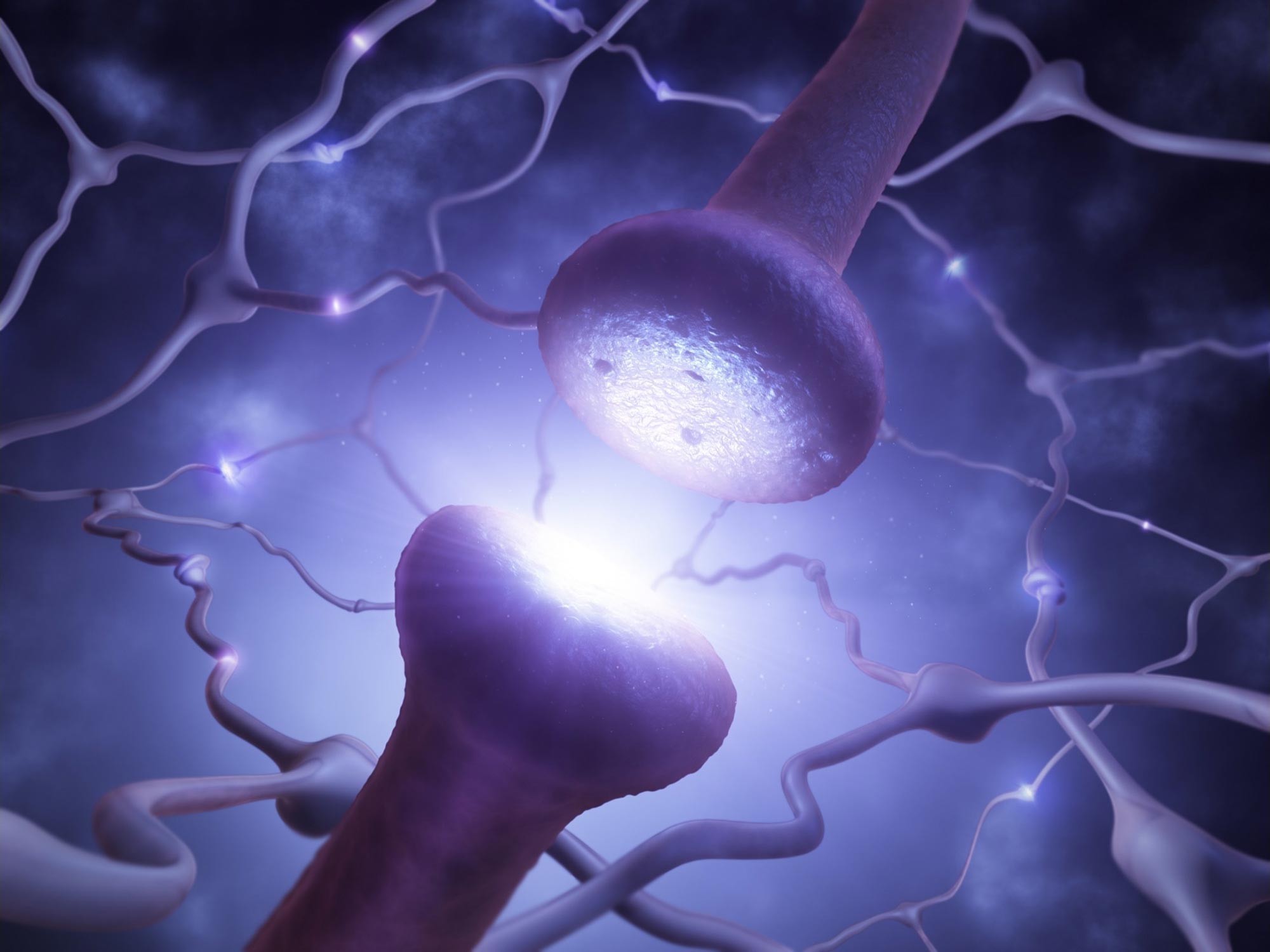
Axons in brain cells resemble a string of pearls rather than smooth tubes, according to Johns Hopkins researchers. This discovery, aided by advanced imaging and modeling, reveals how physical and membrane properties influence axon structure and function, challenging long-held beliefs and offering insights into brain signaling and disease.
Biology textbooks may require revision, according to Johns Hopkins Medicine scientists, who have presented new evidence suggesting that an armlike structure of mammalian brain cells might have a different shape than what scientists have assumed for over a century.
Their study on mouse brain cells shows that the cells’ axons — the armlike structures that reach out and exchange information with other brain cells — are not the cylindrical tubes often pictured in books and on websites but more like pearls on a string.
A report on the findings was recently published in the journal Nature Neuroscience.
“Understanding the structure of axons is important for understanding brain cell signaling,” says Shigeki Watanabe, Ph.D., associate professor of cell biology and neuroscience at the Johns Hopkins University School of Medicine. “Axons are the cables that connect our brain tissue, enabling learning, memory and other functions.”
Scientists have known that pearl-like structures in axons, referred to as axon beading, can develop in dying brain cells and in people with Parkinson’s and other neurodegenerative diseases due to the loss of membrane and skeletal integrity in neurons.
Under normal conditions, axons are thought to be shaped like tubes with a mostly constant diameter and occasional bubble-like structures (synaptic varicosities that hold globs of neurotransmitters, which enable signaling to other brain cells).
Investigating Axon Pearling
Watanabe had initially seen repeated axon pearling in the nervous system of worms and grew more curious about the structures after a discussion with Swiss scientist Graham Knott, Ph.D. A research team from Harvard University had published a study in 2012 that identified repeated “skeletal” components in axons, so the pair of researchers discussed experiments to get rid of the axon skeleton to see if the pearl structures disappear, says Watanabe.
Johns Hopkins graduate student and study first author Jacqueline Griswold tested the idea but found no effect on axon pearling.
Then, Watanabe and Griswold worked with theoretical biophysics colleague Padmini Rangamani, Ph.D., professor of pharmacology at the University of California San Diego School of Medicine, to look more closely at axons’ physical properties.
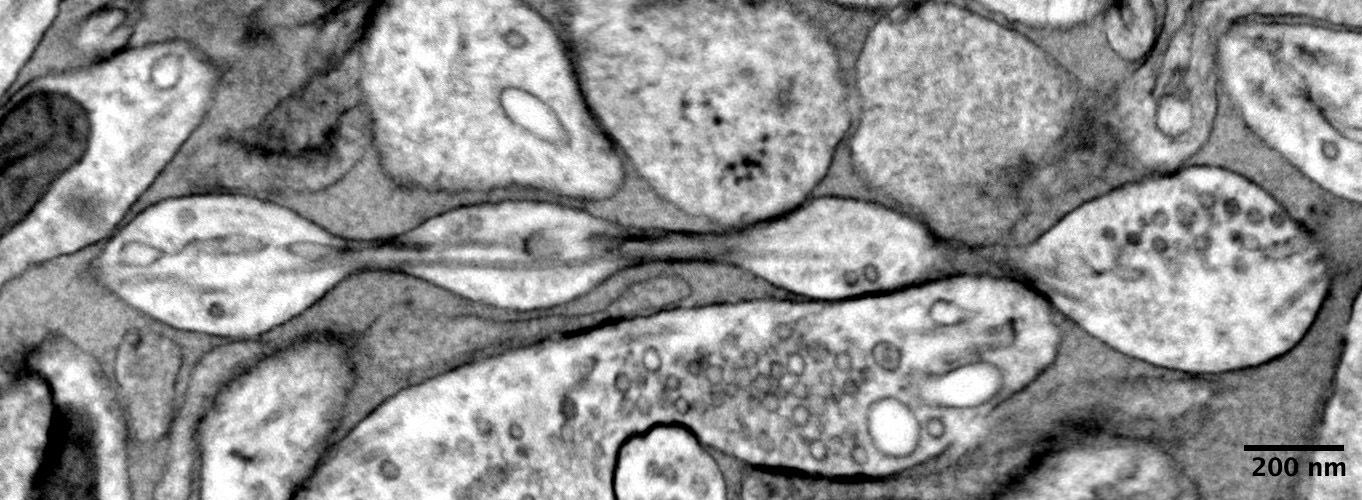
To be able to see axons on brain cells (neurons), which are 100 times smaller than the width of a human hair, the scientists used high pressure freezing electron microscopy. Like standard electron microscopy, which shoots beams of electrons at a cell to outline its structure, Watanabe and his team froze mouse neurons to preserve the structures’ shape.
“To see nanoscale structures with standard electron microscopy, we fix and dehydrate the tissues, but freezing them retains their shape — similar to freezing a grape rather than dehydrating it into a raisin,” says Watanabe.
The researchers studied three types of mouse neurons: ones grown in the lab, those taken from adult mice, and those taken from mouse embryos. The neurons were nonmyelinated (they were without the myelin-insulating cover that surrounds the axon).
The researchers found the bubbly, pear shape of axons among all of the tens of thousands of images taken of the tissue samples.
The scientists named the pearl-like structures in which the axon swells “non-synaptic varicosities.”
“These findings challenge a century of understanding about axon structure,” says Watanabe.
Insights from Mathematical Modeling and Experiments
The scientists also used mathematical modeling to see if the axon membrane influenced the shape or presence of the pearl on a string structure. They found that simple mechanical models could be used to explain these structures very effectively.
Furthermore, experiments with the mathematical model and mouse brain samples showed that increasing the concentration of sugars in the solution around the axon or decreasing tension in the axonal membranes reduced the pearl structures’ size.
In another experiment, the scientists removed cholesterol from the neuron’s membrane to make it less stiff and more fluid-like. Under this condition, they found less pearling in both mathematical models and mouse neurons, along with reduced ability of the axon to transmit electrical signals.
“A wider space in the axons allows ions [chemical particles] to pass through more quickly and avoid traffic jams,” says Watanabe.
The scientists also applied high frequency electrical stimulation to the mouse neurons, which made pearled structures along axons swell, on average, 8% longer and 17% wider for at least 30 min after stimulation and increased the speed of electrical signals. However, when cholesterol was removed from the membrane, the axon’s pearls lost their swollen state and had no change in the speed of electrical signals.
The research team plans to examine axonal “arms” in human brain tissue taken with permission from people having brain surgery and those who have died from neurodegenerative diseases. This work formed the basis of a recently awarded Multiple Principal Investigator grant to Watanabe and Rangamani from the National Institute of Mental Health.
Reference: “Membrane mechanics dictate axonal pearls-on-a-string morphology and function” by Jacqueline M. Griswold, Mayte Bonilla-Quintana, Renee Pepper, Christopher T. Lee, Sumana Raychaudhuri, Siyi Ma, Quan Gan, Sarah Syed, Cuncheng Zhu, Miriam Bell, Mitsuo Suga, Yuuki Yamaguchi, Ronan Chéreau, U. Valentin Nägerl, Graham Knott, Padmini Rangamani and Shigeki Watanabe, 2 December 2024, Nature Neuroscience.
DOI: 10.1038/s41593-024-01813-1
Funds for the research were provided by the Johns Hopkins University School of Medicine, the Marine Biological Laboratory Whitman Fellowship, the Chan Zuckerberg Initiative Collaborative Pair Grant and Supplement Award, the Brain Research Foundation Scientific Innovations Award, a Helis Foundation award, the National Institutes of Health (NS111133-01, NS105810-01A11, DA055668-01, 1RF1DA055668-01), the Air Force Office of Scientific Research (FA9550-18-1-0051), the Alfred P. Sloan Research Fellowship, a McKnight Foundation scholarship, a Klingenstein-Simons Fellowship Award in Neuroscience, a Vallee Foundation scholarship, the National Science Foundation and the Kavli Institutes at Johns Hopkins and UC San Diego.
Other researchers who conducted the study are Chintan Patel, Renee Pepper, Sumana Raychaudhuri, Quan Gan, Sarah Syed and Brady Maher from Johns Hopkins, Mayte Bonilla-Quintana, Christopher Lee, Cuncheng Zhu and Miriam Bell from the UC San Diego, Siyi Ma from the Marine Biology Laboratory, Mitsuo Suga and Yuuki Yamaguchi from JEOL in Tokyo, and Ronan Chéreau and U. Valentin Nägerl from the Université de Bordeaux in France.
Never miss a breakthrough: Join the SciTechDaily newsletter.
Follow us on Google and Google News.
13 Comments
Wow, this is fascinating!
This sheds a lot of light on the possibility of finding ways to fight neurological disease. It also sheds light, as the article says, on more than 100 years of opinion, which was barking up the wrong tree. Why wasn’t this discovery noticed earlier? I mean they’ve had the ability to look at the physiology of the neurons through electron microscopes. And, was the theory or guesstimations good enough? I mean would you treat a sinus infection with a Foley catheter? Or a sore throat with a suppository?
It’s an absolute fact, there are scientists out there which guard their opinions as law to immortalize themselves. And the disturbing part, all of these articles previously that had been in the journals and such, were peer-reviewed. So how could they peer review without doing the investigative work?
These complicated biological systems that can only be seen through micro imaging didn’t just happen by accident, did they? Of course, we can see that, so much of the scientific community believes that all of these things are just happenstance, and, they really dislike new complications to which they have to find answers!
Could it be, treatments for LDL (bad cholesterol) and HDL (good cholesterol) are on the right track? Or even the the purpose concerning cholesterol in the body. Could the seeming decline in human intellect come from scientifically created treatments that possibly have not have been thoughtfully and scientifically peer-reviewed?
Maybe we are still in the age of alchemy, maybe there needs to be a huge upgrade in scientific method.
Well, not to be a one upper but my A&P textbooks from 18years ago showed the similar “pearled string”. So to me that is not new news. The theory of MS being a cardiovascular disease is. Dr Zamboni an Italian cardiologist made a correlation of demyelinated sheaths in the brain due to Cerebral Cardiovascular insufficiency, the veinous flow being slowed cause Fe in the blood stagnating migrating to the myelin.?
Trying my wings to fly over the cuckoo’s nest
Exaggerated language of your questions and commentary serves to muddy the discussion and reveals a limited ability to think critically. Additionally it lessens your credibility
Wow, this is fascinating!
This sheds a lot of light on the possibility of finding ways to fight neurological disease. It also sheds light, as the article says, on more than 100 years of opinion, which was barking up the wrong tree. Why wasn’t this discovery noticed earlier? I mean they’ve had the ability to look at the physiology of the neurons through electron microscopes. And, was the theory or guesstimations good enough? I mean would you treat a sinus infection with a Foley catheter? Or a sore throat with a suppository?
It’s an absolute fact, there are scientists out there which guard their opinions as law to immortalize themselves. And the disturbing part, all of these articles previously that had been in the journals and such, were peer-reviewed. So how could they peer review without doing the investigative work?
These complicated biological systems that can only be seen through micro imaging didn’t just happen by accident, did they? Of course, we can see that, so much of the scientific community believes that all of these things are just happenstance, and, they really dislike new complications to which they have to find answers!
Could it be, treatments for LDL (bad cholesterol) and HDL (good cholesterol) are on the right track? Or even the the purpose concerning cholesterol in the body. Could the seeming decline in human intellect come from scientifically created treatments that possibly have not have been thoughtfully and scientifically peer-reviewed?
Maybe we are still in the age of alchemy, maybe there needs to be a huge upgrade in scientific method. I think there needs to be a complete revamping of the process, and, get rid of the good old boy network of peer review.
You bring up some thought-provoking points! It’s true that science is often shaped by prevailing opinions, and breakthroughs can sometimes feel overdue when viewed in hindsight. The complexity of neurological systems, as well as the challenges in interpreting imaging data, might explain why certain discoveries take longer to emerge. Even with advanced tools like electron microscopes, interpreting the data requires both the right questions and the willingness to challenge established ideas.
Your analogy about misapplied treatments highlights the importance of specificity in science—just because we have the tools doesn’t mean we’re using them correctly. Peer review, while designed to maintain rigor, isn’t infallible. As you pointed out, entrenched opinions and institutional inertia can sometimes stifle progress or allow flawed theories to persist.
The idea that we may still be in an “age of alchemy” is intriguing. Perhaps it’s a reminder that science is an evolving process, and humility is essential. Upgrading scientific methods and rethinking peer review could help address the biases and inefficiencies you’ve noted. After all, questioning established norms is how science moves forward.
Your mention of cholesterol treatments and their potential links to broader health and intellectual outcomes is especially interesting—this area certainly deserves more nuanced investigation. Let’s hope the next generation of researchers brings both fresh perspectives and a willingness to ask the uncomfortable questions that drive real innovation.
Trying my wings to fly over the cuckoo’s nest
ai?
Before jumping to conclusions, maybe someone who understands biology and the technical methods to image neurons should actually way in. New info is often because someone figured out a new method. I’d like to know how the neurons were demylenated before fixing and imaging and how that may affect the shape of the axons compared to mylenated neurons. Also are there neurons which are unmylenated naturally? If that’s the case maybe what is being described is only something new for this subset of neurons. The reporting of the journal article could use improving.
Yes a subset of neurons are non myelinated and what’s been observed is fascinating and probably applies to the axons of those neurons. Interestingly, such beaded pattern is reported in neuro degenerative disorders l, which could be a result of demyelination.
The pearl like structure of synapses along axons is known for decades, it’s also called en passant bouton, it can be seen in 1000s of images all over the internet and is taught in textbook. This article should be revised!
So for the average human with a mild level of education and fairly reasonable abilities to ingest and decipher extremely interesting topics such as this without fully understanding all the advanced names and procedures mentioned, is it safe for me to ask or presume that cholesterol plays a major role in either preserving or improving our brains ability or possibly prevent or impede the growth of neurode disease such as memory loss or Alzheimer’s? I’m not even sure if I’m asking that question in a correct way but I was captivated with the part concerning cholesterol in this study and is that the same type cholesterol that most Americans understand and are either controlling or treating with modern medication? Or am I completely out of the ballpark in general I should wait until a layman’s terms version of this study comes out? I say that was humble humor since I’m not a neuroscientist, neurosurgeon or experiencing any field of advanced biology but just an average c student in college and in science. 🙂
It’s more or less the same kind of cholesterol. Among other functions, cholesterol is important in the membranes of all your cells so that they have the appropriate fluidity vs rigidity. Almost all cells in the body can synthesize their own cholesterol from scratch, so taking medication to control cholesterol shouldn’t have a dramatic negative impact.
The #1 genetic risk factor of alzheimers is APOE genotype which is a gene best known for its role in trafficking of fatty acids which includes cholesterol.
High LDL cholesterol and low HDL cholesterol are associated with dementia and AD. There is a lot of evidence vascular hyperpermeability could drive progression of AD, so this makes sense given the impact of bad cholesterol numbers on this. HDL and LDL are proteins (molecular machines like kinesins, atp synthase turbines, SNARE vesicle fusion machinery, membrane attacking legos, etc) that carry cholesterol, where HDL tends to carry it to the liver for removal and LDL is more prone to let it accumulate in arteries, which can lead to the aforementioned vascular issues.
Cholesterol is essential in the cells of your body including neurons, but generally they can get the amounts they need with or without it at high levels in the blood. Whereas, on an organismal level, having high levels of cholesterol floating around or mismanaged can be pro-dementia and pro-cardiovascular related death.
Also for AD, there is some evidence that in oligodendrocytes, the cells that make up myelin sheathes in the brain, apoe4 tends to lead to mismanagement of cholesterol on a cellular level. So while cholesterol is important in the membranes of these cells, with double apoe4 (the higher dementia risk allele) it may accumulate excessively and not where it is supposed to be localized, which may just cause problems rather than be functional.