

The discovery could have important implications for the health of aging brains and development of therapies for neurodegenerative diseases.
Recent studies suggest that new brain cells are being formed every day in response to injury, physical exercise, and mental stimulation. Glial cells, and in particular the ones called oligodendrocyte progenitors, are highly responsive to external signals and injuries. They can detect changes in the nervous system and form new myelin, which wraps around nerves and provides metabolic support and accurate transmission of electrical signals.
As we age, however, less myelin is formed in response to external signals, and this progressive decline has been linked to the age-related cognitive and motor deficits detected in older people in the general population. Impaired myelin formation also has been reported in older individuals with neurodegenerative diseases such as Multiple Sclerosis or Alzheimer’s and identified as one of the causes of their progressive clinical deterioration.
A new study from the Neuroscience Initiative team at the Advanced Science Research Center at The Graduate Center, CUNY (CUNY ASRC) has identified a molecule called ten-eleven-translocation 1 (TET1) as a necessary component of myelin repair. The research, published today (June 7, 2021) in Nature Communications, shows that TET1 modifies the DNA in specific glial cells in adult brains so they can form new myelin in response to injury.
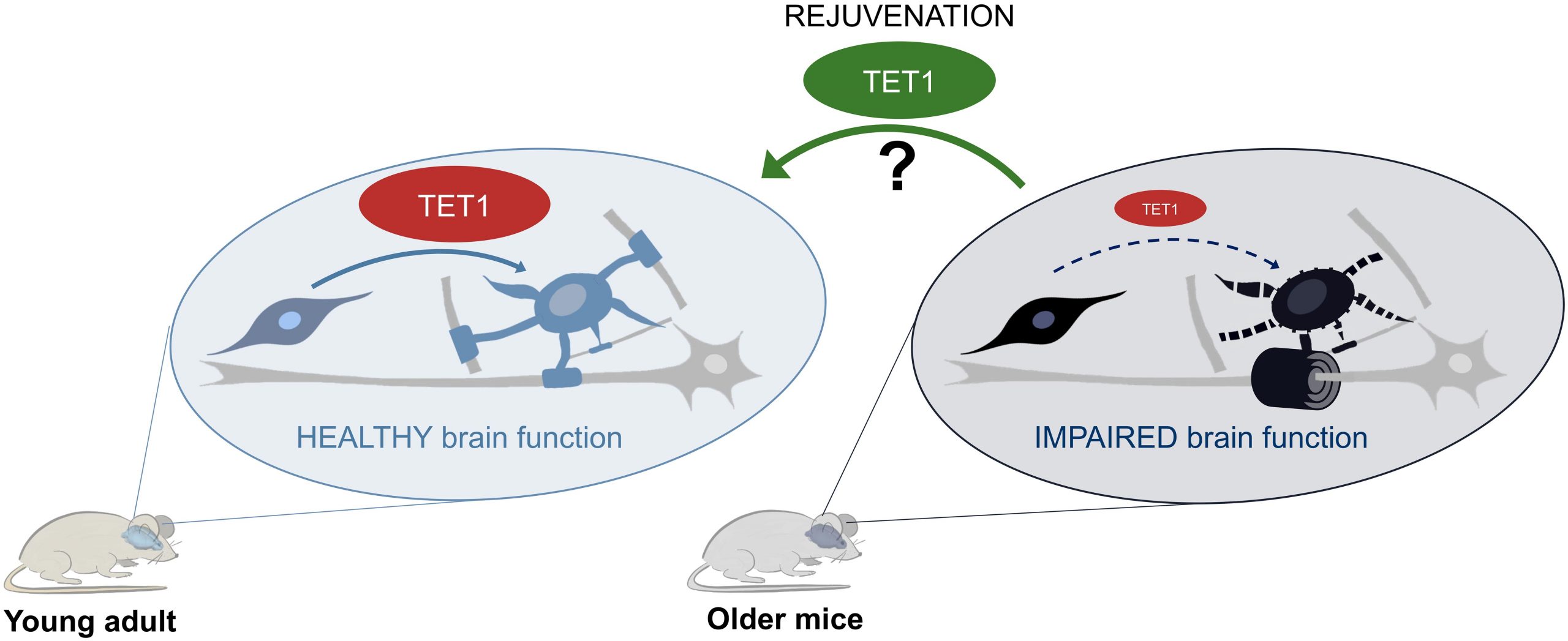
TET1 Enables DNA Modifications for Brain Health
“We designed experiments to identify molecules that could affect brain rejuvenation,” said Sarah Moyon, Ph.D., a research assistant professor with the CUNY ASRC Neuroscience Initiative and the study’s lead author. “We found that TET1 levels progressively decline in older mice, and with that, DNA can no longer be properly modified to guarantee the formation of functional myelin.”
Combining whole-genome sequencing bioinformatics, the authors showed that the DNA modifications induced by TET1 in young adult mice were essential to promote a healthy dialogue among cells in the central nervous system and for guaranteeing proper function. The authors also demonstrated that young adult mice with a genetic modification of TET1 in the myelin-forming glial cells were not capable of producing functional myelin, and therefore behaved like older mice.
Therapeutic Potential for Neurodegenerative Diseases
“This newly identified age-related decline in TET1 may account for the inability of older individuals to form new myelin,” said Patrizia Casaccia, founding director of the CUNY ASRC Neuroscience Initiative, a professor of Biology and Biochemistry at The Graduate Center, CUNY, and the study’s primary investigator. “I believe that studying the effect of aging in glial cells in normal conditions and in individuals with neurodegenerative diseases will ultimately help us design better therapeutic strategies to slow the progression of devastating diseases like multiple sclerosis and Alzheimer’s.”
The discovery also could have important implications for molecular rejuvenation of aging brains in healthy individuals, said the researchers. Future studies aimed at increasing TET1 levels in older mice are underway to define whether the molecule could rescue new myelin formation and favor proper neuro-glial communication. The research team’s long-term goal is to promote recovery of cognitive and motor functions in older people and in patients with neurodegenerative diseases.
Reference: “TET1-mediated DNA hydroxymethylation regulates adult remyelination in mice” by Sarah Moyon, Rebecca Frawley, Damien Marechal, Dennis Huang, Katy L. H. Marshall-Phelps, Linde Kegel, Sunniva M. K. Bøstrand, Boguslawa Sadowski, Yong-Hui Jiang, David A. Lyons, Wiebke Möbius and Patrizia Casaccia, 7 June 2021, Nature Communications.
DOI: 10.1038/s41467-021-23735-3
Never miss a breakthrough: Join the SciTechDaily newsletter.
Follow us on Google and Google News.
5 Comments
I cannot find the article and the DOI doesn’t exists. Could you check if it’s right?
Found it.
DOI: https://doi.org/10.1038/s41467-021-23735-3
Direct: https://www.nature.com/articles/s41467-021-23735-3
Neil B already pointed out the links (thanks!) and the page was updated with the links.
Many of the articles (such as this one) that we publish on SciTechDaily are embargoed until the study is released. This means we publish the article at the exact time the study is supposed to be released. Often the journal has a little delay before the study is actually accessible.
We don’t always have all the information on the study ahead of time, so in the reference at the bottom of the article we include what is available for initial publication and then update it soon after when the study is available. We almost always have the DOI, but we don’t typically make it linkable until a little later when we verify the link is live and add in information we may be missing, such as the list of authors.
For example, this article was published at 2am Pacific Time, which is when the study was supposed to drop. It sometimes takes a while for the direct link to the study to be accessible, the study to be indexed in the journal’s search function, and for the doi.org link to work. The DOI we listed was correct, but because your comment was just 18 minutes after the study dropped, it must not have been accessible quite yet at Nature Communications.
… knowing all brain activity originates as an isometric junction
Soon to be found in iHerb…