
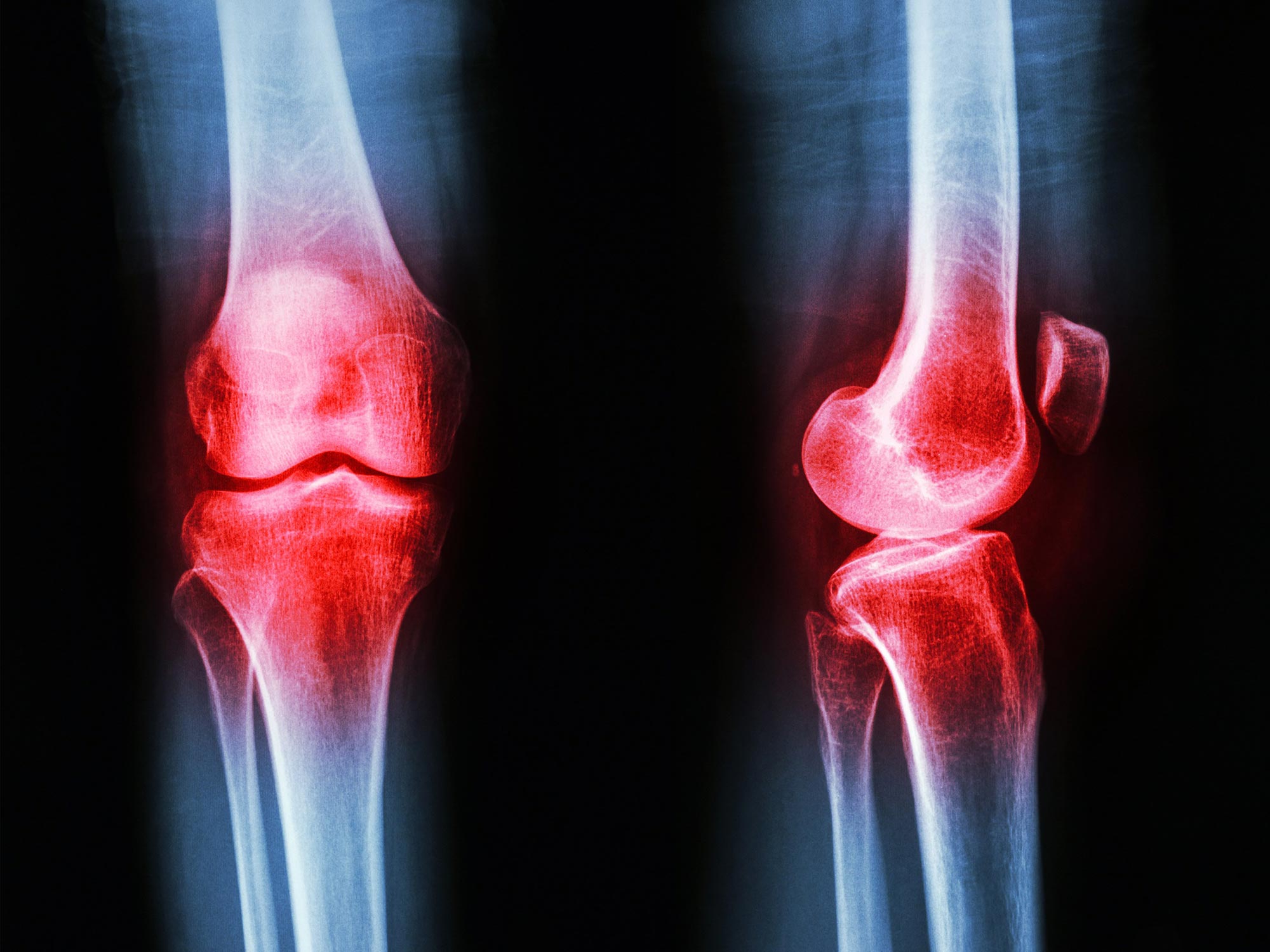
A new study links fatty acid metabolism to rheumatoid arthritis treatment, revealing a natural compound that disrupts inflammation by targeting a previously overlooked enzyme.
A compound derived from a traditional medicinal plant may offer a new way to treat rheumatoid arthritis by targeting how the body processes fats rather than simply suppressing the immune system.
In a study published in Engineering, researchers examined obakulactone (OL), a natural molecule from Phellodendri cortex. They found that OL promotes the breakdown of acyl coenzyme A thioesterase 1 (ACOT1), a protein involved in fatty acid metabolism. This process occurs through the ubiquitin‒proteasome system and helps restore balance in unsaturated fatty acids, which are closely linked to inflammation.
Rheumatoid arthritis is not only driven by immune dysfunction but also by metabolic changes, including disruptions in lipid pathways. Targeting these pathways offers an alternative direction for treatment.
Experimental Model and Treatment Effects
The researchers tested OL in rats with rheumatoid arthritis induced by complete Freund’s adjuvant. The animals received daily doses of OL at low, medium, and high levels for 21 days.
Treated rats showed reduced joint swelling and improved cartilage and synovial tissue structure. The thymus and spleen, which are involved in immune regulation, also showed signs of recovery.
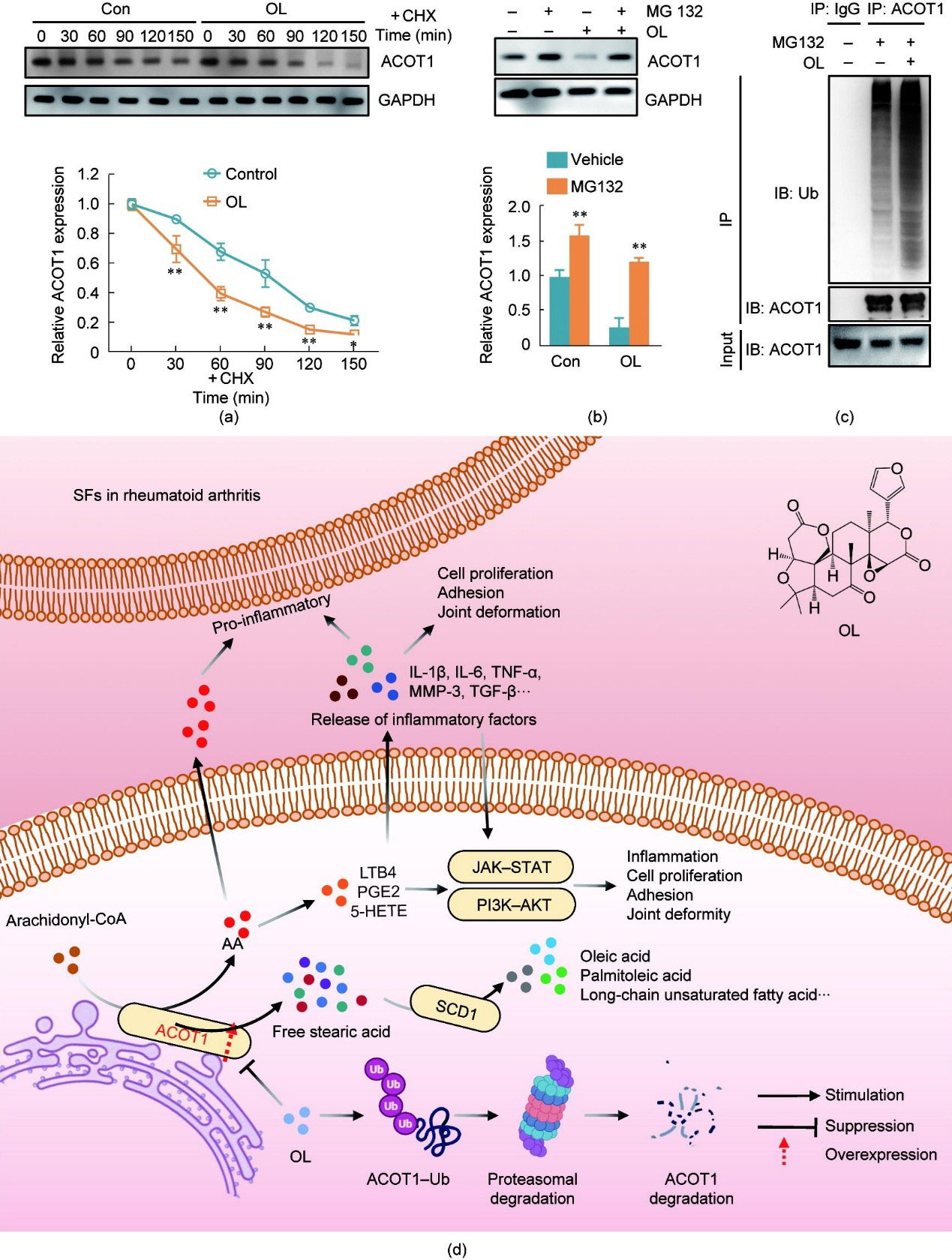
(b) Blocking the cell’s protein disposal system prevents this effect, confirming OL works through that pathway.
(c) OL reduces ACOT1 by marking it for destruction via the ubiquitin–proteasome system.
(d) By lowering ACOT1, OL reduces harmful fatty acids and inflammation signals, slows abnormal joint cell growth, and helps relieve joint damage in rheumatoid arthritis. Credit: Hongda Liu, Le Yang et al.
OL reduced the presence of inflammatory immune cells in joint tissue. It shifted macrophages from the proinflammatory M1 (CD86) type to the anti-inflammatory M2 (CD206) type and limited the formation of Th17 cells from CD4⁺ T cells.
Blood levels of inflammatory molecules, including IL-1β, IL-6, IL-17, and TNF-α, decreased. RA-related markers such as RF, CCP-Ab, CRP, and MMP-3 were also reduced, with stronger effects at higher doses.
Multiomics Insights and Cellular Mechanisms
Multiomics analyses showed that OL corrected abnormalities in key unsaturated fatty acids, including arachidonic acid, linoleic acid, and α-linolenic acid. These molecules influence inflammation through their role in signaling pathways.
In lab experiments, OL slowed the growth of synovial fibroblasts, triggered their programmed cell death, and reduced their release of inflammatory signals.
Binding studies confirmed that OL directly targets ACOT1, with a dissociation constant (Kd) of (6.18 ± 0.26) μmol·L⁻¹ (analyzed by microscale thermophoresis (MST)) and (6.34 ± 0.38) μmol·L⁻¹ (analyzed by surface plasmon resonance (SPR)). OL promotes the degradation of ACOT1, which lowers levels of stearoyl-CoA desaturase-1 (SCD1).
This effect disrupts signaling pathways that drive disease progression, including Janus kinase (JAK)–signal transducer and activator of transcription (STAT) and phosphoinositide 3-kinase (PI3K)–protein kinase B (AKT). As a result, inflammation and fibrosis in synovial fibroblasts are reduced.
Therapeutic Implications for Rheumatoid Arthritis
Additional experiments confirmed that ACOT1 is central to OL’s anti-inflammatory, antiproliferative, and proapoptotic effects, linking fatty acid regulation to immune signaling pathways.
Rheumatoid arthritis affects about 1% of the global population, and current treatments can have limited effectiveness and significant side effects.
These findings suggest that targeting ACOT1 and fatty acid metabolism could lead to more precise treatment strategies that address underlying disease mechanisms.
Reference: “Obakulactone Alleviates Rheumatoid Arthritis by Promotion of ACOT1 Degradation via the Ubiquitin‒Proteasome Pathway and Restoration of Unsaturated Fatty Acid Homeostasis” by Hongda Liu, Le Yang, Yu Yang, Huan Tang, Junling Ren, Hui Sun, Xin Sun, Songyuan Tang, Chong Qiu, Ye Sun, Jigang Wang, Guangli Yan, Ling Kong, Ying Han and Xijun Wang, 7 November 2025, Engineering.
DOI: 10.1016/j.eng.2025.10.029
Never miss a breakthrough: Join the SciTechDaily newsletter.
Follow us on Google and Google News.
13 Comments
You never named the source that causes the positive results.
I am desperate for reversal damage induced by a YEAR OF INTERFERON causing severe rheumatoid autoimmune disease 😢
I was diagnosed with RA of my right wrist when I was 40..I couldnt hold a cup or do anything with my right hand without experiencing severe pain.I was on medication which required me to go for monthly liver function test..A friend told me to try taking Braggs organic Apple cider vinegar which I took 3 times daily for a few years. Slowly I noticed some improvement…n I can’t recall when I finally could move my right wrist in all direction without any pain.
I am going to be 80 this year n I am happily doing gardening n household tasks without feeling any of those pains I used to get anymore.
How much amount you take. I am Rheumatoid arthritis patient. May this remedy help me too.
Exactly…give up a hint!
how did you give rats Rheumatoid Arthritis…. Is that the reason we have it … Did they give it to us too then ???
How many gallons do you drink daily?
There were very interesting articles.
Thanks
I am desperate for reversal damage induced by a YEAR OF INTERFERON causing severe rheumatoid autoimmune disease 😢
Boswellia can help you. Powder extract type will be better. Start from 0.5g to 4g for 3monrh. Increase carefully week by week.
How can I purchase it?
Nice article, I take about 50 ml ginger juice, add half a lemon and little bit jagari powder mix and keep for 15 minutes, stir well and have it on empty stomach. Every day, which helps me in increasing immunity, reducing joint pain, improves blood circulation, reduces cholesterol,e, strengthens bone., reduces inflammation. I am from India, in hot weather balace with cool ingredients like black grapes one can eat after half an hour.
Ginger, lemon jagari mixer along with joint pain helps to manage weight loss also. One can wash ginger nicely and cut it and in a small mixer jar crush without water and then add little water and again crush and then filter. . One can pound ginger in mortar and pestle.