
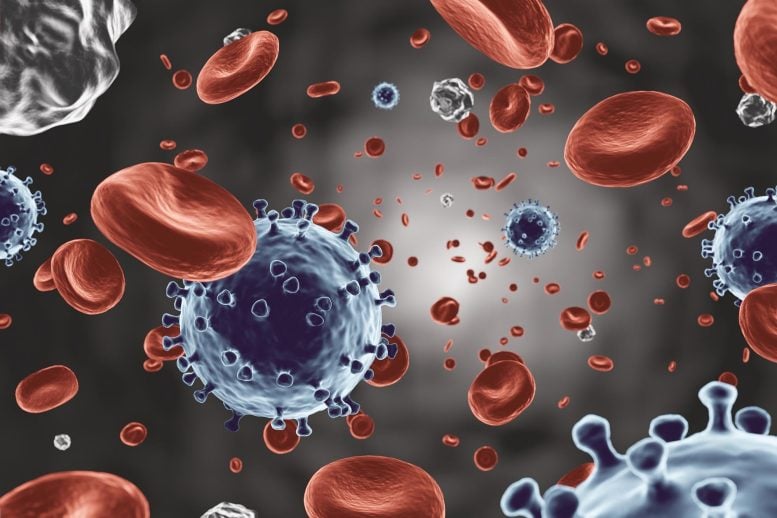
Commonalities found between COVID-19 and Rheumatoid Arthritis could help development of new treatment strategies for Long Covid.
The observations from the study – published in JCI Insight and led by the University of Glasgow’s Research into Inflammatory Arthritis Centre (RACE) in collaboration with the Fondazione A.Gemelli IRCCS in Italy – could help the development of new treatment strategies for severe COVID-19 and post-COVID-19 syndrome, or Long Covid.
The researchers observed that some rheumatoid arthritis patients who became infected with SARS-CoV-2 had ‘flares’ of joint pain and inflammation, which hinted at similarities between COVID-19 and rheumatoid arthritis.
In the study, researchers identified a specific pathogenic macrophage cluster (a group of specialized cells) within the lungs of patients with severe COVID-19 and in the joints of rheumatoid arthritis (RA) patients. Macrophages are immune cells that are responsible for engulfing and destroying pathogens and dying cells, but when over-activated, they induce pathologies in the tissues.
Detailed molecular studies showed that these specialized cells produce a mediator called SPP1. Blood levels of this mediator are high in COVID-19 patients, and particularly high levels are predictive of patient transfer to intensive care.
By investigating the mechanisms of SPP1, the study found that this mediator drives multiple features of pathogenic inflammatory response that characterize severe COVID-19.
The study also provides some insight into the mechanisms of post-COVID-19 syndrome, or Long Covid. The authors found that some COVID-19 patients who recovered and were virus negative, but with persistent symptoms, still had abnormally high blood levels of SPP1, despite normalized levels of other pro-inflammatory mediators.
Dr. Mariola Kurowska-Stolarska, from the University of Glasgow, said: “Our investigation is promising, because understanding these mechanisms which drive features of COVID-19 can help open the prospect for new treatment strategies for severe COVID-19.
“Our study findings also suggest that SPP1 pathogenic function might contribute to long COVID-19, and if so, this identifies SPP1 as a potential therapeutic target for this increasingly common syndrome.”
SPP1’s Role in COVID and RA
Lucy MacDonald, RACE PhD student and one of the first lead authors of the study, said: “We were curious about the most likely common link between joint inflammation and severe response to SARS-CoV-2 infection, which then became the focus of our investigation.
“By understanding this commonality, we have now identified SPP1 as a potential therapeutic target. Our goal now is to identify how SPP1-positive macrophages and their mediators may be involved in the long-COVID-19 symptom spectrum, for example musculoskeletal pain. Our goal is to improve the treatment for patients with COVID-19 and post-COVID-19 as well as for our RA patients.”
Dr. Caroline Aylott, Head of Research Delivery at Versus Arthritis, says: “In both rheumatoid arthritis and COVID-19, the immune system attacks the body’s own tissues, causing inflammation and damage. This research is a step forward in understanding why inflammation continues in both rheumatoid arthritis and COVID-19 and may provide a potential target for the future treatments for both conditions.
“Understanding our immune system is key to helping the 18 million people who experience the pain and fatigue linked to arthritis. Versus Arthritis research funding may be unlocking the prospects of future treatment not only for arthritis but also for long COVID.”
Reference: “COVID-19 and RA share SPP1 myeloid pathway that drives PD-L1pos neutrophils and CD14pos monocytes” by Lucy MacDonald, Stefano Alivernini, Barbara Tolusso, Aziza Elmesmari, Domenico Somma, Simone Perniola, Annamaria Paglionico, Luca Petricca, Silvia L. Bosello, Angelo Carfì, Michela Sali, Egidio Stigliano, Antonella Cingolani, Rita Murri, Vincenzo Arena, Massimo Fantoni, Massimo Antonelli, Francesco Landi, Francesco Franceschi, Maurizio Sanguinetti, Iain B. McInnes, Charles McSharry, Antonio Gasbarrini, Thomas D. Otto, Mariola Kurowska-Stolarska and Elisa Gremese, 18 June 2021, JCI Insight.
DOI: 10.1172/jci.insight.147413
The study was funded by the Medical Research Council, Versus Arthritis UK and the Italian Ministry of Health.
Never miss a breakthrough: Join the SciTechDaily newsletter.
Follow us on Google and Google News.