
The Texas Advanced Computing Center celebrated 20 years of innovation, having grown into a global leader in supercomputing. With systems like Frontera and Stampede2, TACC has enabled discoveries in black hole imaging, COVID-19 modeling, and quantum physics, while aiding in disaster response and medical breakthroughs.
Twenty years ago, a handful of computing experts with a hand-me-down Cray computing cluster began the journey of building the Texas Advanced Computing Center, or TACC, at The University of Texas at Austin into a research organization that today stands at the pinnacle of academic supercomputing.
On September 30, 2021, the center and its longest partners — the National Science Foundation (NSF) and Dell Technologies — celebrated the milestone with remarks on the growing importance of advanced computing and TACC’s role in powering discoveries across science and engineering.
“Two decades ago, UT made a big bet on TACC and supercomputing. It’s an investment that’s paid off handsomely,” said UT Austin President Jay Hartzell. “And, given the proliferation of data science, AI, and machine learning across fields and throughout society, there’s no limit to TACC’s impact over the next 20 years.”
A Legacy of Groundbreaking Discoveries
Throughout its history, TACC has powered many notable discoveries, aided society and enabled new approaches to answering humanity’s oldest questions.
- Astronomers used TACC systems to analyze data and confirm the Event Horizon Telescope’s first-ever image of a black hole.
- TACC devoted more than 30% of its computing resources to supporting over 50 COVID-19 research teams, leading to the first atomistic model of SARS-CoV-2 and daily pandemic forecasts that continue to drive state, local and national policy decisions.
- TACC supercomputers helped confirm the first observation of gravitational waves by detectors at the Laser Interferometer Gravitational-Wave Observatory (LIGO). The discovery opened a new window to the universe and lead to a 2017 Nobel Prize in physics.
- Physicists computed the behavior of “magic angle” bilayer twisted graphene using TACC systems and proposed a theory that a decade later led to superconducting materials that could enable quantum computing and more efficient electrical transmission.
Since June 2001, the center has grown from a dozen employees to nearly 200, with emerging expertise in data science and artificial intelligence, life sciences, science gateways, and STEM education.
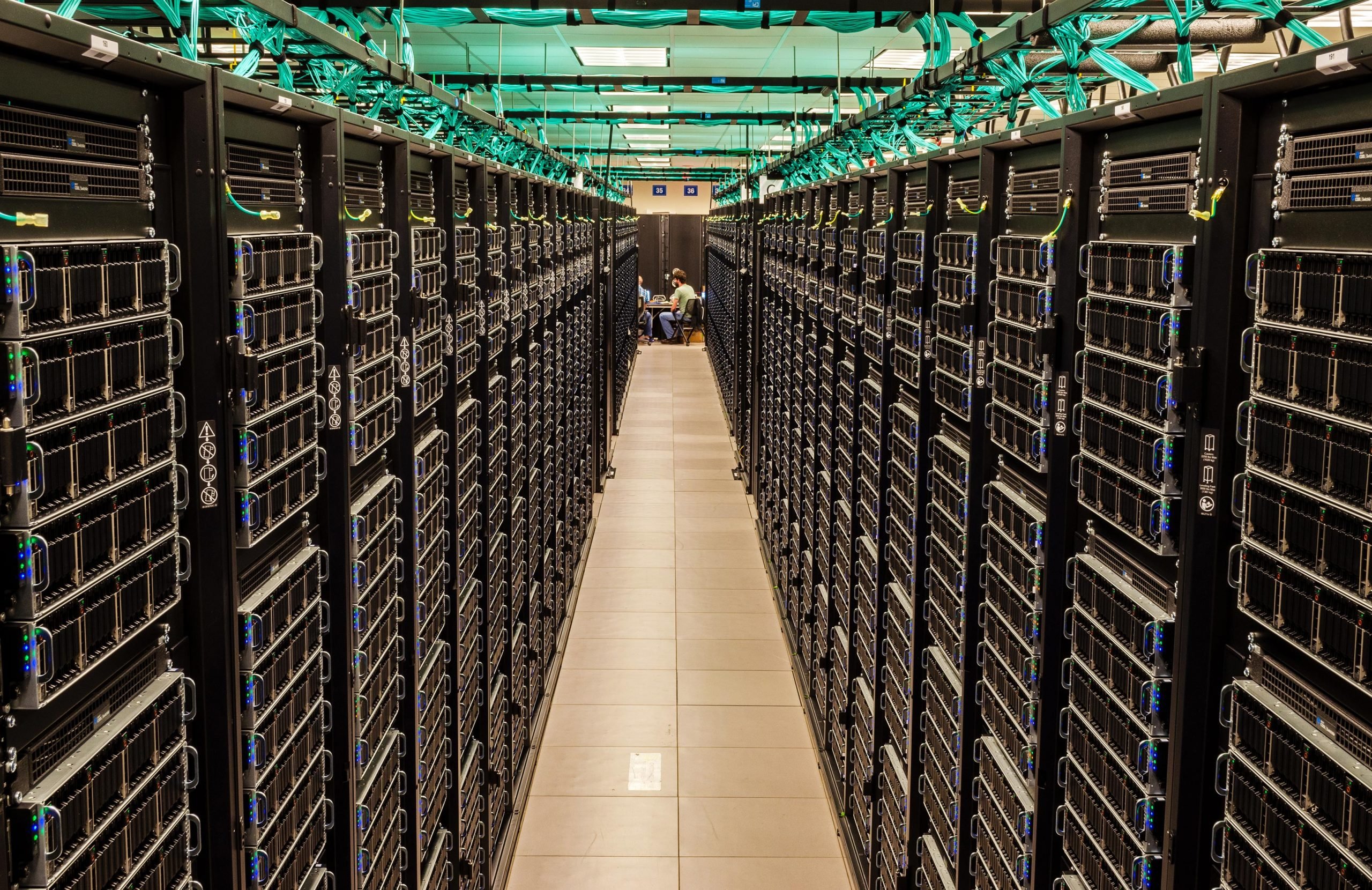
The center now operates two of the most powerful university supercomputers in the U.S. — Frontera, 10th fastest globally; and Stampede2, currently 35th — and more than a dozen advanced computing systems in total. Tens of thousands of scholars and students from across the U.S. use TACC’s supercomputers each year to advance every field of science from astronomy to zoology, and from the nano- to the cosmic scale.
“TACC’s growth has been remarkable and is a testament to the people who work here and the organizations that have supported us, notably UT Austin, UT System, the National Science Foundation, the O’Donnell Foundation, and Dell Technologies — our longest and most consistent champions,” said Dan Stanzione, TACC’s executive director and associate vice president for research at UT Austin.
Over time, TACC has become an integral contributor during emergencies, producing urgent storm surge simulations for hurricanes in the Gulf of Mexico making landfall and guiding first responders after the Deepwater Horizon oil spill.
“TACC’s resources have been of extraordinary service to science, ranging from its contribution of resources to the COVID-19 HPC consortium, to its cultivation of new talent through the Frontera Computational Science Fellowships,” said Margaret Martonosi, the NSF’s assistant director for computer and information science and engineering.
A Coalition of Public, Private, and Academic Support
Support for TACC has expanded in recent years to include federal agencies such as the Department of Defense, the National Institutes of Health, the National Oceanic and Atmospheric Administration, and the Defense Advanced Research Projects Agency, as well as the State of Texas, the City of Austin, Microsoft and even Tito’s Vodka.
Over its history, the center has partnered closely with technology companies, notably Dell Technologies, to architect systems and develop tools for the academic research community.
“At Dell Technologies, we are incredibly proud to stand alongside UT and TACC as we continue to set the bar for high-performance computing,” said Michael Dell, chairman and CEO of Dell Technologies.
The computational community has grown considerably during the past two decades, encompassing entire new disciplines, from digital humanities to computational oncology and deep learning.
“Supercomputing has become essential to research across all of science, engineering, and medicine,” said Dan Jaffe, UT Austin’s vice president for research. “TACC has not only grown tremendously in its computing capabilities, but also as a research supporter and partner for the many investigators from around the world who use it. I am eager to see what the coming improvements in the machines and the TACC ecosystem will bring in the way of new discoveries and even more impactful contributions to society.”
The center celebrated its anniversary with remarks by Hartzell, Jaffe, Dell, Martonosi, and Stanzione.
Never miss a breakthrough: Join the SciTechDaily newsletter.
Follow us on Google and Google News.