
Close Menu
    Facebook X (Twitter) Instagram
    SciTechDaily
    • Biology
    • Chemistry
    • Earth
    • Health
    • Physics
    • Science
    • Space
    • Technology
    Facebook X (Twitter) Pinterest YouTube RSS
    SciTechDaily
    Home»Physics»SLAC Scientists Complete Terahertz Experiment
    Physics

    SLAC Scientists Complete Terahertz Experiment

    By Glenn Roberts Jr., SLAC National Accelerator LaboratoryJuly 26, 2012No Comments3 Mins Read
    Facebook Twitter Pinterest Telegram LinkedIn WhatsApp Email Reddit
    Share
    Facebook Twitter LinkedIn Pinterest Telegram Email Reddit
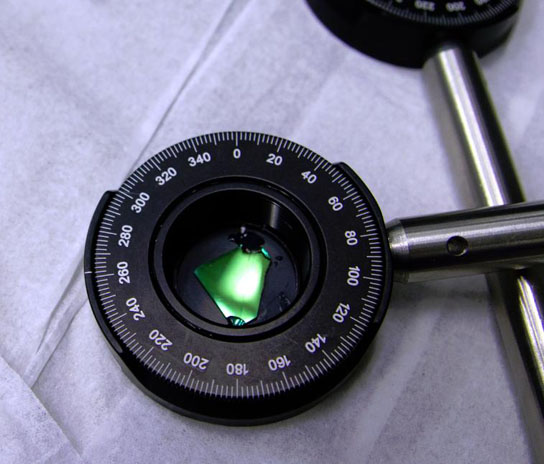
    crystal is used to convert near-infrared laser light into terahertz frequencies
    This thin green crystal, developed by a company in Switzerland, is used to convert near-infrared laser light into terahertz frequencies, which are useful for a range of experiments. Credit: Photo by Glenn Roberts Jr.

    Using a pump-probe technique, scientists at SLAC’s Linac Coherent Light Source used terahertz frequencies of light to change the magnetic state of a sample and then measured those changes with ultrafast pulses from a powerful X-ray laser.

    Invisible to human eyes, terahertz describes a band of frequencies between microwave and infrared light. These frequencies are alluring to scientists because they can be used to control and study magnetic and electric states in materials, and have been applied to fields ranging from data storage to biological imaging and explosives detection. They provide an atomic-scale window into fundamental processes such as magnetism, molecular motion, and protein vibrations.

    But observations in the terahertz range were until recently largely out of reach for scientists, said Matthias Hoffman, a SLAC scientist specializing in terahertz laser research who worked on the latest experiments. “There were no real efficient sources and detectors. It was relatively difficult to do science” at terahertz frequencies, he said.

    The experiment in July involved a technique called pump-probe in which one laser, the “pump,” is used to stimulate changes in the sample – in this case a material with exotic magnetic properties – while the X-ray laser probes these changes.

    A team led by Urs Staub of the Paul Scherrer Institute in Switzerland and Steven Johnson of the Institute for Quantum Electronics at ETH Zurich in Switzerland generated the terahertz laser pulses by aiming an infrared laser beam at a specialized crystal. The passage through the crystal changed the frequency of light from near-infrared to terahertz light. The terahertz pulses then hit a sample, and the researchers measured changes in the sample using closely synchronized pulses from the LCLS X-ray laser.

    The crystal they used was a special type of thin organic crystal known by the acronym DAST, grown by a private company in Switzerland. DAST crystals tend to be more fragile and susceptible to damage than some non-organic crystals designed for terahertz conversion, Hoffmann noted. He is working with the LCLS laser group to develop better sources of intense terahertz pulses as a regular option for LCLS users conducting pump-probe experiments.

    Hoffman said another possible way to generate terahertz frequencies is with the electron beams that power advanced synchrotrons and LCLS. “This can produce even higher pulse energies,” he said, but has proven more challenging for use in experiments.

    Never miss a breakthrough: Join the SciTechDaily newsletter.
    Follow us on Google and Google News.

    Linac Coherent Light Source Materials Science SLAC National Accelerator Laboratory
    Share. Facebook Twitter Pinterest LinkedIn Email Reddit

    Related Articles

    Bendable Crystals Help Measure the Characteristics of X-Ray Pulses

    Probing the Effects of Light at the Atomic Scale

    “Self-Seeding” Enhances Linac Coherent Light Source Performance

    “Pump-Probe” Technique Explores How Molecules Respond to Light

    LCLS Finding Gives a Better Understanding of Light-Matter Interaction

    LCLS Zaps Electrons Out of Atoms, Resulting in Chemical Analysis with Atomic Resolution

    LCLS Low-Energy Test Just Shy of the 284-Electronvolt Carbon Edge

    Unexpected Graphite Experiment Results Raise New Questions

    Scientists Use Ultra-Short Pulses of Terahertz Laser Light to Manipulate Magnetism

    Leave A Reply Cancel Reply

    • Facebook
    • Twitter
    • Pinterest
    • YouTube

    Don't Miss a Discovery

    Subscribe for the Latest in Science & Tech!

    Trending News

    Scientists Call for a Complete Rethink of Alzheimer’s Treatment

    Scientists Identify Molecular Switch That Lets Exercise Reverse Muscle Aging

    Why Your Most Vivid Dreams Might Be the Key to Deep, Restful Sleep

    A Bright Star Hid a Massive Secret for 50 Years: Mystery of Gamma Cassiopeiae Finally Solved

    Scientists Identify Protein That Slows Key Effects of Aging

    Revolutionary Submarine Mysteriously Disappears Without a Trace – Scientists Are Now Preparing for a Bold Return

    Why Drinking More Water Isn’t Enough To Stop Kidney Stones

    New Study Reveals Surprising Effect of Drinking Coffee at Night

    Follow SciTechDaily
    • Facebook
    • Twitter
    • YouTube
    • Pinterest
    • Newsletter
    • RSS
    SciTech News
    • Biology News
    • Chemistry News
    • Earth News
    • Health News
    • Physics News
    • Science News
    • Space News
    • Technology News
    Recent Posts
    • 3.5-Billion-Year-Old Rocks Rewrite the Story of Plate Tectonics
    • “These Wrinkles Shouldn’t Exist” – A Geologist’s Hike Uncovers a 180-Million-Year-Old Mystery
    • Why Aging Lungs Turn Mild Infections Into Life-Threatening Illness
    • Lost Bronze Age Mines Unearthed in Spain Transform Bronze Age History
    • First New Dinosaur Species Found in Korea in 15 Years Surprises Scientists
    Copyright © 1998 - 2026 SciTechDaily. All Rights Reserved.
    • Science News
    • About
    • Contact
    • Editorial Board
    • Privacy Policy
    • Terms of Use

    Type above and press Enter to search. Press Esc to cancel.