
While using a technique to simultaneously blast and probe samples of graphite, scientists at SLAC National Accelerator Laboratory saw ultrafast changes from solid to liquid and from solid to plasma in the graphite, resulting in many new questions.
In experiments at SLAC National Accelerator Laboratory, a powerful X-ray laser blasted solid carbon crystals into a liquid and plasma even faster than expected, raising new questions about how these intense beams interact with matter.
The tests took place at the Linac Coherent Light Source, or LCLS, using a pioneering technique to simultaneously blast and probe samples of graphite, a pure form of carbon.
The team chose graphite partly because it might offer a way to see whether biological molecules, which are also carbon-based, will produce useful data when probed with intense X-ray laser pulses, said Stefan P. Hau-Riege, a staff physicist at Lawrence Livermore National Laboratory who led the research team. In addition, its fundamental properties, such as its melting behavior, are still not well understood.
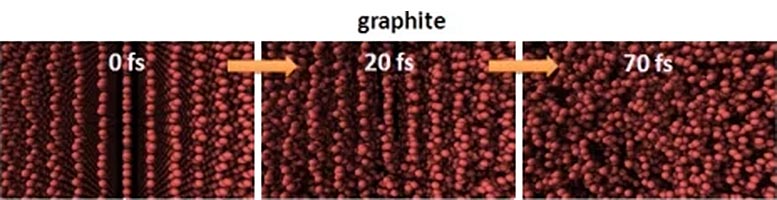
Hau-Riege said the results, which show ultrafast changes from solid to liquid and from solid to plasma in the graphite, defied the team’s expectations. “The models that we’re currently using don’t explain it,” he said. There are “processes taking place that we don’t fully understand.”
He added that these results could have implications for a range of future experiments using X-ray free-electron lasers, or XFELs.
In a paper scheduled for publication on May 23 in Physical Review Letters, the researchers note that the type of change they saw in the graphite samples could be an obstacle to using free-electron lasers to image single particles and crystals with atomic resolution, “since X-ray damage proceeds faster than anticipated.”
The team included Marc Messerschmidt, Christoph Bostedt and Sebastian Schorb, who work at SLAC’s LCLS facility. Other collaborators were from the University of Duisburg-Essen, the Max Planck Advanced Study Group’s Center for Free Electron Laser Science, the Max Planck Institut für Medizinische Forschung, and the Max Planck Institut für Kernphysik in Germany.
Researchers commonly employ XFELs for “probe before destroy” experiments: They hit the sample with an X-ray laser pulse and extract as much useful data as possible before the sample is damaged.
The planes of a crystal sample can function like tiny mirrors, and the Livermore-led team used the Atomic, Molecular and Optical instrument at LCLS to observe this reflectivity, gathering data from the scattering of X-rays as they hit the graphite sample with laser pulses just 40 to 80 femtoseconds (quadrillionths of a second) long.
Researchers found that, based on their results, the models they used to simulate the stressed properties of graphite significantly underestimated the extent and timing of the material’s transformation when struck by the X-ray laser.
Hau-Riege said he is planning follow-up research with LCLS’ Coherent X-ray Imaging instrument in July to study silicon samples.
Both studies are part of ongoing research to study materials’ reaction to high-energy XFEL pulses, and to identify materials that are most resistant to damage in XFEL experiments.
Hau-Riege said LCLS is an attractive facility for experiments because it allows researchers to simultaneously study various states of matter using a variety of imaging techniques. He has also been a part of similar experiments, including XFEL tests of multilayered materials using the FLASH soft X-ray laser at the Deutsches Elektronen-Synchrotron (DESY) in Germany.
Reference: “Ultrafast Transitions from Solid to Liquid and Plasma States of Graphite Induced by X-Ray Free-Electron Laser Pulses” by S. P. Hau-Riege, A. Graf, T. Döppner, R. A. London, J. Krzywinski, C. Fortmann, S. H. Glenzer, M. Frank, K. Sokolowski-Tinten, M. Messerschmidt, C. Bostedt, S. Schorb, J. A. Bradley, A. Lutman, D. Rolles, A. Rudenko and B. Rudek, 23 May 2012, Physical Review Letters.
DOI: 10.1103/PhysRevLett.108.217402
Never miss a breakthrough: Join the SciTechDaily newsletter.
Follow us on Google and Google News.