
Close Menu
    Facebook X (Twitter) Instagram
    SciTechDaily
    • Biology
    • Chemistry
    • Earth
    • Health
    • Physics
    • Science
    • Space
    • Technology
    Facebook X (Twitter) Pinterest YouTube RSS
    SciTechDaily
    Home»Physics»Search for Neutrino Properties at EXO-200 Reveals First Results
    Physics

    Search for Neutrino Properties at EXO-200 Reveals First Results

    By SLAC National Accelerator LaboratoryJune 5, 2012No Comments4 Mins Read
    Facebook Twitter Pinterest Telegram LinkedIn WhatsApp Email Reddit
    Share
    Facebook Twitter LinkedIn Pinterest Telegram Email Reddit
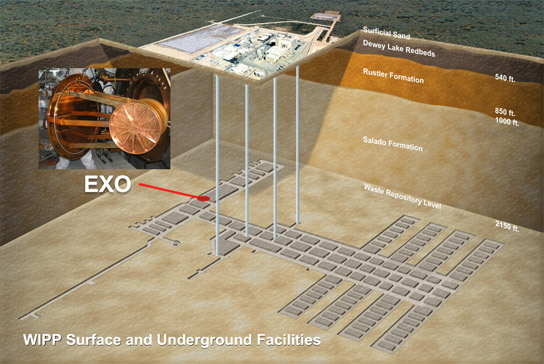
    Enriched Xenon Observatory 200 (EXO-200) is a neutrino experiment housed 2,150 feet below ground
    The Enriched Xenon Observatory 200 (EXO-200) is a neutrino experiment housed 2,150 feet below ground in a salt basin at the Waste Isolation Pilot Plant (WIPP). The subterranean location isolates it from cosmic rays and other sources of natural radioactivity. Credit: EXO/WIPP/SLAC

    While studying neutrino properties and searching for a mechanism called “neutrinoless double-beta decay,” scientists at the Enriched Xenon Observatory 200 found with the highest degree of sensitivity yet that neutrinos behave like other elementary particles at the quantum level.

    Scientists studying neutrinos have found with the highest degree of sensitivity yet that these mysterious particles behave like other elementary particles at the quantum level. The results shed light on the mass and other properties of the neutrino and prove the effectiveness of a new instrument that will yield even greater discoveries in this area.

    The Enriched Xenon Observatory 200 (EXO-200), an international collaboration led by Stanford University and the U.S. Department of Energy’s (DOE) SLAC National Accelerator Laboratory, has begun one of the most sensitive searches ever for a mysterious mechanism called “neutrinoless double-beta decay” in which two neutrinos, acting as particle and antiparticle, do not emerge from the nucleus.

    If this decay were observed, it would signal that neutrinos have a different quantum structure than other elementary particles. EXO-200, which is capable of detecting decays that happen, on average, only once every 1025 years (1 quadrillion times the age of the universe), did not observe this decay, which constitutes the strongest evidence yet that neutrinos behave like other particles.

    “The result could only have been more exciting if we’d been hit by a stroke of luck and detected neutrinoless double-beta decay,” said Giorgio Gratta, a professor of physics at Stanford University and spokesperson for EXO-200. “In the region where double-beta decay was expected, the detector recorded only one event. That means the background activity is very low and the detector is very sensitive. It’s great news to say that we see nothing!”
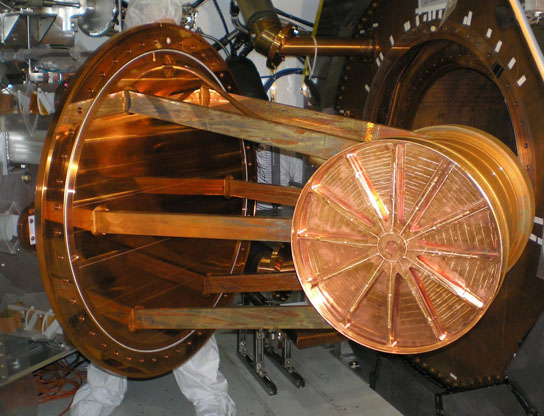
    EXO-200 Time Projection Chamber
    This large copper cylindrical vessel is the Enriched Xenon Observatory 200’s (EXO-200) time projection chamber, the part of the detector that contains the liquid xenon, isotopically enriched in xenon-136. The photo shows the chamber being inserted into the cryostat, which keeps the experiment at extremely low temperatures. Credit: EXO

    EXO-200 has been able to all but rule out a previous, highly controversial result claiming to have detected the decay, and they’ve also been able to narrow down the mass of the neutrino to less than 140- to 380-thousandths of an electronvolt (the unit of mass used in particle physics). For comparison, the minuscule electron has a mass of roughly 500,000 electronvolts.

    At the heart of EXO-200 is a thin-walled cylinder made of extremely pure copper. It is full of about 200 kilograms (about 440 pounds) of liquid xenon and buried 2,150 feet (655 meters) deep at the DOE’s Waste Isolation Pilot Plant (WIPP), a New Mexico salt bed where low-level radioactive waste is stored. The xenon—in particular the isotope xenon-136, which makes up the lion’s share of the xenon in EXO-200—is one of the few substances that can theoretically undergo the decay. Constructing the experiment of exceedingly pure materials and locating it underground ensured that all other traces of radioactivity and cosmic radiation are eliminated or kept at a minimum.

    EXO-200 will take data for a few more years and in the future, the team hopes to expand the technique to a several-ton version that would be even more sensitive at observing the nearly imperceptible physical processes that have been theorized.

    EXO is a collaboration that involves scientists from SLAC, Stanford, the University of Alabama, Universität Bern, Caltech, Carleton University, Colorado State University, University of Illinois Urbana-Champaign, Indiana University, UC Irvine, ITEP (Moscow), Laurentian University, the University of Maryland, the University of Massachusetts – Amherst, the University of Seoul and the Technische Universität München. This research was supported by DOE and NSF in the United States, NSERC in Canada, SNF in Switzerland, and RFBR in Russia. This research used resources of the National Energy Research Scientific Computing Center (NERSC).

    Never miss a breakthrough: Join the SciTechDaily newsletter.
    Follow us on Google and Google News.

    Antiparticles Neutrinos Particles Quantum Physics SLAC National Accelerator Laboratory Stanford University
    Share. Facebook Twitter Pinterest LinkedIn Email Reddit

    Related Articles

    Electron Motion Tracked in a Quantum State of Matter Using X-Ray Pulses Less Than a Millionth of a Billionth of a Second Long

    Stanford Scientists Have Produced the First Complete Picture of an Elusive Quasiparticle

    First Structural Observations of Liquid Water at Temperatures Down to Minus 51 Degrees Fahrenheit

    SLAC Scientists View Ultrafast Snapshots of Light-Driven Superconductivity

    GERDA Experiment Phase I Results – No New Evidence That Neutrinos Are Their Own Antiparticles

    Fermilab Narrows the Gap Between the Masses of Neutrinos and Antineutrinos

    Unexpected Graphite Experiment Results Raise New Questions

    ICARUS Experiment Claims Neutrinos Aren’t Faster Than Light

    Possible Mistakes Found in Faster Than Light Neutrino Measurement

    Leave A Reply Cancel Reply

    • Facebook
    • Twitter
    • Pinterest
    • YouTube

    Don't Miss a Discovery

    Subscribe for the Latest in Science & Tech!

    Trending News

    Millions Take These IBS Drugs, But a New Study Finds Serious Risks

    Scientists Unlock Hidden Secrets of 2,300-Year-Old Mummies Using Cutting-Edge CT Scanner

    Bread Might Be Making You Gain Weight Even Without Eating More Calories

    Scientists Discover Massive Magma Reservoir Beneath Tuscany

    Europe’s Most Active Volcano Just Got Stranger – Here’s Why Scientists Are Rethinking It

    Alzheimer’s Symptoms May Start Outside the Brain, Study Finds

    Millions Take This Popular Supplement – Scientists Discover a Concerning Link to Heart Failure

    The Universe Is Expanding Too Fast and Scientists Can’t Explain Why

    Follow SciTechDaily
    • Facebook
    • Twitter
    • YouTube
    • Pinterest
    • Newsletter
    • RSS
    SciTech News
    • Biology News
    • Chemistry News
    • Earth News
    • Health News
    • Physics News
    • Science News
    • Space News
    • Technology News
    Recent Posts
    • Scientists Say Adding This Unusual Seafood to Your Diet Could Reverse Signs of Aging
    • U.S. Waste Holds $5.7 Billion Worth of Crop Nutrients
    • Scientists Say a Hidden Structure May Exist Inside Earth’s Core
    • Doctors Surprised by the Power of a Simple Drug Against Colon Cancer
    • Why Popular Diabetes Drugs Like Ozempic Don’t Work for Everyone: The “Genetic Glitch”
    Copyright © 1998 - 2026 SciTechDaily. All Rights Reserved.
    • Science News
    • About
    • Contact
    • Editorial Board
    • Privacy Policy
    • Terms of Use

    Type above and press Enter to search. Press Esc to cancel.